
Provaris Energy Ltd (ASX:PV1, OTC:GBBLF) has completed a major front-end engineering design (FEED) milestone for its proprietary YP-Provaris low-pressure liquefied carbon dioxide (LCO₂) tank, advancing the technology through DNV’s approval process for maritime applications.
The company has submitted a detailed engineering package to DNV to support the General Approval for Ship Application (GASA) review, with the design review targeted for completion in August 2026.
The milestone is intended to de-risk Provaris’ strategy to commercialise its cargo containment solution for the emerging maritime CO₂ transport and storage market, where carbon capture and storage (CCS) infrastructure is expected to play a growing role.
The company has completed a $1 million placement to support key 2026 technical milestones across its compressed hydrogen and liquid CO₂ storage and transport development programs.
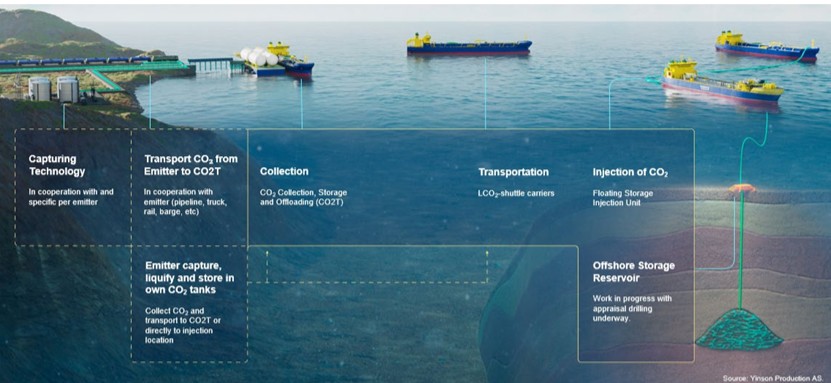
Illustration of Yinson’s large scale CCS Supply Chain infrastructure suitable for <10 Mtpa of LCO2, including FSIU, carriers and terminal storage.
Detailed engineering package submitted to DNV
The YP-Provaris LCO₂ tank has been engineered as a Type C-equivalent maritime tank, targeting safety and performance outcomes aligned with the International Code for the Construction and Equipment of Ships Carrying Liquefied Gases in Bulk (IGC Code).
With a design capacity of 25,000 cubic metres, the tank is intended to address limitations in alternative Type C tanks, which Provaris says are typically up to 7,000 cubic metres in capacity.
Provaris chief technical officer Per Roed said completion of the FEED engineering package was an important technical milestone for the company and reflected extensive structural design work undertaken by Provaris and Yinson.
He said the engineering package went beyond the normal scope of an Approval in Principle and was designed to give shipowners, shipyards and CCS project participants greater confidence in the maturity, safety basis and practical application of the company’s low-pressure LCO₂ containment solution.
DNV has worked with Provaris through the 2025-26 design and engineering phases to ensure the detailed structural design addresses IGC Code requirements with equivalent levels of safety and performance.
Final testing stage underway
The final stage of FEED includes a test program for selected materials and welding procedure specifications.
Testing of fabricated elements is expected to validate strength and fatigue calculations in the structural model, with completion planned during August 2026. Results will be incorporated into DNV’s continuing review process.
Provaris will also produce sample sections of the tank design to demonstrate that proprietary design elements can be fabricated using robotic mounting and laser welding at its robotic facility in Fiskå, Norway.
Tank positioned for CCS supply chain applications
The YP-Provaris LCO₂ tank is designed to provide a scalable marine containment solution for transporting liquefied carbon dioxide as part of emerging CCS supply chains.
The design applies a proprietary sandwich construction approach and is intended for shipboard installation without a secondary barrier, while targeting equivalent safety outcomes to conventional Type C containment systems under the IGC Code.
Provaris said large-scale CO₂ storage solutions had the potential to improve transport and storage efficiency and reduce cost per tonne compared with existing market offerings.
The tank has also been selected by Yinson Production for CCS supply chain development, extending potential commercial applications across floating storage and injection units (FSIUs), LCO₂ carriers and terminal storage.
Scheduled development activities for 2026 include completion of the testing program, further progress through the GASA approval process, integration into Yinson’s FSIU FEED activities and development of a proposed joint venture company between Yinson and Provaris.
About Provaris Energy
Provaris Energy is developing compressed hydrogen and carbon dioxide storage and transport solutions through proprietary tank designs for maritime gas carriers and integrated supply chain development.
The company is focused on storage and transport technologies designed to support regional supply chains and the broader global energy transition.