
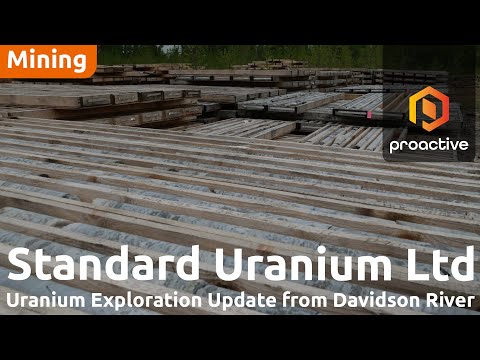
Standard Uranium Ltd (TSX-V:STND, OTCQB:STTDF, FRA:9SU0) Vice President of Exploration Sean Hillacre talked with Proactive about the company's ongoing drill program at its flagship Davidson River project in Saskatchewan's Athabasca Basin.
Proactive: Welcome back inside our Proactive newsroom. Joining me now is the Vice President of Exploration for Standard Uranium, Sean Hillacre. Sean, it's great to see you again. How are you doing?
Sean Hillacre: Really well, thanks.
Exciting news from the company today with an update on Davidson River, your flagship project. Remind everyone about Davidson River and the work underway there.
Davidson River is our flagship project for a reason. It's almost 31,000 hectares in one of the most exciting uranium districts in the Athabasca Basin. Located in the southwest corner of the basin, the project contains approximately 70 kilometres of strike length along graphitic trends that continue structures hosting more than 400 million pounds of uranium to the west.
The area remains very underexplored and Standard Uranium was the first company to drill it. The project is surrounded by major companies and some of the most significant uranium discoveries of the last decade. Our objective is to discover high-grade basement-hosted uranium.
Drilling began at the beginning of June and you've completed around 1,000 metres. What are you seeing so far?
We wanted to update the market because the program has started very well. We've been drilling for about two weeks and have now surpassed 1,000 metres completed.
We're particularly encouraged to have encountered radioactivity in the first drill hole. The result reflects several years of target development work involving Fleet Space, ALS GoldSpot, machine learning studies and multiphysics surveys. It's an exciting start.
You highlighted Bronco and Thunderbird as important target areas. How did your recent work help identify those targets?
We knew we had the right host rocks and structures, but we needed additional information to identify the best targets along our 70 kilometres of strike length.
The multiphysics work, particularly gravity surveys, allowed us to strip away the effects of overburden and better image the subsurface. That helped identify areas of alteration commonly associated with uranium deposits.
We completed survey grids across Warrior, Thunderbird and Bronco. Multiple target areas now display geophysical characteristics similar to other high-grade uranium deposits in the region.
The first drill hole at Bronco, hole 40, returned three metres of radioactivity with peak readings of 1,650 counts per second, the highest readings observed on the project. Importantly, this hole was drilled kilometres away from previous drilling, demonstrating the value of the new targeting approach.
The radioactivity is associated with large graphitic faults and shear zones. These structures act as the plumbing system for uranium mineralisation, making the result particularly encouraging.
You're heading back to site soon. This is a major summer program with drilling operating continuously, correct?
That's right. We have two drills operating throughout the summer. One is currently working at Bronco and the other at Thunderbird.
We'll be testing multiple corridors simultaneously and drilling 24 hours a day through to the end of August. There's plenty more news to come and we're very encouraged by these initial results.
Thanks for the update, Sean. We look forward to speaking with you again from site.
Absolutely. We'll be sharing additional videos from site and keeping investors updated as the program progresses.
Quotes have been lightly edited for style and clarity