
Lightning Minerals Ltd (ASX:L1M, FRA:YZ1) has defined multiple new gold targets from systematic soil sampling across a 10-kilometre section of the Drummer Fault corridor at its wholly owned Mt Turner Gold Project in North Queensland.
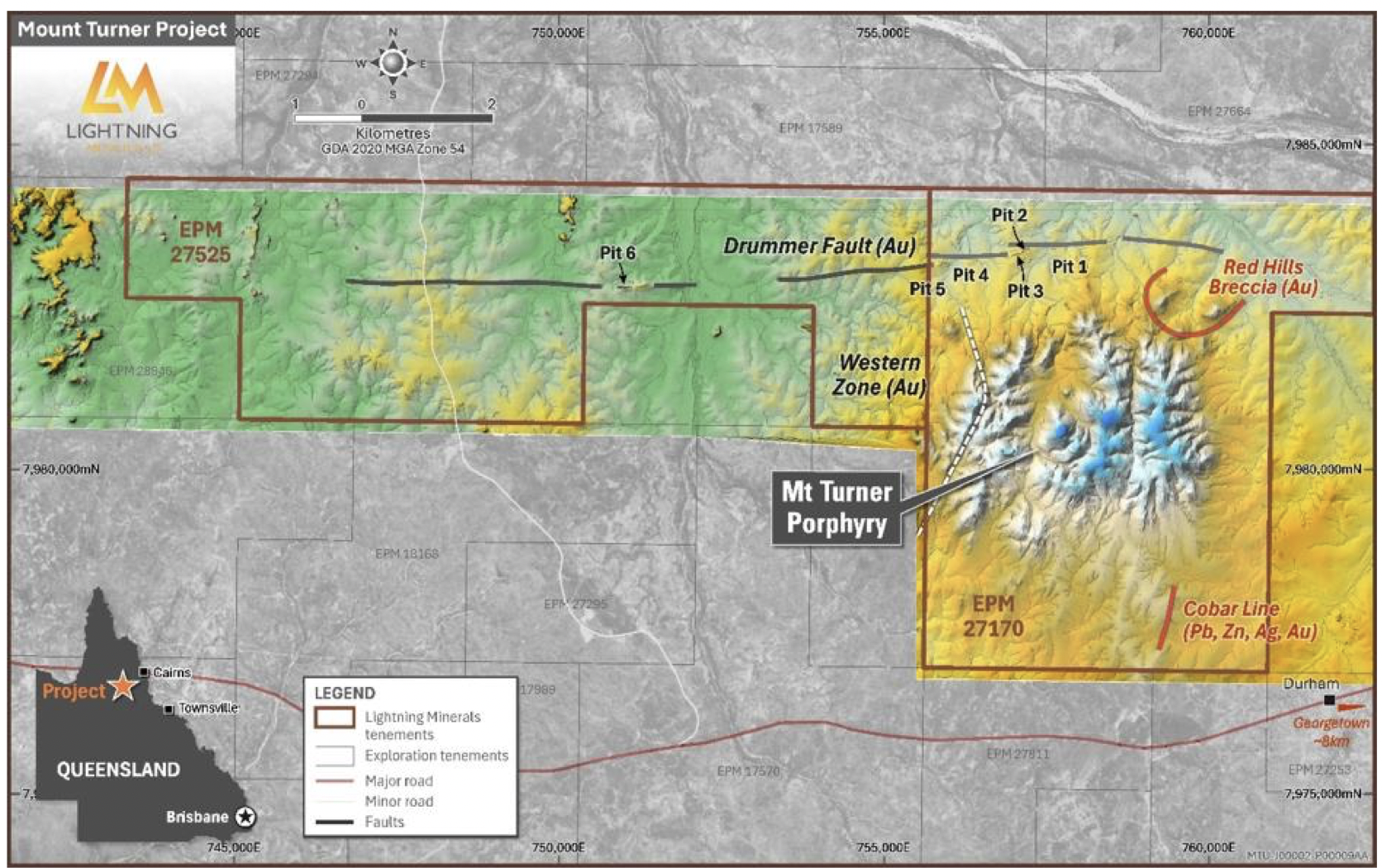
Location Map –Mt Turner Project, including the Drummer Fault.
The program has identified up to six areas of multi-element anomalism over a combined strike length of about 3.9 kilometres, providing new targets for the company’s fully funded Phase 2 drilling program, which is scheduled to begin in mid-July.
The soil program was completed in late 2025 during the company’s Phase 1 drilling campaign and was designed to test strike extensions of the Drummer Fault between historical oxide pits, identify additional geochemical anomalies and refine drill targeting.
A total of 492 soil samples were collected on systematic north-south traverses across the fault. Samples were taken at 20-metre intervals on lines spaced 100 metres apart and analysed by ALS Laboratories for gold and multi-element geochemistry.
The program supported continuity of mineralisation between several historical shallow oxide mining centres and extended prospective zones east and west of known workings.
Targets generated across Drummer Fault
The company has defined a high-priority 2.2-kilometre exploration corridor between historical Pits 1 and 5, where geochemical responses coincide with interpreted structural trap sites along the Drummer Fault.
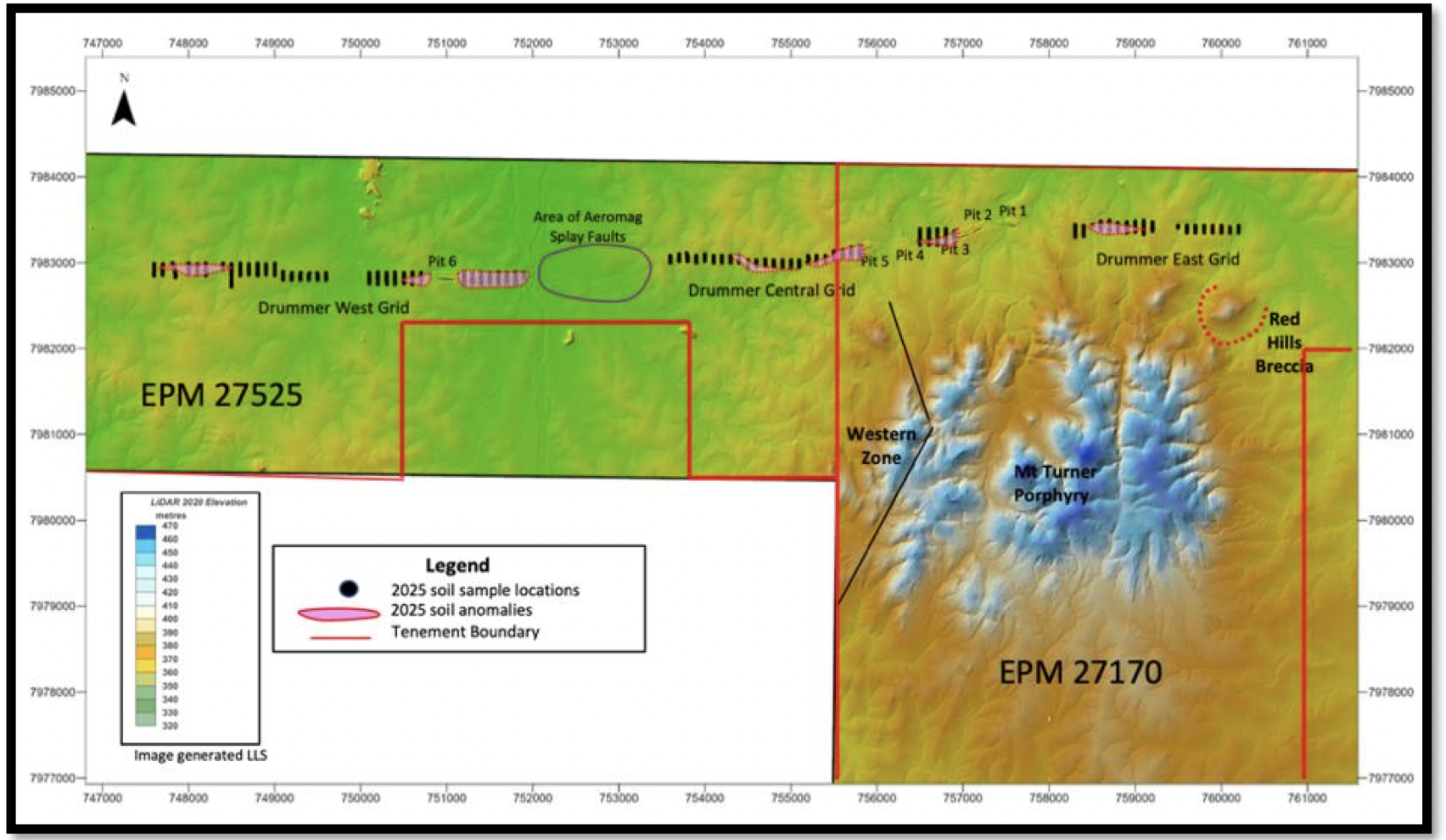
Drummer Fault Soil Anomalies, using DTM to highlight topography.
The central grid returned some of the more significant results, with anomalies extending westward from Pit 3 and Pit 5 and indicating a mineralised footprint of around 1.6 kilometres between Pit 3 and areas west of Pit 5.
In the eastern grid, a broad multi-element anomaly extends about 600 metres westward and remains open to the west. The anomaly includes elevated arsenic, silver and lead, with local chromium values that may relate to mafic dyking along the fault.
The strongest gold-pathfinder response was identified in the western grid, east of Pit 6, where a coherent gold-silver-arsenic anomaly extends for about 1.2 kilometres before terminating beneath floodplain sediments associated with Aurora Creek.
A second 800-metre-long anomaly further west is associated with gossanous quartz fragments, arsenic enrichment and sporadic gold responses.
Mt Turner exploration model
Mt Turner is Lightning’s flagship growth asset and hosts a large-scale gold system along the Drummer Fault, a mineralised structure extending for about 14 kilometres across the project area.
The company’s exploration model is based on gold-bearing fluids being focused along major structures near the Mt Turner porphyry system. Lightning’s maiden drilling in 2025 confirmed the model at Pits 3, 5 and 6, where all holes intersected breccia-hosted precious metal mineralisation beneath oxide pits.
Lightning CEO Troy Brice said the soil results strengthened the company’s confidence in the scale potential of Mt Turner.
“The combination of geochemistry, historical workings and structural interpretation has generated a pipeline of high-priority targets that will be incorporated into our upcoming Phase 2 drilling campaign,” Brice said.
Next steps
Lightning will now move to Phase 2 drilling along the Drummer Fault corridor, with the program to test priority targets generated from the soil sampling.

The company also plans follow-up geochemical work across unsampled parts of the Drummer Fault, evaluation of covered targets beneath Aurora Creek sediments and continued regional target generation across the broader Mt Turner Project.
Planning for Phase 3 drilling is also expected to advance as Lightning works toward potential future resource definition at Mt Turner.