
White Cliff Minerals Ltd (ASX:WCN) has confirmed another high-grade copper discovery at its Rae Copper Project in Nunavut, Canada, with new assay results identifying a copper zone adjacent to the Teshierpi Fault Zone.
The discovery comes from reverse circulation drill hole DAN26015 at the Danvers target, which returned 79.24 metres at 1.59% copper from 67.06 metres, including 24.38 metres at 3.05% copper from 120.4 metres.
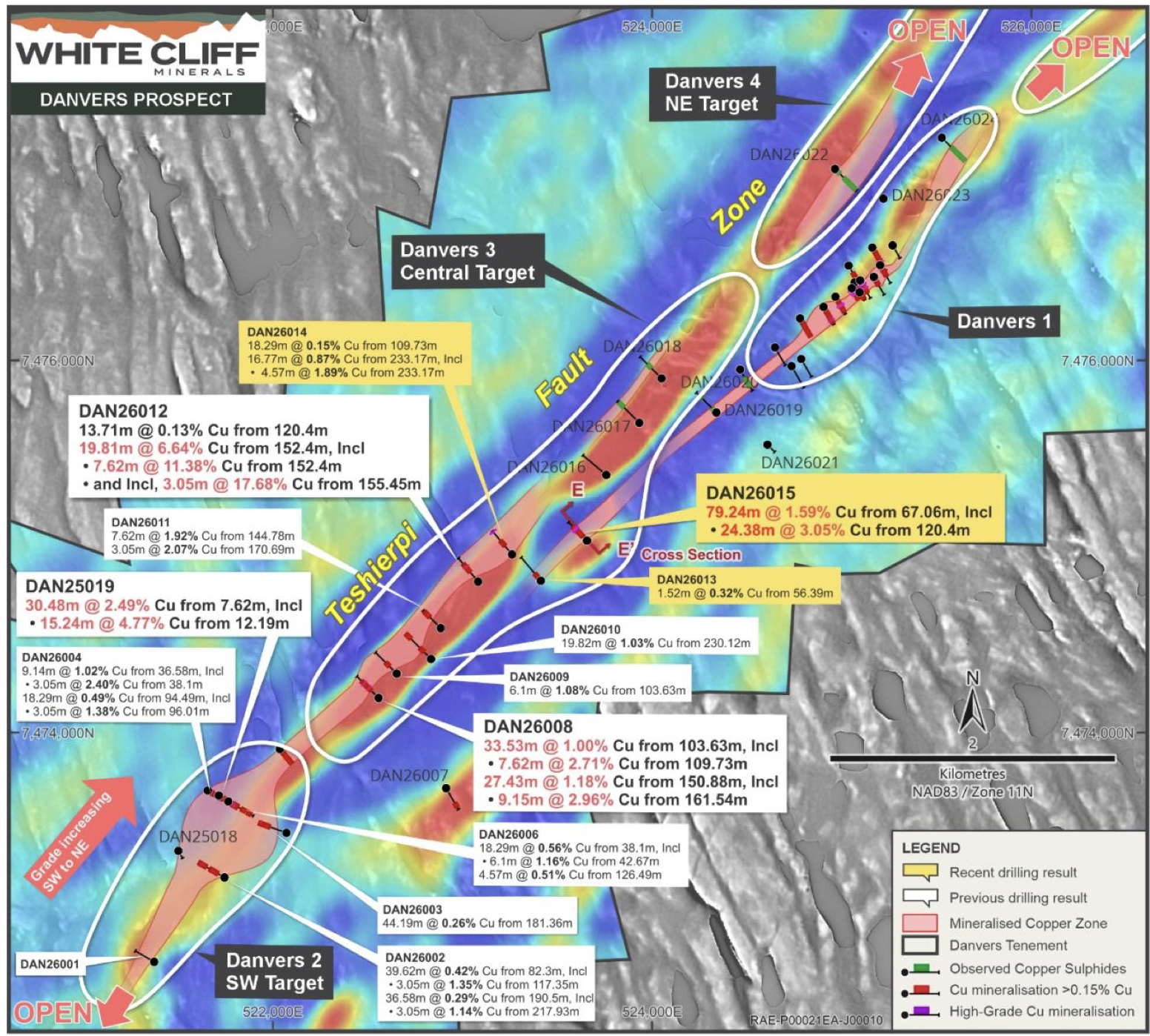
Map of 2026 RC drillholes in the Teshierpi Fault Zone. Basemap of EM anomalism (X component) from 2025 geophysical survey. Interpreted mineralisation trend highlighted by white outline between the observed downhole intervals of copper sulphides.
The result confirmed mineralisation outside the main Teshierpi Fault Zone and demonstrated that copper mineralisation was not confined to a single structure.
New discovery beside major fault zone
The new zone lies parallel to the Teshierpi Fault Zone, a major northeast-southwest structure that runs for more than 10 kilometres through the Rae Copper Project.
The company said 2026 drilling had now confirmed copper mineralisation on both contacts of the regional fault zone, with the latest result from DAN26015 linked to the southeastern fault zone boundary.
The result also opens up magnetic low and resistive areas as new exploration targets, broadening the company’s target model at Danvers.
Drilling expands copper footprint
The 2026 regional drilling program at Danvers is testing the broader Teshierpi system with wide-spaced RC holes, commonly 300 to 400 metres apart.
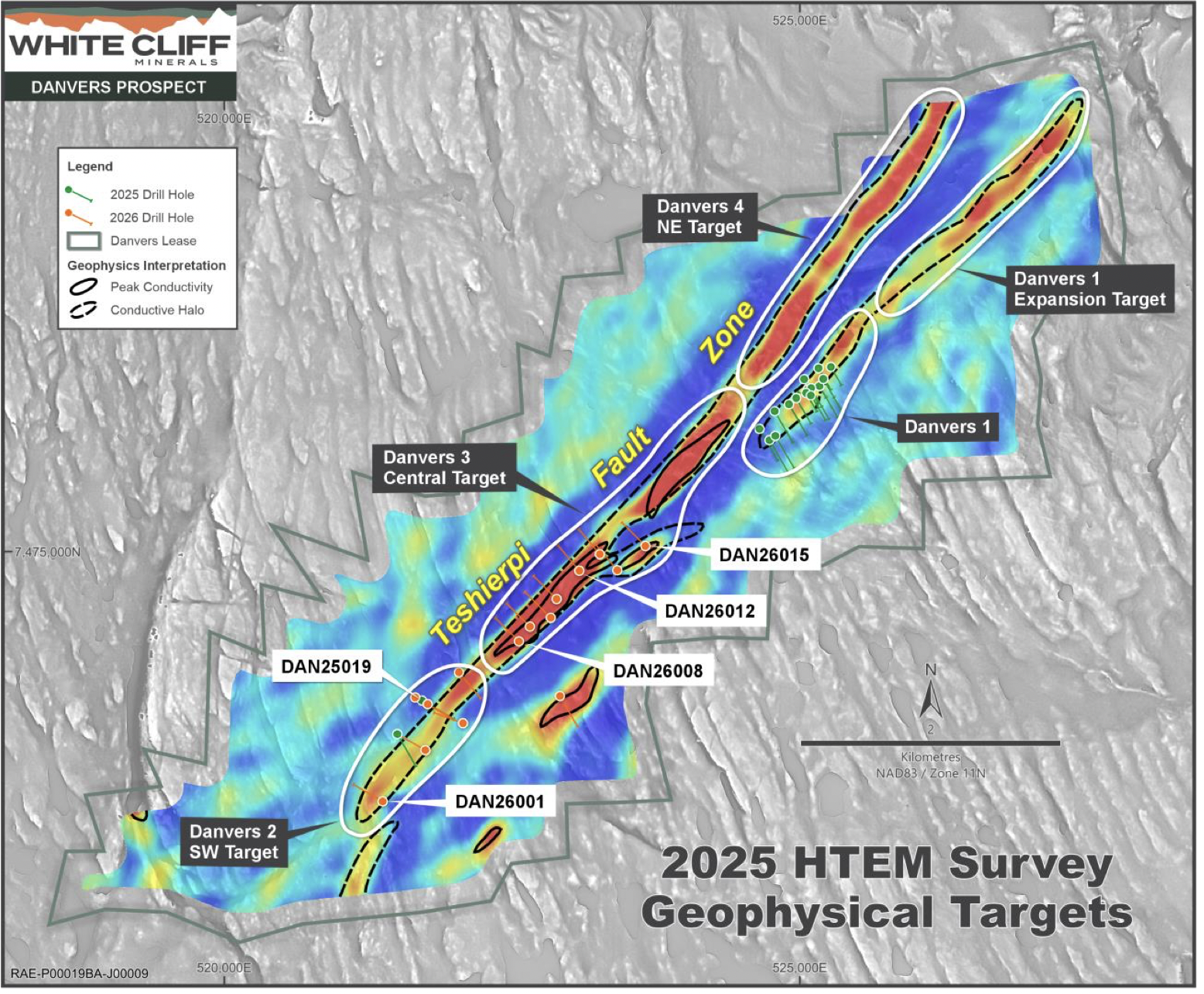
Overview of target areas along the Teshierpi Fault Zone and Danvers NE Expansion Targets. Basemap of EM anomalism (X component) from 2025
geophysical survey.
Assay results have now confirmed a copper mineralised footprint of more than 3.1 kilometres of strike, while visual observations indicate copper sulphides over more than 6 kilometres of strike length — more than half of the interpreted geophysical anomaly.
Further drilling has also pointed to expansion potential around the Danvers 1 deposit.
DAN26024, drilled 686 metres northeast of DAN25020, returned 67.05 metres of combined copper sulphides, while holes drilled more than 460 metres southwest of Danvers 1 returned 30 metres of combined copper sulphides.
A separate new zone was also identified in DAN26022, 606 metres northwest of DAN25001, where 47.55 metres of combined copper sulphides were observed, including up to 5% visible bornite.
Assays highlight high-grade potential
In addition to the headline DAN26015 intercept, White Cliff reported further assay results from nearby holes.
DAN26014 returned 16.77 metres at 0.87% copper from 233.17 metres, including 4.57 metres at 1.89% copper, with the interval open downhole. The hole also returned 18.29 metres at 0.15% copper from 109.73 metres.
DAN26013 returned 1.52 metres at 0.32% copper.
The latest results follow earlier 2026 results from Danvers, including DAN26012, which returned 19.81 metres at 6.64% copper.
Company sees larger copper system emerging
White Cliff managing director Troy Whittaker said DAN26015 was an important result that confirmed another high-grade copper discovery outside the main Teshierpi Fault Zone.
“We are now seeing copper zones expanding materially around Danvers 1, with new drilling extending the system 462 metres to the southwest, 686 metres to the northeast, and identifying a parallel mineralised zone 606 metres to the north at DAN26022,” Whittaker said.
“These results are being delivered from wide-spaced drilling into largely untested ground, which speaks directly to both the strength of the Teshierpi copper system and the effectiveness of our targeting.”
Whittaker said the results indicated Danvers was emerging as a larger and more significant copper system than previously understood.
Rae Project in established mining jurisdiction
The Rae Copper Project is in Nunavut, northern Canada, and includes numerous high-grade copper occurrences.
White Cliff describes the project as a large-scale copper opportunity in one of the world’s leading mining jurisdictions, with mineralisation styles including chalcocite-dominant vein and breccia systems, flow-top replacements and sediment-hosted stratiform copper.
The project includes the Danvers prospect, which hosts a historic resource estimate of 4.16 million tons at 2.96% copper. The company notes the estimate is historic and not reported in accordance with the JORC Code 2012.
White Cliff Minerals is focused on defining and expanding copper mineralisation across the Rae Project, including Danvers-style volcanic-hosted copper deposits and sediment-hosted copper targets elsewhere on the tenure.
Diamond drilling to follow up discoveries
A second diamond drill rig is now on site to follow up the ultra-high-grade DAN26012 discovery and other 2026 high-grade results.
Diamond drilling will provide structural information, assist with targeting higher-grade zones, support estimates of true widths and guide future step-out drilling across the expanding Danvers copper system.
Upcoming work includes oriented diamond core drilling, scissor holes across key 2026 RC drill holes, infill and step-out drilling around new discoveries, and further exploration along the Teshierpi Fault Zone.