
Aruma Resources Ltd (ASX:AAJ) has strengthened its exploration model at the Tillex Copper-Silver Project in Ontario, Canada, after downhole electromagnetic surveys confirmed a strong conductor extending along strike and at depth.
The results provide the company with more clearly defined targets ahead of Phase 2 drilling and support its view that Tillex could host a larger, continuous copper-silver system than previously understood.
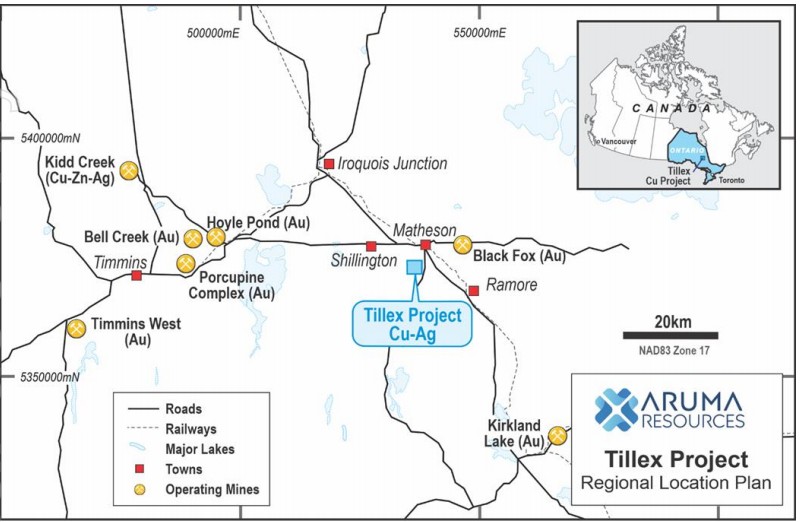
Tillex is Aruma’s core asset and sits in the Timmins mining district, a long-established Canadian mining region. The project hosts copper-silver sulphide mineralisation beneath shallow cover and has been the focus of renewed geophysical and drilling work since Aruma acquired the project.

Survey highights
The fixed-loop downhole electromagnetic (DHEM) survey was completed across three drill holes, including two from Aruma’s recently completed Phase 1 drilling program and one historical hole.
The work confirmed a single, coherent main conductor zone over a possible 100-150 metres of strike length and depth, materially refining earlier interpretations from surface EM data.
The company said the conductor appeared to dip steeply, at around 70-85 degrees to the southeast, and could be traced from shallow drill-tested areas through to a deeper conductor intersected in drill hole TX26-001.
Stronger confidence in scale and continuity
Aruma Managing director Grant Ferguson said the DHEM results represented “a significant step forward” in Aruma’s understanding of Tillex.
“The confirmation of a strong, continuous conductor extending along strike and at depth, together with the identification of discrete high-grade conductive plates, reinforces our confidence that Tillex is a robust and potentially scalable mineralised system.”
He said the findings validated the company’s geological model and provided “clear, high-quality targets” for the next phase of drilling.
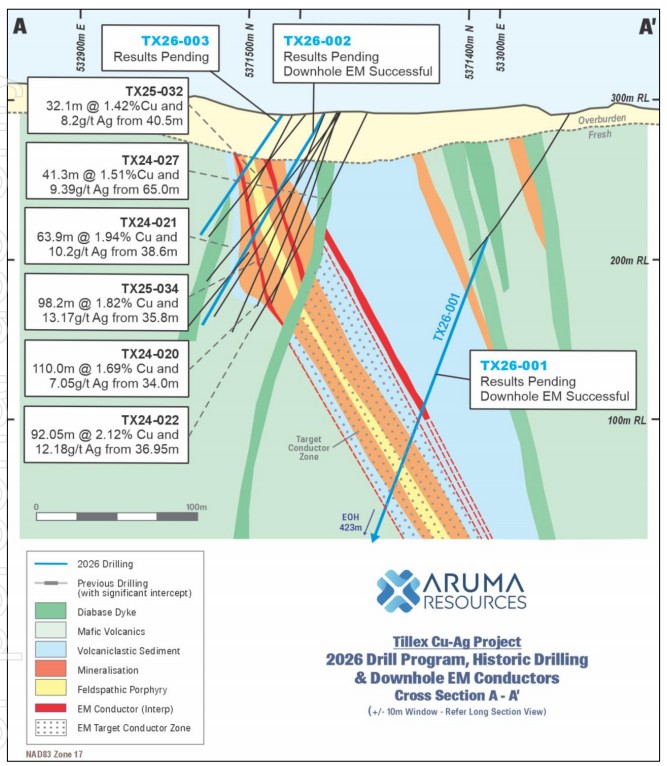
Detailed modelling had resolved the main conductor into two discrete, highly conductive plates within a broader conductive corridor.
These plates are interpreted to coincide with known zones of wide, high-grade mineralisation and argillite separated by mineralised porphyry.
Importantly, Aruma said the new interpretation consolidates what were previously considered two separate conductors into a single, unified conductive zone hosting multiple high-grade centres.
This provided a more focused and predictive exploration framework for future drilling and potential resource delineation.
Southwest extension opens new drill corridor
One of the key outcomes from the DHEM program was the confirmation that the conductive system continues beyond the current drilling limits.
Hole TX26-001 tested the margin of a highly conductive off-hole anomaly, which may represent the down-dip extension of the Tillex deposit or conductive package.
The company has interpreted a shallow plunge of about 11 degrees, with the strong EM response continuing along strike to the southwest.
This points to a largely untested corridor that Aruma says is near-surface and drill-ready.
The DHEM survey also recorded conductor strengths of up to 100 Siemens within the mineralised stratigraphy and associated graphitic argillite.
The results were consistent with historical drilling in the district, where previous downhole EM anomalies have been associated with copper mineralisation.
Historical drilling underpins target
Tillex has previously returned broad copper-silver intersections, giving the new geophysical results added context.
Historical results include:
- 110 metres at 1.69% copper and 7.05 g/t silver from 34 metres in TX24-020, including 28.72 metres at 2.35% copper and 9.52 g/t silver from 55 metres;
- 29 metres at 2.64% copper and 12.31 g/t silver from 100 metres;
- 98.2 metres at 1.82% copper and 13.17 g/t silver from 35.8 metres in TX25-034; and
- 92.05 metres at 2.12% copper and 12.18 g/t silver from 36.95 metres in TX24-022.
A historical result from TX11-008 also returned 42.46 metres at 2.12% copper and 53.45 g/t silver from 53.77 metres, including 5 metres at 5.55% copper and 355.30 g/t silver from 89 metres.
Aruma said the broader geological setting at Tillex is interpreted as VMS-style copper-silver mineralisation, hosted mainly within graphitic argillite units with associated sulphides.
What’s ahead
Aruma said assay results from its completed Phase 1 drilling program were due imminently.
The company plans to integrate those assays with DHEM results, geological logging, structural data and historical drilling information to refine targets for Phase 2.
Planning for Phase 2 drilling is already underway and will be designed to expand the known mineralised footprint, test strike and down-plunge extensions and support future mineral resource estimation.
Aruma is also assessing additional historical drill holes for potential DHEM surveying along strike to the southwest, aiming to improve target definition while making use of existing drill infrastructure.