
Pilbara Gold Ltd (ASX:PGL) has cleared a key milestone at its Roe Hills Gold Project in Western Australia's Eastern Goldfields, securing Aboriginal heritage approvals that pave the way for a substantial drilling program aimed at delivering a maiden resource estimate. The news comes just as the company has strengthened its board as work at Mt York also ramps up.
Pilbara Gold and the Ngadju Native Title Aboriginal Corporation recently completed a heritage survey covering the mineralised footprints at both Terra and Caliburn.
With approval in hand, the company plans to start up to 12,200 metres of reverse circulation and diamond drilling across the Terra and Caliburn prospects in July or August, targeting extensions to known gold mineralisation and advancing the project towards a maiden mineral resource estimate.
Earthmoving equipment is expected to mobilise in coming weeks to establish drill access tracks and drill pads ahead of the program.
Managing director Dr Peter Turner said the company was excited to begin drilling with the aim of defining a maiden resource at Roe Hills, highlighting the scale potential of the mineralised system.
“We are very excited to be drilling the Roe Hills Gold Project in the Kalgoorlie area, with the aim of estimating a maiden resource at this quality asset. The mineralisation is a continuous over 1,800m and is open in all directions, suggesting a fertile gold system of good scale occurs beneath the ground. Examination of historic core shows similarities in geology and alteration to the nearby giant St Ives gold operation and we can’t wait to see how big the project can be as we embark on drilling.”
Large-scale drilling program planned
The staged campaign is designed to test a gold corridor spanning the Terra and Caliburn prospects, with up to 57 holes planned across the two targets. Terra will account for up to 46 holes across 18 drill fences, while Caliburn is expected to host 11 holes across three fences.
Drilling will assess mineralisation continuity along a 2-kilometre strike length at Terra and around 1 kilometre at Caliburn. The program is also designed to test extensions to the north and south of existing mineralisation as well as depth potential beneath previous drilling.
Terra currently hosts a bedrock mineralised trend extending more than 1,800 metres and remains open in all directions, while Caliburn hosts a 900-metre-long mineralised target that is also open along strike and at depth.
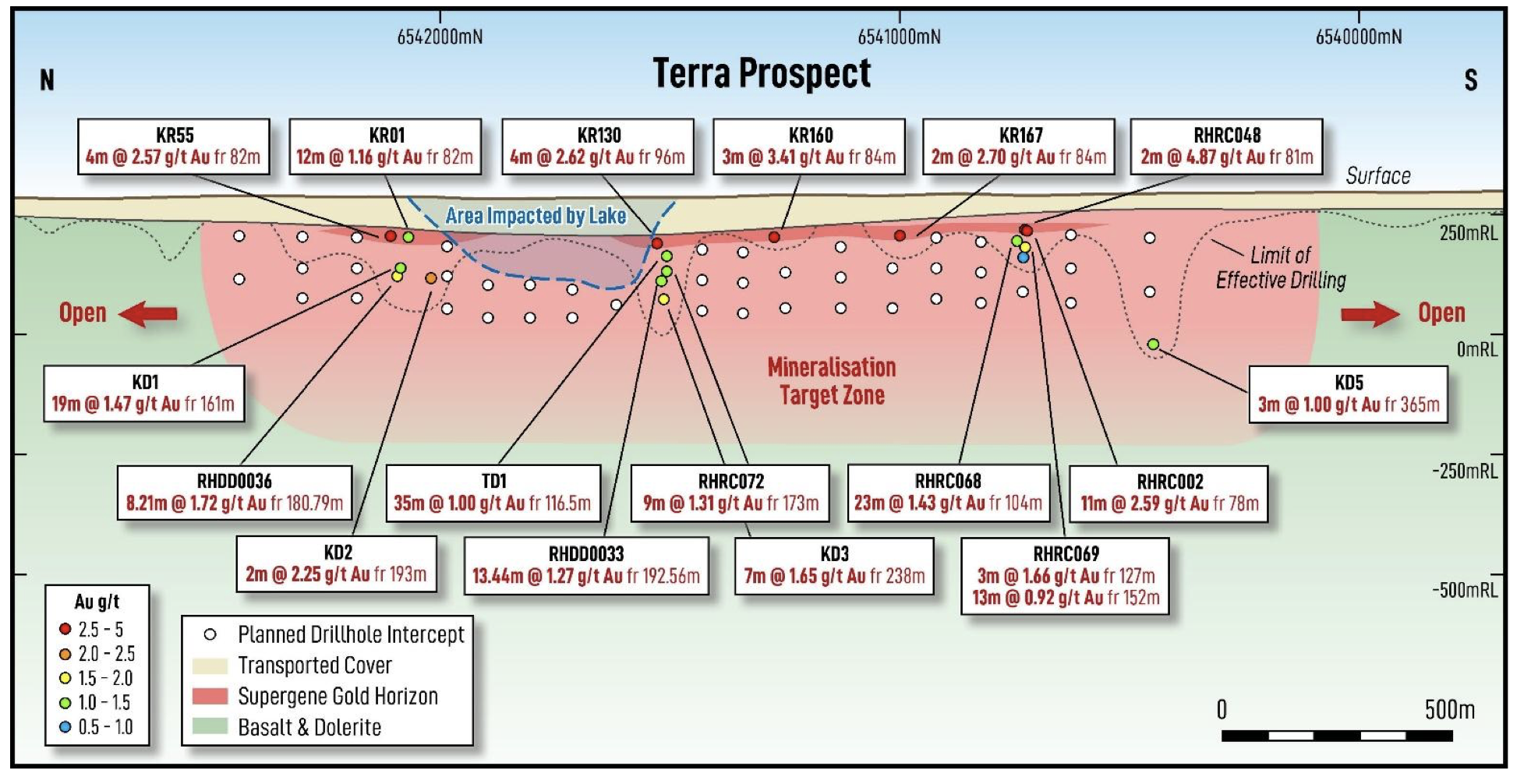
Long-section view looking east showing the 1,500m strike length of the Terra prospect. Historic drillhole intercepts are coloured by Au g/t and are reporting downhole lengths. The limit of existing drilling is shown in a dashed line and highlights the under-drilled nature and the significant upside potential of the Terra prospect. 2026 planned drill holes shown as white circles.
Historic results point to resource potential
The drilling campaign follows encouraging historical exploration results generated during previous programs.
At Terra, earlier drilling defined a gold corridor exceeding 1,500 metres in strike length and returned standout intersections including 35 metres at 1.00 g/t gold from 116.5 metres and 23 metres at 1.43 g/t gold from 104 metres.
Caliburn, located around 4 kilometres southeast of Terra, has delivered results including 22 metres at 1.55 g/t gold from 144 metres and 54 metres at 0.74 g/t gold from 10 metres, including 16 metres at 1.02 g/t gold from 20 metres.
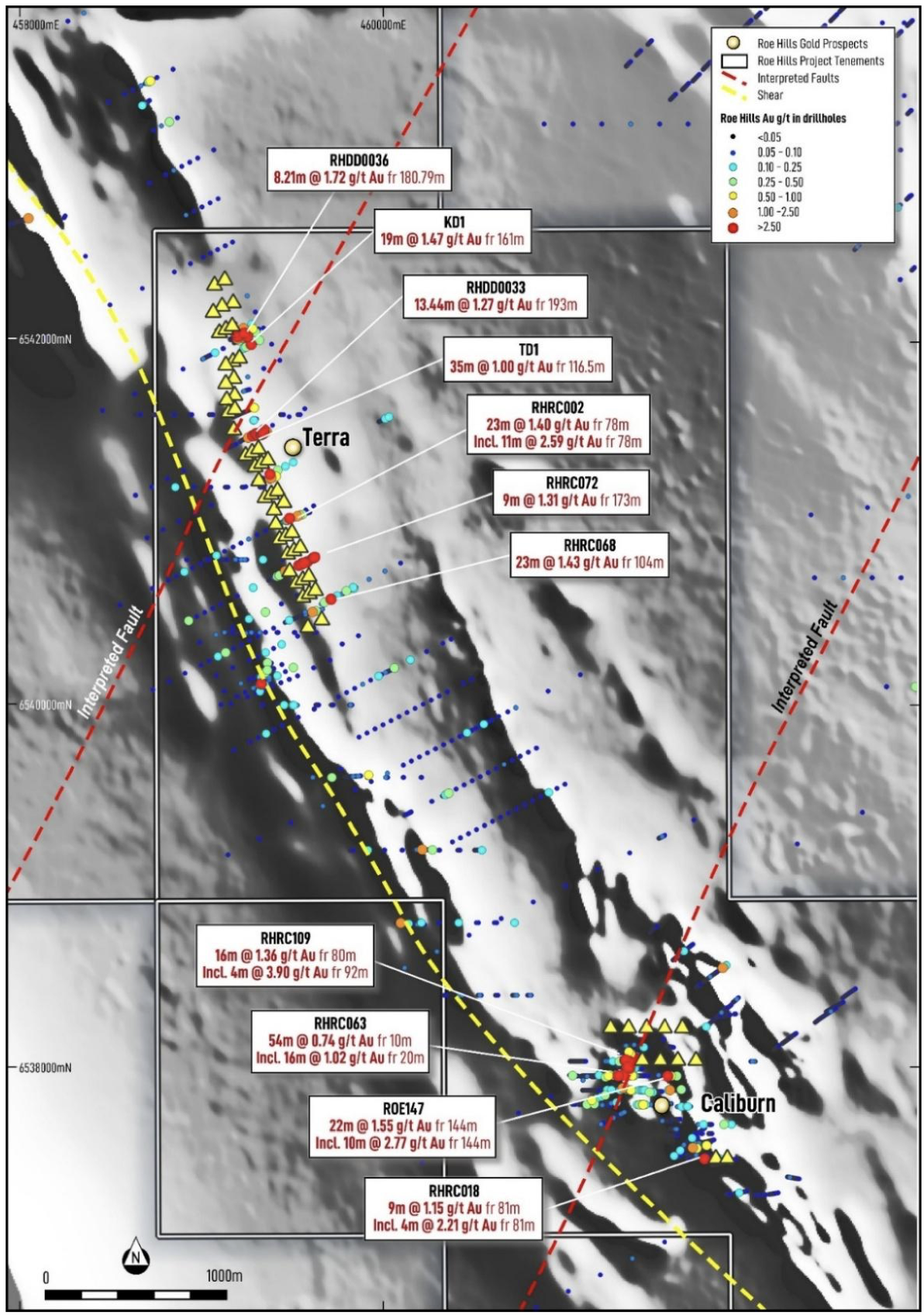
Terra and Caliburn Prospects (on a magnetic image background) showing previously announced drilling results by Kairos Minerals Ltd. Planned 2026 drilling shown as yellow triangles.
The company believes both prospects share geological characteristics with deposits at Gold Fields' nearby St Ives gold camp, one of Western Australia's major gold-producing districts.
Surrounded by established gold operations
Roe Hills is located about 100 kilometres east of Kalgoorlie and sits within an established mining region.
The project lies around 50 kilometres east of Vault Minerals' Mt Monger operations and Randalls processing plant, while also being approximately 50 kilometres south of Ramelius Resources' 1.8-million-ounce Roe Gold Project and 15 kilometres south of Forrestania Resources' Karonie Gold Project.
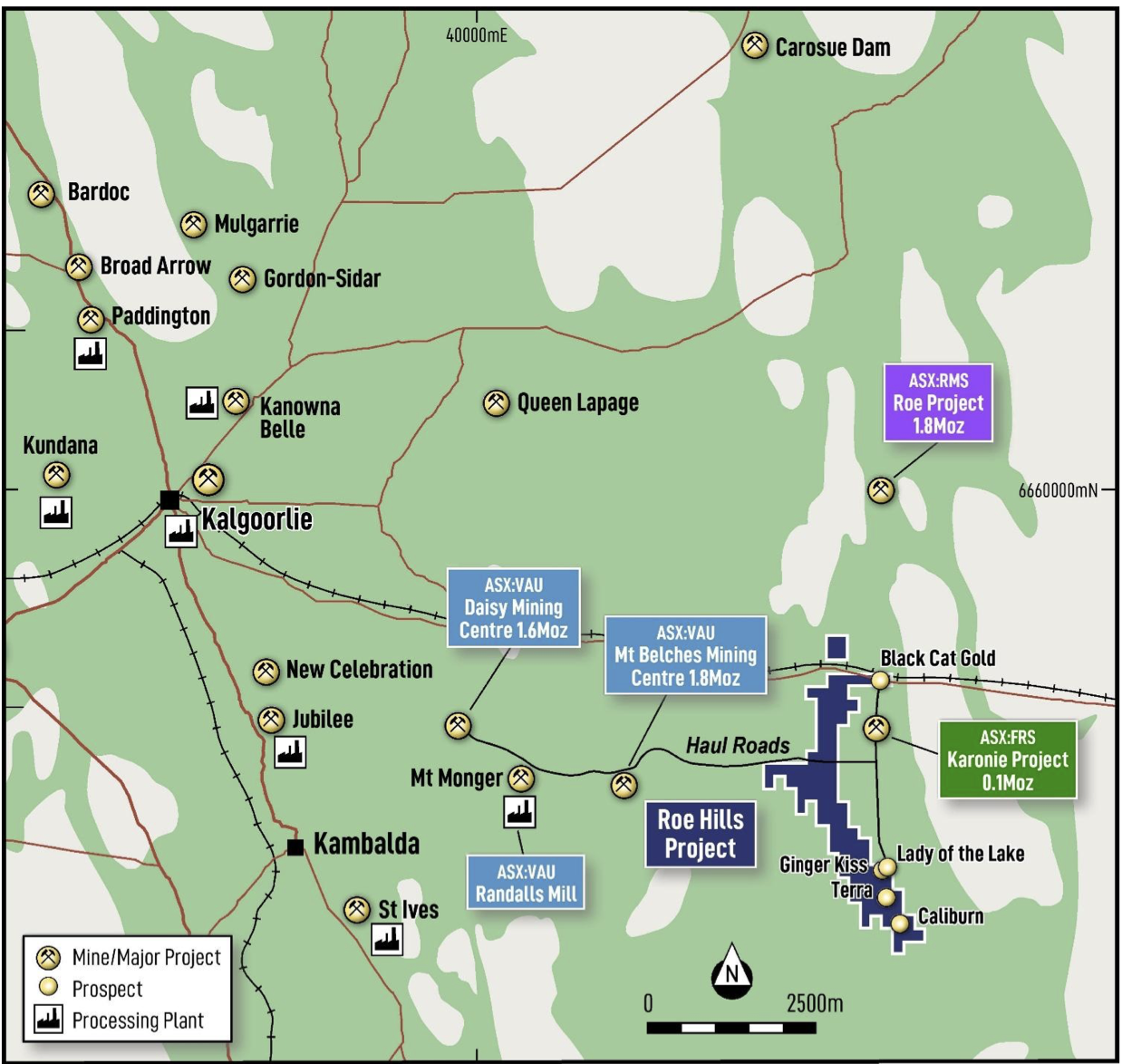
Location map of the Roe Hills Gold Project in relation to regional gold mining centres. Refer to text for reference to resources.
The proximity to operating mines and processing infrastructure is expected to enhance the project's strategic appeal as exploration progresses.
What's next?
Pilbara Gold expects to complete drilling over a two-month period before commencing geological modelling and wireframing of mineralised domains. The company is targeting a maiden resource estimate for Roe Hills by late 2026 or early 2027.
Immediate next steps include engaging earthmoving and drilling contractors, establishing drilling operations, completing the planned campaign and progressing resource estimation work. All this while it ramps up its largest-ever drilling campaign at 2.1Moz Mt York project.
