
Australia's east coast gas market has spent years grappling with a problem that refuses to go away.
Warnings of looming supply shortfalls have become increasingly common as legacy gas fields mature, industrial demand remains strong and LNG export facilities continue to compete for molecules. Governments, producers and large energy users are all searching for new sources of supply capable of delivering meaningful volumes into a market that already possesses extensive pipeline and export infrastructure.
The challenge is not simply finding gas. Australia has discovered plenty of gas over the decades. The challenge is finding resources large enough, close enough to existing infrastructure and commercially attractive enough to justify the billions of dollars required to bring them into production.
That search is drawing increasing attention to Queensland's Taroom Trough.
The basin has been known for decades, but recent advances in drilling and stimulation technology have prompted comparisons with one of North America's most successful unconventional resource plays — Canada's Montney formation.
Among the companies helping test that thesis is Elixir Energy Ltd (ASX:EXR, OTC:ELXPF), which controls one of the largest land positions in the emerging basin and is preparing what could become an important milestone in the play's development.
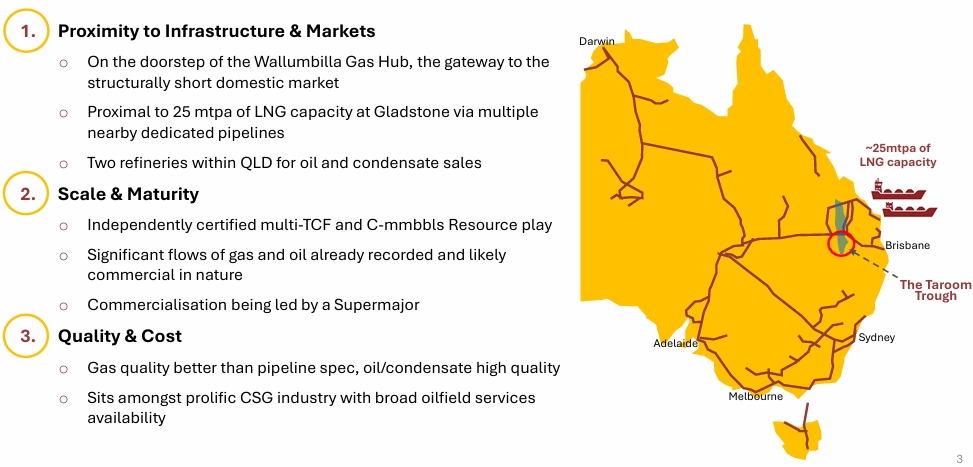
The Taroom Trough – Australia’s Next Major Energy Supply (Source: Elixir Energy)
Why the Montney comparison matters
Resource companies are rarely shy about comparing their projects to world-class deposits or producing basins. Most comparisons deserve a healthy dose of scepticism.
The Montney, however, provides a useful benchmark because it demonstrates how technological change can transform a resource that was long recognised but commercially underdeveloped.
Today the Montney is one of North America's most prolific gas-producing regions, accounting for roughly half of Canada's gas production and supporting major LNG export developments on the country's west coast. Yet the play remained largely stranded until horizontal drilling and multi-stage hydraulic fracturing unlocked its economics.
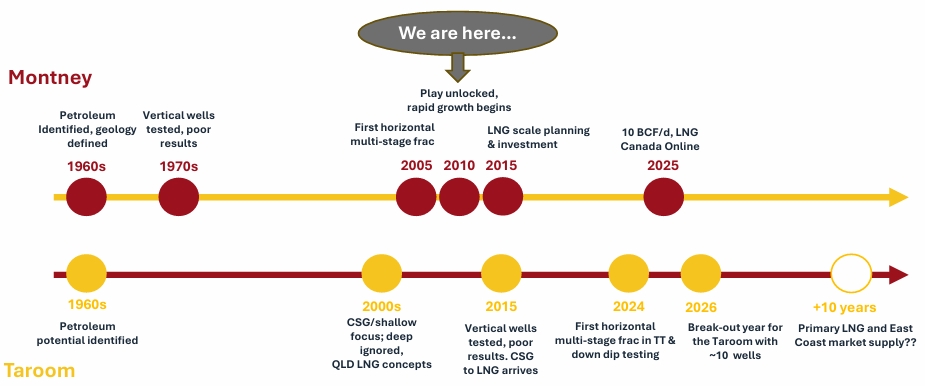
According to Elixir and independent consultant Sproule ERCE, the Taroom shares a number of geological characteristics with the Montney, including its basin-centred gas system, reservoir depths, pressure regimes and regional scale.
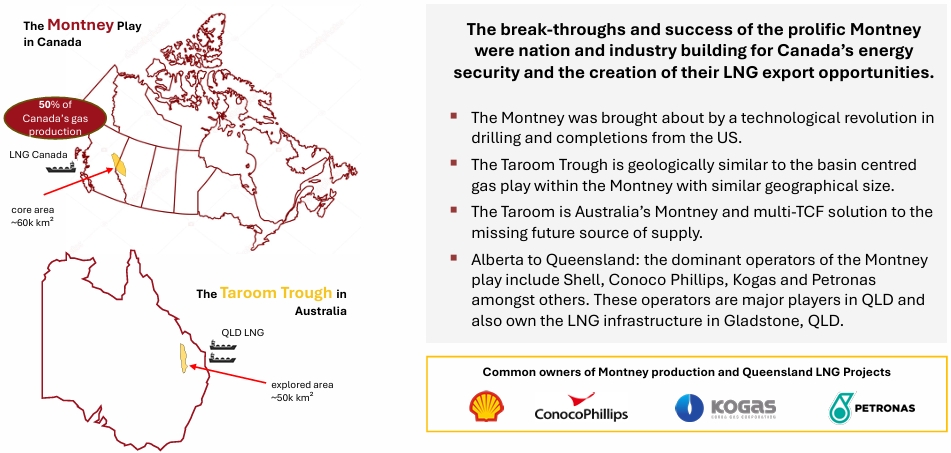
The Taroom Trough: A Montney-sized opportunity
The comparison is not simply academic. Many of the same international energy companies that helped develop the Montney — including Shell, KOGAS and Petronas — already have significant interests in Queensland's LNG industry.
Perhaps more importantly, Queensland starts from a very different market position from where Canada began.
When horizontal drilling unleashed a flood of new Montney production, Canadian gas prices collapsed because export capacity lagged behind resource growth. The Taroom enters a market facing the opposite problem: concerns about future supply shortages and existing infrastructure capable of moving gas to domestic consumers and LNG export terminals.
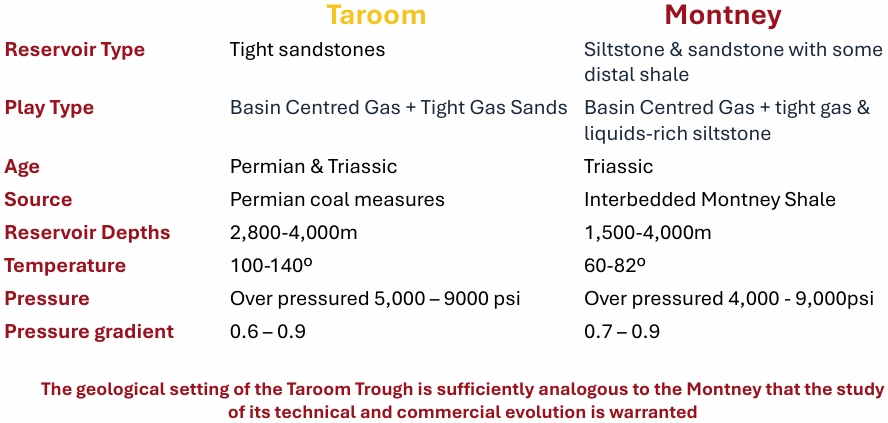
The older sister from Canada
A basin beginning to accelerate
For much of its history, development activity in the Taroom lagged behind Queensland's coal seam gas boom.
Early vertical wells produced mixed results and industry attention focused elsewhere. That appears to be changing.
The Queensland Government has begun advancing a Taroom Development Plan aimed at accelerating approvals and bringing production online sooner. At the same time, operators across the basin are increasing drilling activity. Elixir estimates around 10 wells will be drilled across the Taroom during 2026, marking a substantial increase in exploration and appraisal activity.
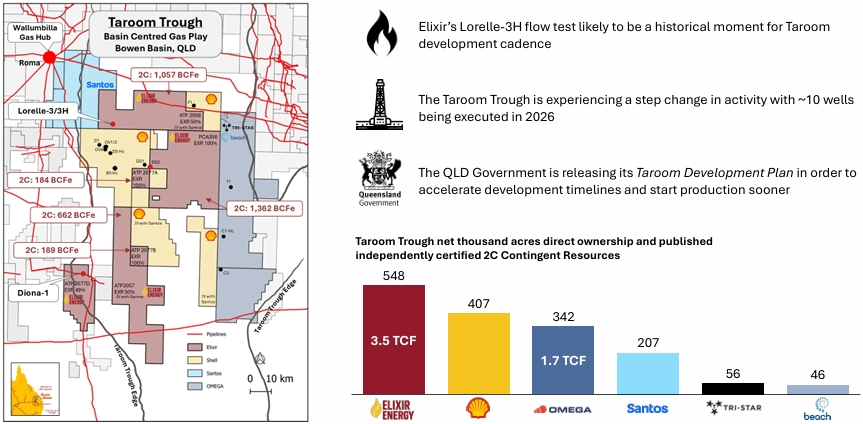
2026: The breakout year for the Taroom
The basin is increasingly attracting the attention of larger industry players.
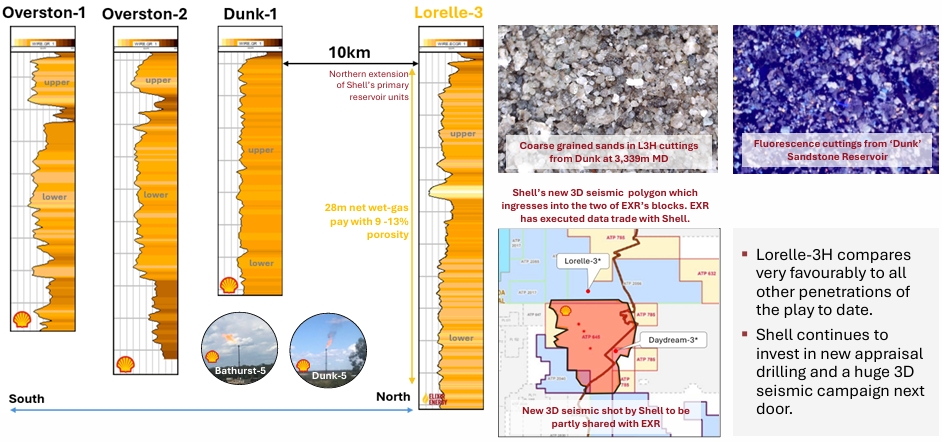
Shell continues to invest in new appraisal drilling nearby and has acquired extensive new 3D seismic data across parts of the region. Elixir has entered data-sharing arrangements covering portions of that survey area.
While the basin remains at an early stage, the level of activity increasingly resembles the period when other unconventional plays began transitioning from geological concept to commercial appraisal.
A well drilled path
The significance of Lorelle-3H
That broader story provides the backdrop for Elixir's latest work at the Lorelle-3H well.
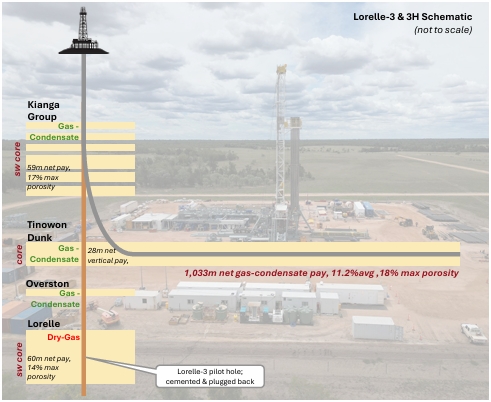
The company describes the project as a “defining moment” for its acreage position and potentially for the wider Taroom Trough. The well includes what Elixir says is the longest horizontal lateral drilled in the basin to date and was completed in 46 days at a cost of $15.7 million, including associated research and appraisal activities.
Results from drilling identified 148 metres of net gas pay across four key Permian reservoir units, with the company highlighting particularly encouraging results from the Dunk Sandstone and Lorelle Sandstone intervals.
Lorelle-3: A defining moment for the Taroom
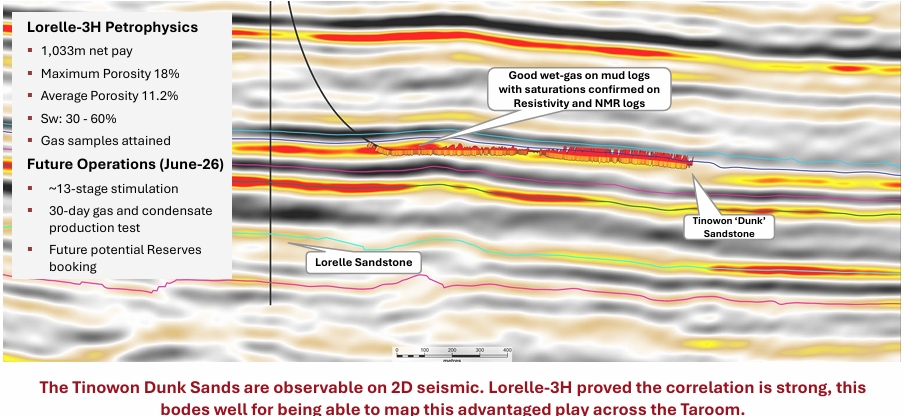
The horizontal section intersected more than 1,000 metres of net pay, with average porosity of 11.2% and maximum porosity reaching 18%. Gas samples have already been collected, and the next phase involves a stimulation program followed by a 30-day gas and condensate flow test.
The next stage of the program is likely to be more revealing than the drilling campaign itself.
Geological results can identify gas-bearing reservoirs and measure their characteristics. The flow test will provide a better indication of how those reservoirs perform when placed into production.
Lorelle-3H: Homogeneous Reservoir Results with Seismic Conformity
A potentially larger prize
Although much of the current attention is focused on a single well, Elixir's ambitions extend far beyond Lorelle-3H.
The company believes the Tinowon "Dunk" Sandstone, which delivered some of the most encouraging results from Lorelle-3H, extends across a regionally significant fairway known as the Dunk Sand play, covering about 2,795 square kilometres.
Lorelle-3’s Dunk is regionally significant
Based on mapping work using wells, seismic data and proprietary geological information, Elixir estimates it has exposure to roughly 40% of this prospective area.
Using analogies drawn from Montney development, the company argues the mapped fairway could ultimately support thousands of well locations and potentially contain substantial recoverable gas and condensate volumes.
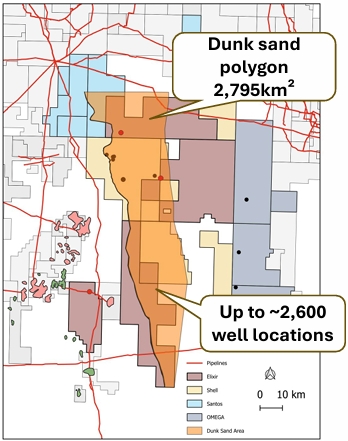
Those figures remain conceptual and dependent on future appraisal and development success. But they illustrate why companies continue to invest heavily in the basin despite its early-stage status.
The attraction lies not in a single discovery, but in the possibility of establishing an entirely new producing region.
Testing the Taroom thesis
The Taroom Trough still has important questions to answer.
Operators must demonstrate consistent production performance, optimise completion designs, reduce development costs and prove commercial scalability. Those are the same challenges faced by virtually every unconventional basin before it reached maturity.
The experience of the Montney suggests those hurdles are overcome through repeated drilling, testing and refinement rather than any single well result.
For Elixir, the upcoming Lorelle-3H flow test is the next step in that process.
For the Taroom more broadly, it will add another data point to a growing body of evidence that could determine whether Queensland has identified a new long-term source of domestic gas and LNG supply.