
Hydrogen has long been one of the energy transition's most ambitious ideas.
Governments have announced billions of dollars in support, industrial companies have unveiled decarbonisation plans, and energy developers have proposed projects across Europe, Australia, the Middle East and North America. Yet turning those ambitions into a functioning hydrogen economy has proved far more difficult.
The challenge is not simply producing hydrogen, but moving it.
Transport remains one of the biggest obstacles facing the industry. Hydrogen is expensive to store, difficult to handle and often loses much of its economic appeal once transportation costs are added to the equation.
That problem is becoming increasingly important as Europe attempts to secure new supplies of renewable hydrogen while also accelerating carbon capture and storage (CCS) projects.
For Provaris Energy Ltd (ASX:PV1, OTC:GBBLF, FRA:WS90), the opportunity sits in the infrastructure needed to connect emerging hydrogen supply with end users.
The company is developing proprietary technologies designed to transport and store both hydrogen and carbon dioxide, then licensing those designs to industrial partners. The approach aims to generate revenue through intellectual property, licensing fees and long-term participation in infrastructure projects without requiring the capital commitments typically associated with energy developments.
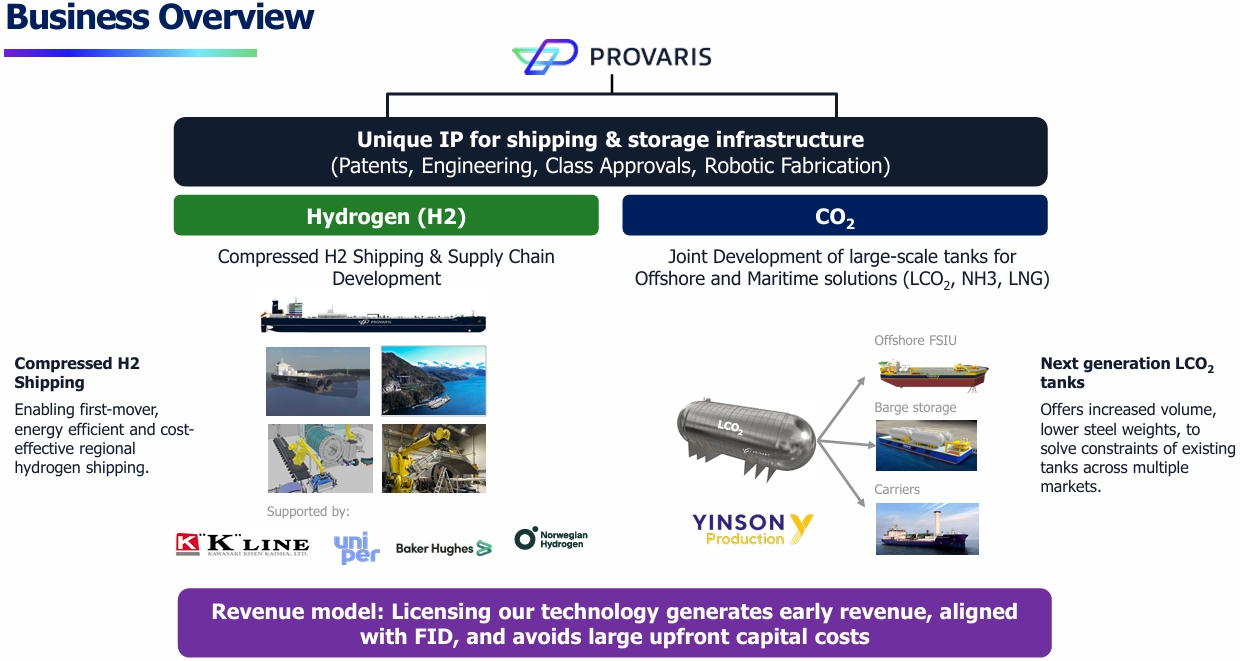
Source: Provaris Energy Ltd
Europe's hydrogen demand is becoming law
Hydrogen projects have often been criticised for relying on future demand forecasts rather than actual customers. But Europe's latest policy shift may help change that.
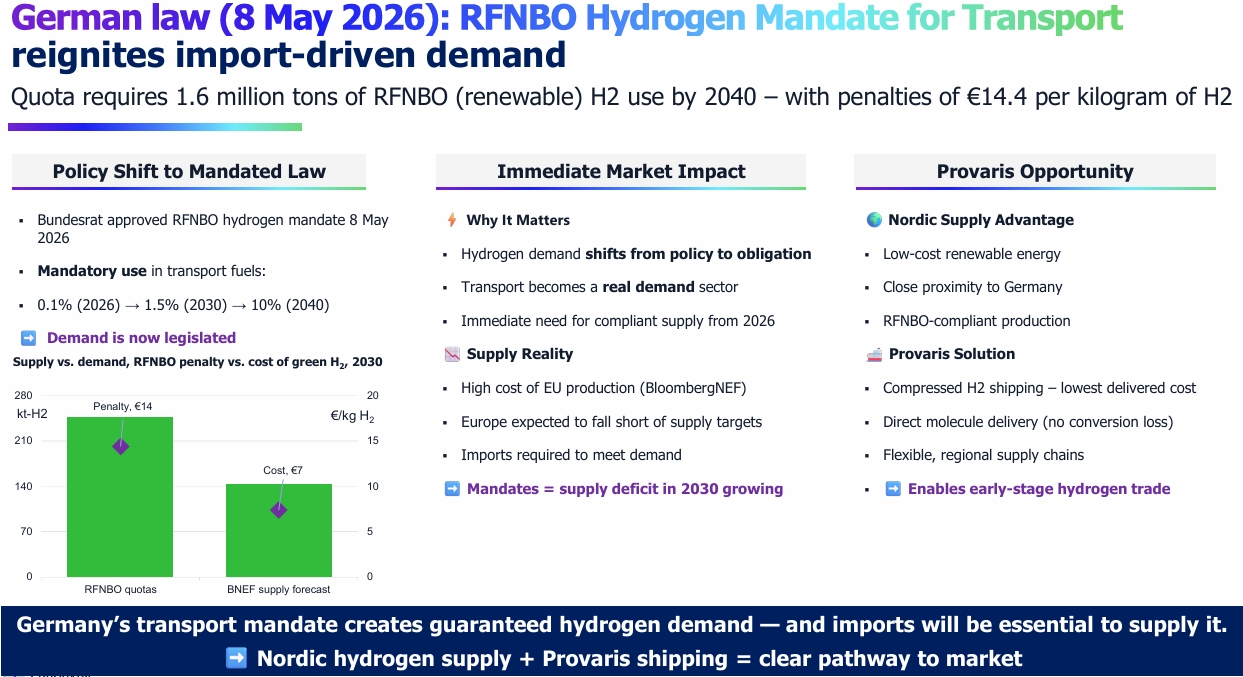
In May 2026, Germany approved legislation requiring increasing volumes of renewable hydrogen-based fuels in transport, starting at 0.1% this year and rising to 10% by 2040. The policy effectively creates a mandated market for renewable hydrogen rather than relying solely on voluntary adoption.

The legislation arrives as Europe confronts a growing gap between hydrogen ambitions and domestic production capacity.
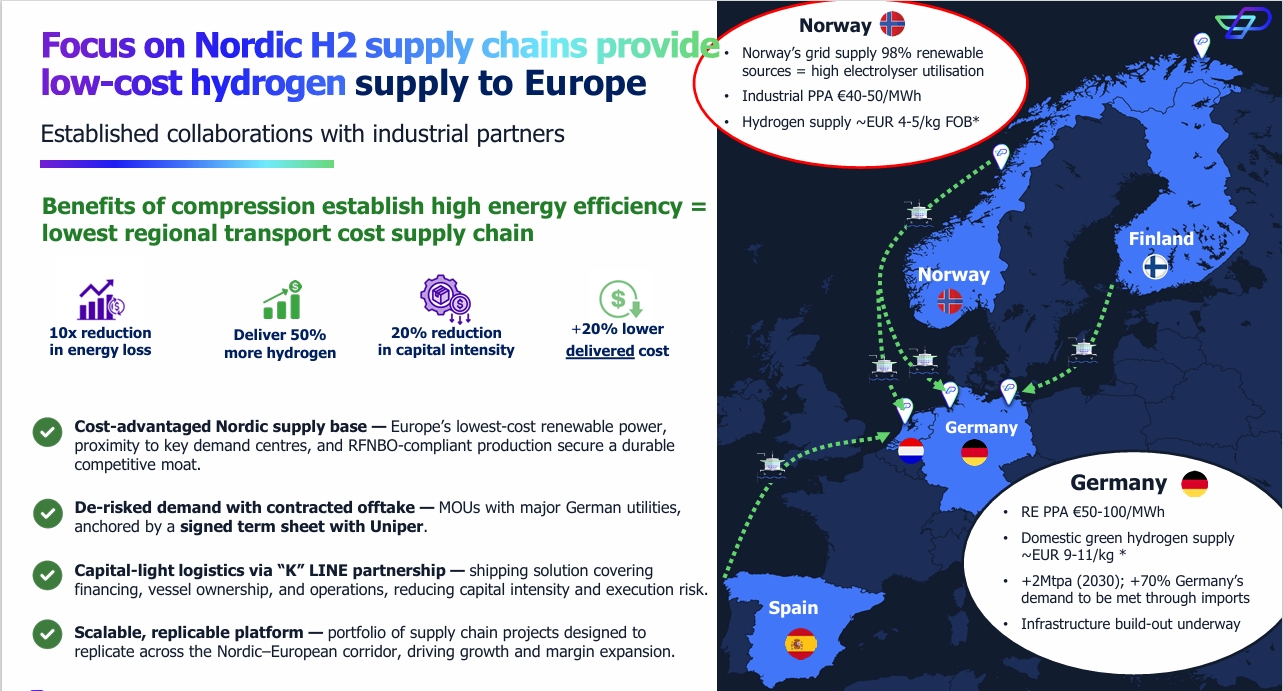
Germany is expected to rely heavily on imported hydrogen over the coming decade, creating an opportunity for nearby suppliers with access to low-cost renewable power. Norway has emerged as one of the most attractive locations thanks to its hydroelectric-dominated grid, established industrial infrastructure and proximity to European demand centres.
That Nordic-to-Europe corridor sits at the centre of Provaris' hydrogen strategy.
In Norway, Provaris is working with Norwegian Hydrogen on the proposed FjordH2 green hydrogen export facility, while relationships with German utility Uniper and Japanese shipping group K Line are intended to connect production, transport and end-market demand.
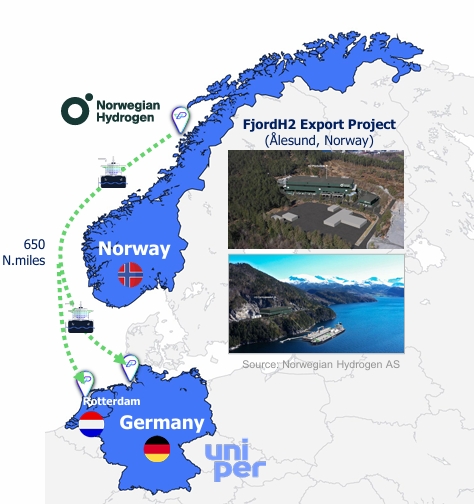
A term sheet signed with Uniper contemplates the supply of around 34,000 tonnes per year of renewable hydrogen from Norway into Germany under a long-term arrangement. The project remains subject to further commercial and technical milestones, but it provides one of the clearest indications yet of how Provaris intends to commercialise its technology.
Betting on compression rather than conversion
Hydrogen transport has largely focused on two approaches.
One involves cooling hydrogen into a liquid state. Another converts it into derivatives such as ammonia before shipment.
Provaris is pursuing a different route through compressed hydrogen.
The company argues that transporting hydrogen in compressed gaseous form avoids several energy-intensive conversion steps required by alternative supply chains. According to its studies, compression can reduce energy losses, lower delivered costs and increase the volume of hydrogen ultimately reaching customers.
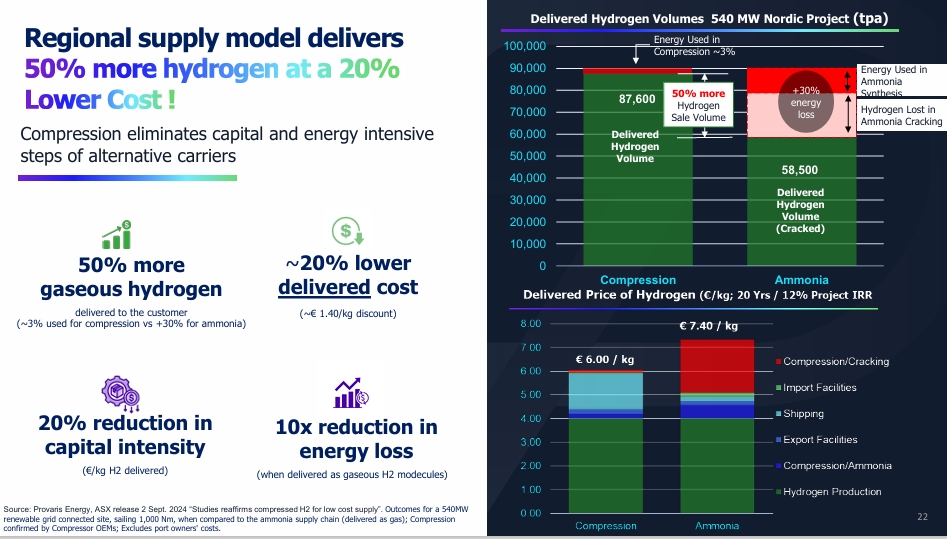
At the centre of that strategy is the H2Neo carrier, a purpose-built compressed hydrogen vessel designed to transport hydrogen at high pressure without boil-off losses. The vessel is intended to operate alongside the company's H2Leo storage barge as part of a broader hydrogen transport network. Provaris has spent several years advancing the design through engineering studies, front-end engineering and design work, class approvals and patent development.
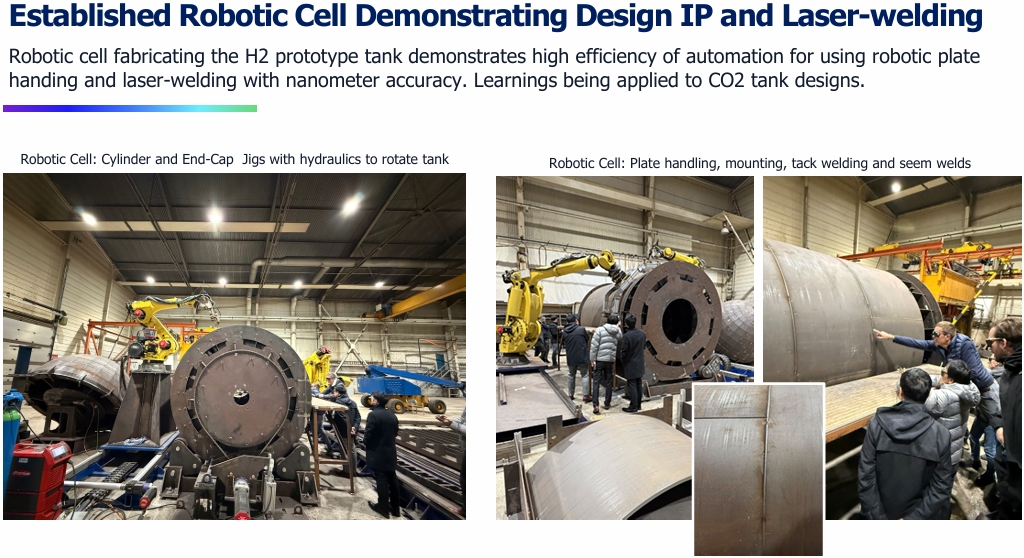
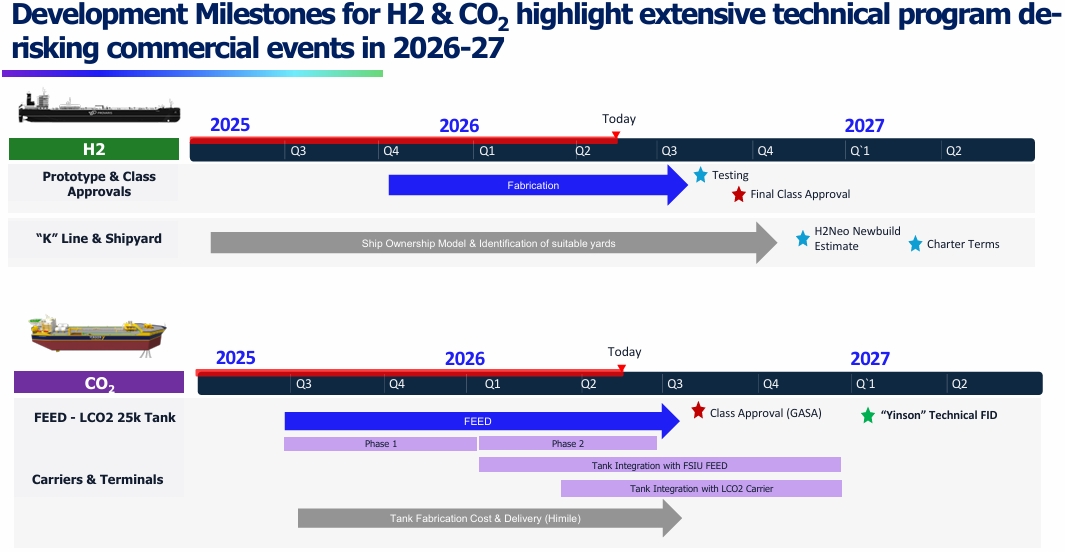
The next major milestone is expected later this year when Provaris completes fabrication and testing of its prototype hydrogen tank and seeks final Class approvals. Success would move the technology closer to commercial deployment and potentially unlock the company's first licensing opportunities.
A different way to build an energy business
One of the more unusual aspects of the Provaris model is that the company does not intend to become a ship owner.
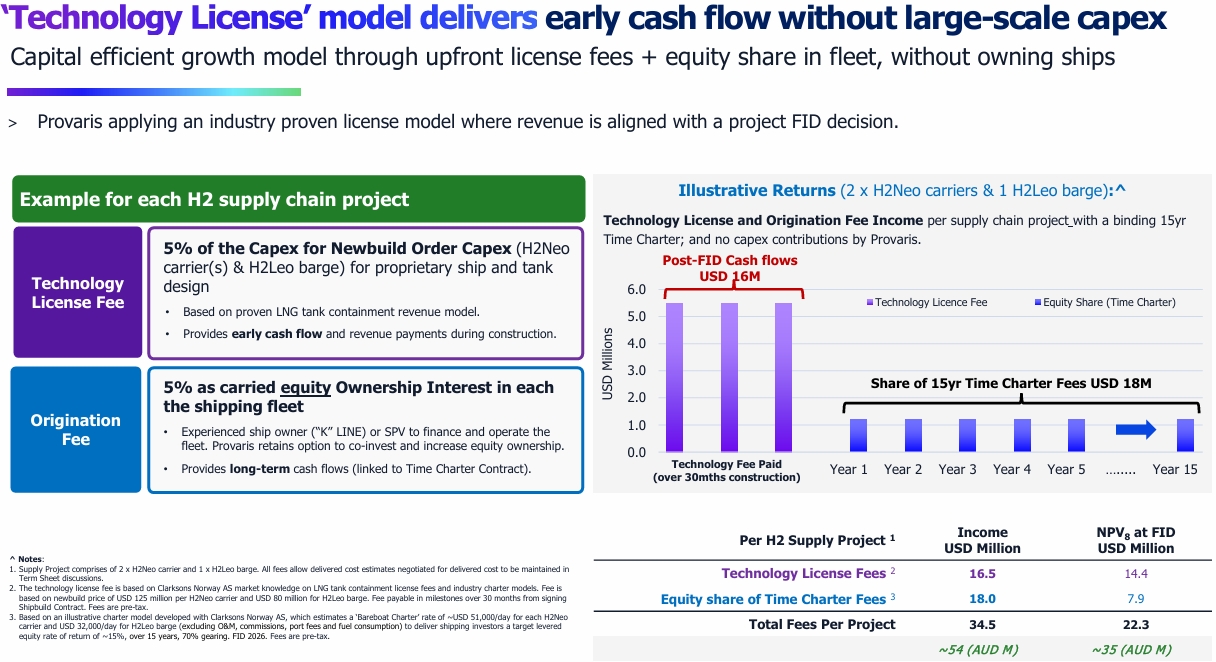
Instead, management is attempting to replicate a structure commonly used elsewhere in the maritime industry, where technology owners earn licensing income while third parties fund, build and operate vessels.
Under illustrative economics outlined by the company, Provaris would receive technology licence fees tied to new vessel construction as well as a minority equity interest in shipping fleets operated by partners. For a typical hydrogen supply chain involving two H2Neo carriers and one H2Leo storage barge, the company estimates total fees of about US$34.5 million, comprising US$16.5 million in licence and origination fees and a further US$18 million from its share of long-term charter revenues.
This is where K Line becomes important.
The Japanese shipping group, which operates hundreds of vessels globally and has experience across LNG, hydrogen and carbon dioxide shipping, signed a collaboration agreement with Provaris last year. The partnership is intended to cover vessel ownership, financing and operations, reducing the amount of capital Provaris would otherwise need to raise.

For investors, the attraction is obvious.
Traditional energy infrastructure projects often require hundreds of millions of dollars before generating meaningful returns. Provaris is attempting to position itself further up the value chain, monetising intellectual property rather than owning large physical assets.
Whether that model proves successful will depend on converting development work into binding commercial agreements over the next several years.
Carbon capture opens a second pathway
Hydrogen remains the company's original focus, but carbon capture and storage is emerging as an increasingly important part of the story.
Across Europe, CCS is attracting growing political and financial support as governments seek ways to reduce emissions from heavy industries that cannot easily electrify.
The European Union's Clean Industrial Deal includes €100 billion in funding support for industrial decarbonisation projects, while Norway has become the leading centre for offshore carbon storage development.
Provaris believes many CCS projects face a similar challenge to hydrogen: infrastructure costs.
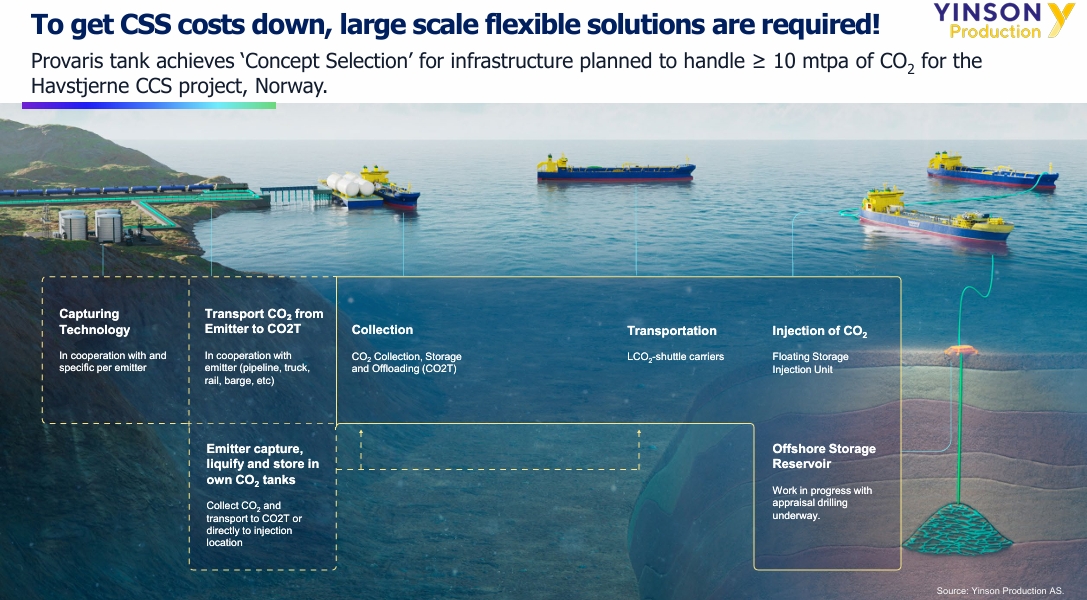
Its answer is a large-scale liquid carbon dioxide storage tank designed to reduce the cost of transporting and storing captured emissions. The company is developing the technology through a joint development agreement with Yinson Production, a major energy infrastructure company with interests spanning offshore production, renewables and carbon capture.
The partnership has already progressed beyond initial concept work.
A proposed joint venture would jointly own and commercialise the tank technology, while Yinson is funding development activities. The design is being evaluated for use across floating storage and injection units, carbon dioxide carriers and terminal storage infrastructure.
Importantly, the project is linked to Yinson's Havstjerne CCS development offshore Norway, a proposed large-scale carbon storage project supported by European funding and industry partners.
That connection potentially gives the carbon capture business a more direct route to commercialisation than is often seen with early-stage energy technologies. Recent analysis sees the CCS opportunity beginning to emerge as a meaningful second pillar alongside Provaris' hydrogen strategy, particularly as European investment in carbon transport and storage infrastructure accelerates.
A busy 18 months ahead
For a company with a market capitalisation of around $10 million, Provaris has assembled an unusually large group of industrial partners.
The challenge now is execution.
The remainder of 2026 is expected to be dominated by technical milestones across both hydrogen and carbon dioxide programs, including prototype testing, final approvals, FEED completion work, and negotiations around vessel ownership and commercial structures.
Management is targeting initial licensing transactions from 2027 as projects move closer to final investment decisions.
The broader investment case rests on a simple proposition: that decarbonisation will require vast amounts of new infrastructure, and that the companies supplying the underlying technology may be able to capture value without taking on the balance-sheet risk of building it themselves.
Hydrogen and carbon capture remain challenging sectors. Yet as Europe moves from policy ambitions towards legally mandated emissions reductions, the need for transport and storage infrastructure is becoming harder to ignore.
Provaris is betting that the companies enabling those networks could ultimately be as important as the producers and end users they connect.