
American Tungsten & Antimony Ltd (ASX:AT4, OTCQB:ATALF, FRA:4VZ) has delivered its strongest drill result to date from the Phase 1 diamond drilling program at the Antimony Canyon Project in Utah, with new assays confirming both the grade potential and growing scale of the antimony system at the Little Emma prospect.
The latest results include 10.37 metres at 3.98% antimony from 3.35 metres, including 4.57 metres at 8.56% antimony from 6.71 metres in hole ACP26DD026, alongside 5.73 metres at 2.80% antimony from 48.68 metres, including 1.95 metres at 8.09% antimony from 51.21 metres in hole ACP26DD014.
The results build on previously reported high-grade intersections and continue to extend mineralisation along strike, with the company saying the stibnite-hosted system remains open in multiple directions.
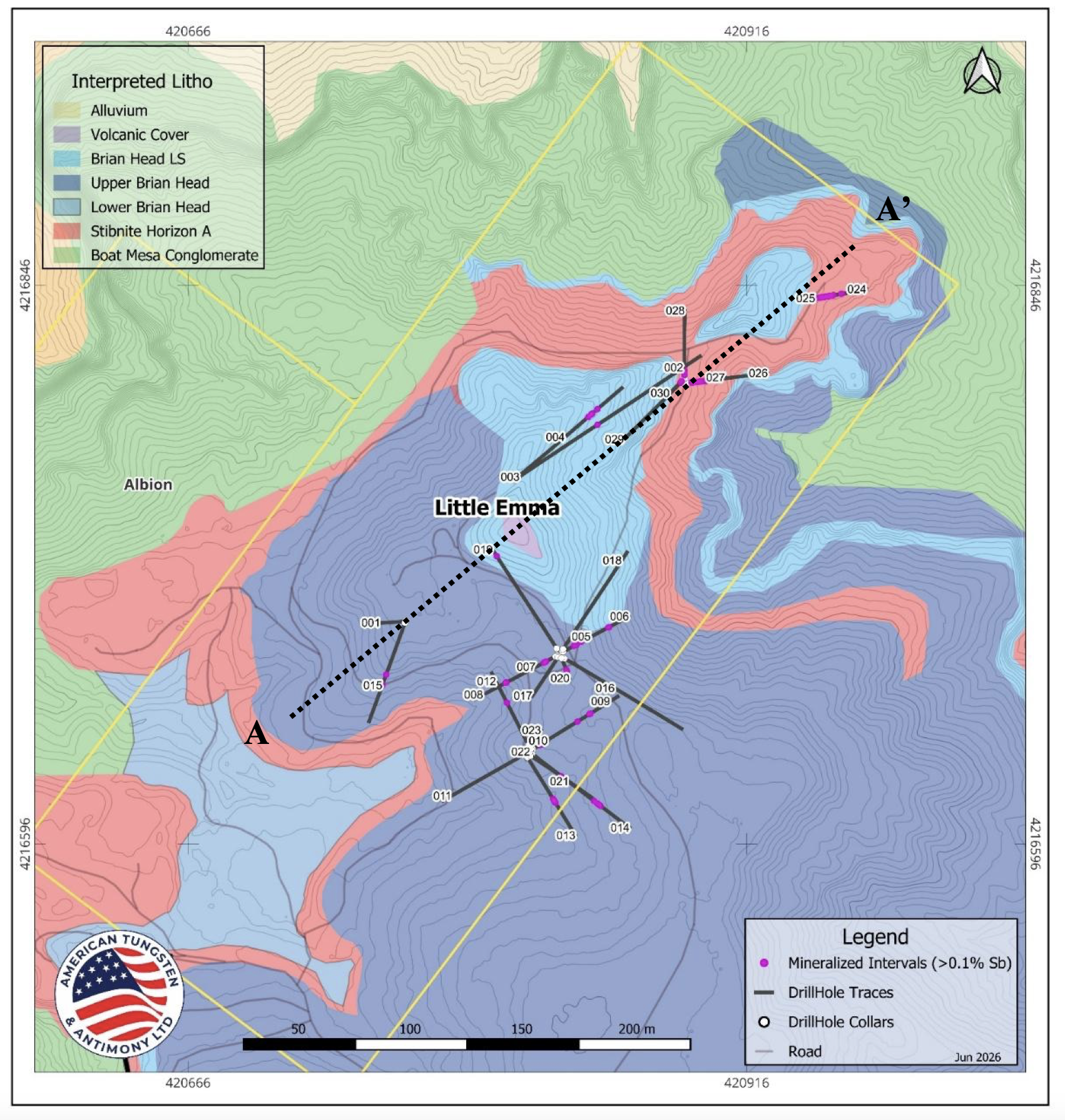
Plan view at Little Emma Claim highlighting the location of Phase 1 drill hole collars and drill traces that display intercepts >0.1% Sb cut-off. Drilling is overlain on local geology comprised from mapping and correlation with geology encountered from drilling. Cross section A-A’
Phase 1 drilling strengthens geological model
Phase 1 drilling at Little Emma has now completed 30 diamond holes for 1,970 metres, with assay results received for 24 holes. The current drilling campaign has focused entirely on the Little Emma patented claim, one of more than 20 historic workings within the company's patented claim package and representing less than 1% of the overall project footprint.
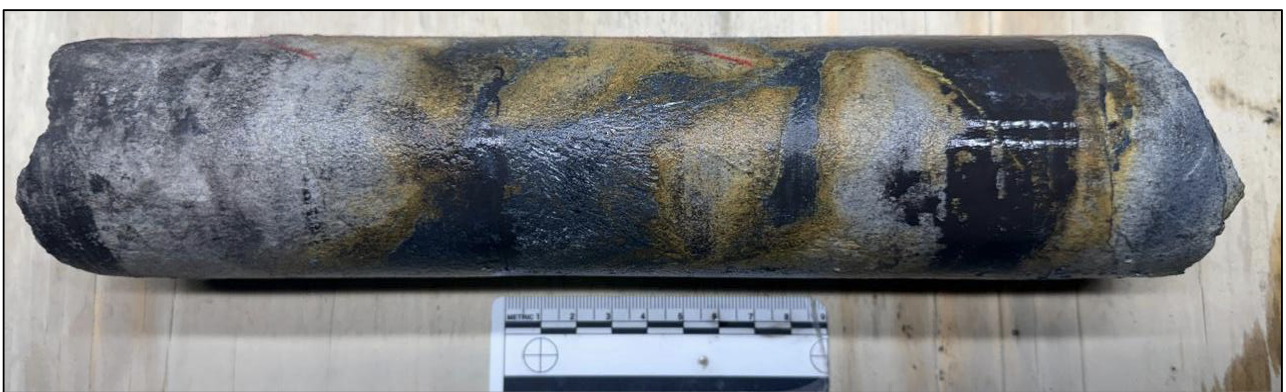
ACP26DD026 core sample 1103384 from the high-grade pod interval, returning 42.10% Sb. Wet core photograph showing dark steel-grey to black massive to semi-massive acicular stibnite replacing the sandy Salt and Pepper tuff and infilling fractures and pore spaces. Grey-beige altered tuff remnants, orange-brown oxide halos and minor veinlet textures are visible along the margins, supporting a carbonate dissolution and pore-space replacement style of mineralisation.
The program was designed to test the "Salt and Pepper" host horizon, a volcanosedimentary unit within the Paleocene Flagstaff Formation that has emerged as the principal host to antimony mineralisation.
Drilling has confirmed the continuity of this mineralised horizon over more than 250 metres and supports the company's interpretation of a large-scale stratabound hydrothermal antimony system.
Managing director Andre Booyzen said the latest results demonstrated that the company was steadily improving its understanding of the broader system.
He noted that Little Emma represented just one of more than 20 historic workings across the patented claims and only a small fraction of the overall project area.
Results confirm high-grade pod-style mineralisation
The latest drilling has helped define what the company describes as a poddy stratabound system, where high-grade stibnite replacement pods occur within broader envelopes of lower-grade mineralisation.
Hole ACP26DD026 delivered the standout result of the program and returned the highest individual assay to date, with a 0.3-metre interval grading 42.1% antimony. Detailed logging indicates the high-grade zone consists of massive to semi-massive stibnite replacing the host rock and filling fractures and pore spaces.
The company said broader intersections from holes ACP26DD024 and ACP26DD025 represent mineralised envelopes between the higher-grade pods and provide evidence that the hydrothermal system extends beyond the currently defined high-grade zones.
Importantly, several of the higher-grade intersections exceed the grade assumptions used in the company's previously announced exploration target of 6.1–6.9 million tonnes grading 1.4–2.3% antimony.
Geological studies have also identified a suite of pathfinder elements, including arsenic, mercury and thallium, which are helping refine targeting and improve understanding of controls on mineralisation.
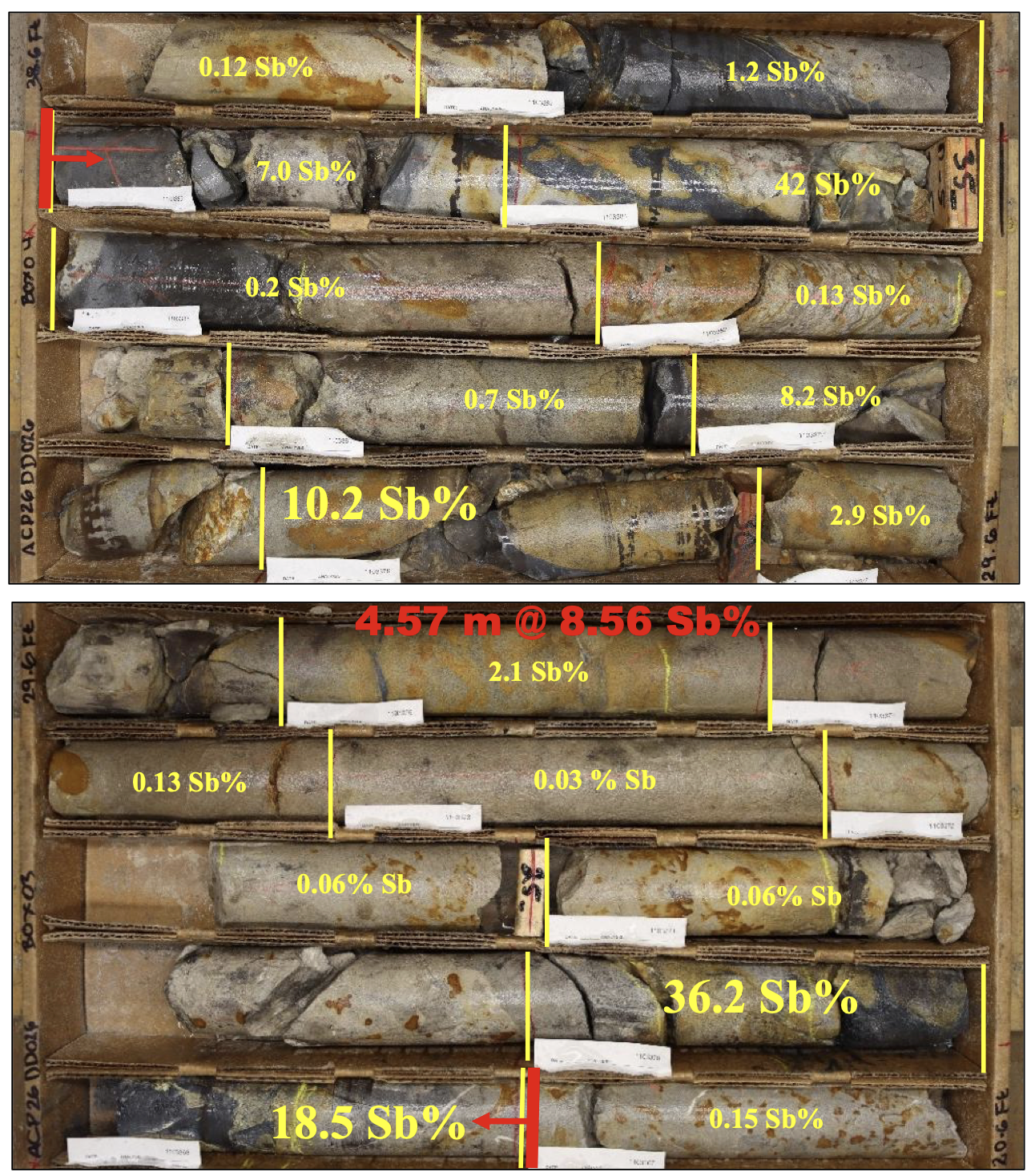
Box from: 6.3m to 11.8m ACP26DD026. Yellow assay results correlate to 10.37m @ 3.98% Sb from 3.35m with higher-grade core of 4.57m at 8.56% Sb from 6.71m in red.
Expansion drilling and regional targets planned
With the Little Emma geological model becoming increasingly defined, American Tungsten & Antimony is preparing to test additional targets across the broader Antimony Canyon project area.
A soil sampling program covering the patented claims has been completed, with assay results expected within six weeks. Geological mapping is continuing and the sampling program is being expanded onto US Forest Service lands toward the Dry Wash target around 10 kilometres north of Little Emma.
The company has also received approval for a Notice of Intent at the Blackjack prospect and expects drilling to commence within about two months, subject to final US Forest Service permitting. Blackjack will represent the first major test of mineralisation beyond Little Emma and is aimed at assessing the canyon-wide extent of the hydrothermal system.
Planning is also advancing for drill programs at the Mammoth, Stella and Stebenite prospects, with permit applications expected to be submitted during June.
About American Tungsten & Antimony
American Tungsten & Antimony is focused on developing critical minerals projects in the United States. Its flagship Antimony Canyon Project in Utah is considered one of the largest and highest-grade undeveloped antimony systems in the country, while the recently acquired Tennessee Mountain Tungsten Project in Nevada provides additional exposure to strategic metals critical to Western supply chains.