
Lightning Minerals Ltd (ASX:L1M, FRA:YZ1) has confirmed widespread high-grade tungsten mineralisation from initial reconnaissance rock chip sampling at its 100%-owned Warby Project in North Queensland.
The company received assays from 14 rock chip samples collected from historical workings across eight vein systems, with tungsten values ranging from 750 ppm tungsten to more than 50,000 ppm, or greater than 5% tungsten.
Results included 10 samples grading more than 1% tungsten and six samples above 3% tungsten, confirming the presence of high-grade mineralisation across a 2-kilometre northwest-trending structural corridor.
Notable assays included more than 50,000 ppm tungsten from historical tailings material, 43,200 ppm from quartz vein material, 42,900 ppm from quartz vein material, 40,300 ppm from quartz vein material and 39,800 ppm from quartz vein material.
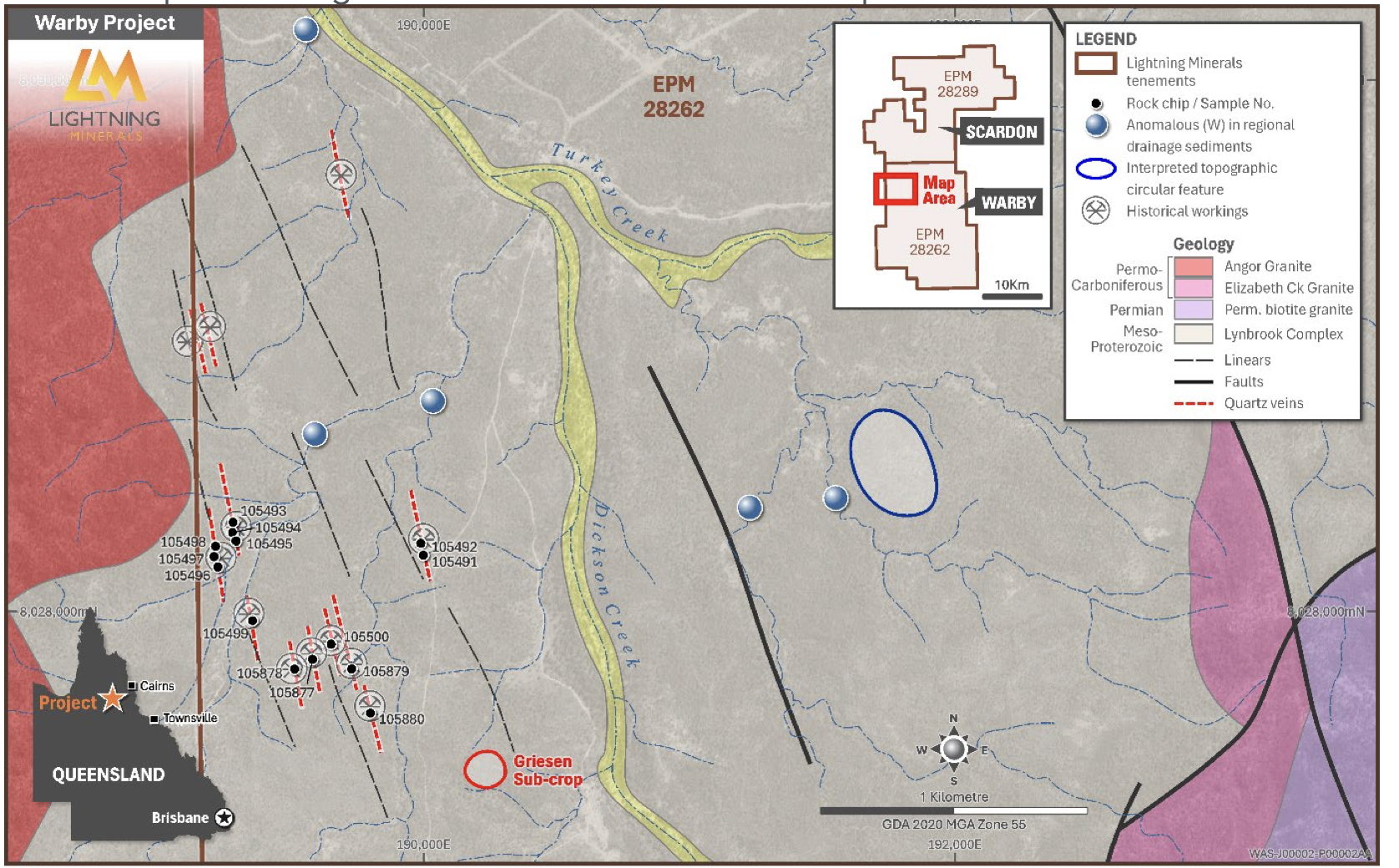
Warby Tungsten Project – location map and geology.
Results support broader system
The assays confirm tungsten mineralisation across multiple wolframite-bearing vein systems associated with quartz veining, greisen and altered granite.
Importantly, Lightning Minerals said mineralisation was not limited to quartz veins, with tungsten also recorded in altered granitic host rocks and greisen material.
One sample of altered pegmatitic granite returned 30,400 ppm tungsten, while biotite greisen material returned 750 ppm tungsten, supporting the potential for a broader intrusive-related mineralised system.
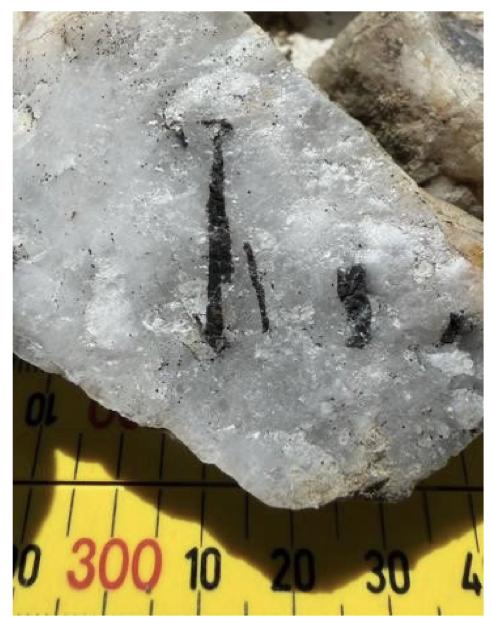
Sample no 105496. Vein no 3 (4.32% W). Close-up of acicular wolframite to 3cms in Type 2 glassy vein quartz.
Elevated bismuth, tin and copper values associated with tungsten mineralisation further support the prospectivity of the Warby system.
What the assays confirm
The initial program was designed to test whether tungsten mineralisation was present within historical workings identified during reconnaissance field mapping.
The results confirmed significant tungsten mineralisation across all sampled vein systems, with samples collected from eight known vein systems across about 1 square kilometre within the broader 2-kilometre structural corridor.
Lightning noted that the sampling was early-stage and selective in nature, with rock chip samples taken from historical dump material. As such, the results are not necessarily representative of in-situ grade, continuity or scale.
“The initial assay results are a strong outcome from our first-pass work at Warby and confirm widespread high-grade tungsten mineralisation across multiple historical workings. This gives us confidence there is considerable scope to define the scale and continuity of the mineralisation. We’re looking forward to our follow-up field exploration aimed at expanding our understanding of the broader tungsten system at Warby,” chief executive officer Troy Brice said.
What’s next
Lightning plans follow-up exploration in the third quarter of 2026 to define the broader footprint and continuity of mineralisation.
Planned work includes infill drainage geochemistry, systematic soil geochemical sampling, detailed geological mapping, extension sampling of historical workings and assessment of drill-ready targets.
The company said limited outcrop exposure and dense vegetation may conceal additional mineralised veins or extensions within the broader target area.
No evidence of modern systematic tungsten exploration has been identified across the current target area, giving Lightning further scope to assess Warby’s potential as a tungsten system within a favourable regional geological setting.