
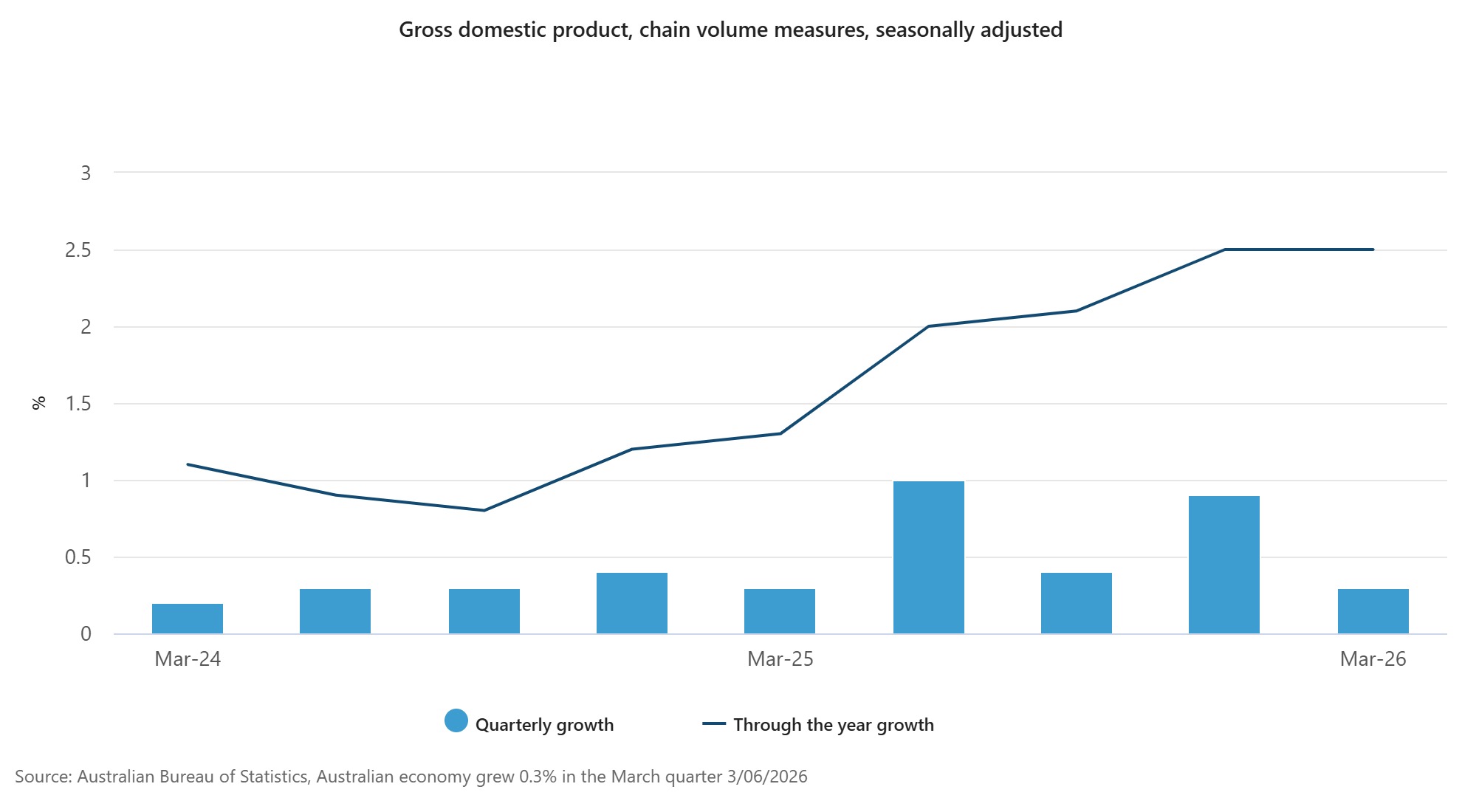
Australia's economy grew just 0.3% in the March quarter as cyclone-related disruptions hit exports, government spending weakened and consumers remained cautious, according to new figures from the Australian Bureau of Statistics (ABS).
Annual growth held at 2.5%, but exports recorded their biggest quarterly decline in two years and net trade subtracted 0.8 percentage points from GDP growth.
“Economic growth slowed in the March quarter, with modest household and public sector expenditure as well as cyclone disruptions to mining and export activities,” ABS head of national accounts Grace Kim said.
Exports weaken as cyclone disruptions bite
Weather disruptions had a noticeable impact on export-dependent industries during the quarter.
Mining production fell 1.5%, while transport, postal and warehousing activity declined 1.3%. Exports dropped 1.1% — their largest quarterly decline in two years — driven by falls in coal exports and mineral ores.
Imports rose 2.1%, contributing to the drag from net trade.
One of the quarter's brighter spots was business investment. Private business investment increased 6.0%, driven by a 16.3% jump in machinery and equipment (M&E) spending.
“M&E investment recorded the largest rise in 30 years with the expansion of data centres in New South Wales and Victoria during the quarter,” Kim said. “The contribution of investment to GDP growth was moderated as most of this equipment was imported.”
Consumers remain cautious
Household spending rose 0.5% during the quarter, supported by higher spending on electricity, gas and other fuels as government rebates wound back.
Spending on essential goods and services increased 0.8%, while discretionary spending rose just 0.1%.
“Rising interest rates and significantly higher fuel costs in the March month likely created an environment for more cautious consumer behaviour,” Kim said. “This resulted in reduced spending across a range of household expenditure categories.”
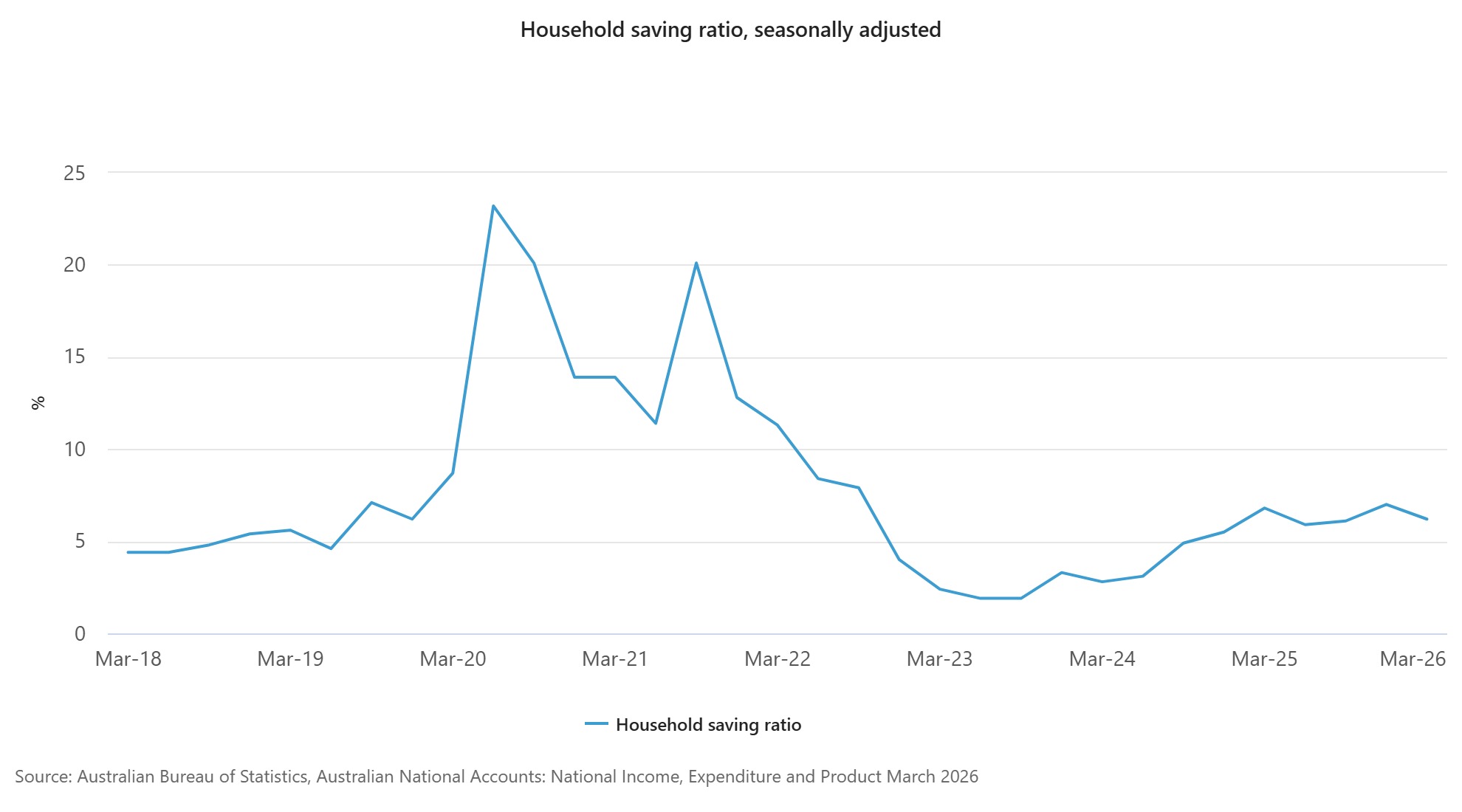
The household saving-to-income ratio fell to 6.2% from 7.0% in the December quarter as spending growth outpaced gains in disposable income.
Government final consumption expenditure declined 0.2%, its weakest quarterly result since September 2022, reflecting lower Commonwealth spending and the end of electricity rebate payments by state and local governments.
Productivity remains weak, buit momentum building
The national accounts also highlighted Australia's ongoing productivity challenges.
Xero Inc (ASX:XRO) economist Louise Southall said the official figures showed continued stagnation in labour productivity but suggested conditions among smaller businesses were improving.
“Today's labour productivity figures — measured by GDP per hour worked — show continued stagnation in Australia's productivity levels, but they don't capture the full picture,” Southall said.
“Xero's Small Business Insights (XSBI) shows that small business labour productivity levels reached a near four-year high in the March quarter, with the sector recording two consecutive quarters above its long-term average,” she added.
“While the national headline looks broadly flat, our data suggests momentum is quietly building at the small business level — the average Australian business.”
What it means for rates
The GDP figures arrive ahead of the Reserve Bank of Australia's June policy meeting and are likely to reinforce expectations that policymakers will remain cautious.
BNY APAC macro strategist Wee Khoon Chong said the result was slightly softer than expected but still reflected a resilient economy.
“Australia's Q1 GDP came in slightly softer than expected but remained at a solid 2.5% year-on-year pace, validating the RBA’s response of three consecutive rate hikes so far in 2026,” Chong said.
“Looking ahead, we expect the RBA to stay in wait-and-see mode at the June policy meeting, given the recent downside surprise in CPI and the rise in unemployment.”
Chong added that labour market conditions remained relatively tight and elevated oil prices continued to pose upside risks to inflation.
“There is no room for complacency, and the risk is that the RBA hikes again if inflation expectations remain persistently high,” he said.
Stagflation concerns emerge
VanEck head of investments and capital markets Russel Chesler said the full impact of recent rate increases and broader economic pressures had yet to be fully reflected in the data.
“The sharp rise in imports, partly driven by the fuel crisis, has pushed Australia into a trade deficit for the first time since 2017,” Chesler said.
“We expect annual GDP growth to fall below 2% this year, well below the 2.5% reported today for the year to 31 March 2026.”
Chesler warned that the effects of the Iran war-driven fuel crisis and RBA rate hikes “has only been partly reflected” in the latest GDP reading.
“Australia could now be entering a stagflationary regime of low growth and high inflation,” he said. “GDP growth is slowing, unemployment is rising and inflation remains elevated.”
Despite those concerns, Chesler said he did not expect the Reserve Bank to raise rates at its June meeting.
“Even though inflation is high and likely to remain stubborn, we do not expect the increase in trimmed mean inflation to 3.4%, combined with the added pressure from yesterday's wage decision, to be enough for the RBA to move again in June.”