
The world's biggest industrial sectors face a common challenge.
Builders need lower-carbon construction materials. Infrastructure operators want longer-lasting assets. Energy developers are searching for safer and more efficient storage solutions. Across industries, the pressure is mounting to improve performance while reducing costs and environmental impact.
That need is fuelling demand for advanced materials capable of delivering measurable gains without requiring manufacturers to redesign existing products. Among the most closely watched is graphene — a carbon-based material long touted as a potential game-changer but which has often struggled to achieve widespread commercial adoption.
After years of industry hype and technological development, First Graphene Ltd (ASX:FGR, OTCQB:FGPHF, FRA:M11) believes that may be starting to change.
The company has spent the past decade developing its PureGRAPH® product range and manufacturing capability, targeting industries where small additions of graphene can improve strength, durability, conductivity and barrier performance. Its commercial focus now spans construction materials, coatings, composites and energy storage, with recent developments suggesting growing traction across several markets.

Source: First Graphene
Why timing may finally be improving for graphene
For years, graphene was often described as a wonder material in search of a market.
Since researchers first isolated the material in 2004, its remarkable properties have generated enormous interest. Graphene consists of a single layer of carbon atoms arranged in a hexagonal lattice — effectively a sheet of graphite just one atom thick. Despite its extreme thinness, graphene is stronger than steel by weight, highly conductive and exceptionally versatile, making it attractive for applications ranging from electronics and aerospace to batteries and construction materials.
Yet commercial adoption has proven slower than many early forecasts suggested. The challenge has not been demonstrating graphene's capabilities in the laboratory, but proving it can be produced consistently, integrated into existing products and deliver enough value to justify widespread use.
First Graphene compares graphene's development path with technologies such as plastics, carbon fibre composites and semiconductors, all of which took decades to progress from scientific breakthroughs to mainstream industrial adoption. It argues graphene is now moving beyond the industry's "hype cycle" as validated applications begin generating recurring commercial demand.
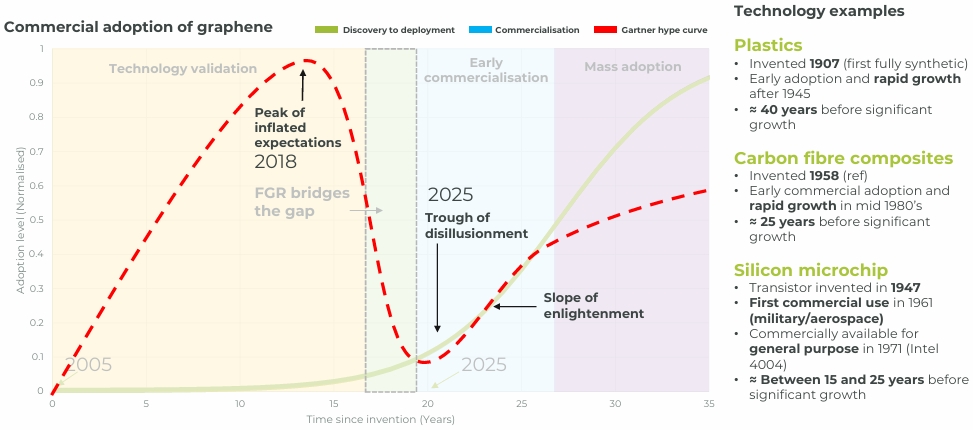
Where graphene is in the hype cycle
The company manufactures its PureGRAPH® products in Western Australia and works with industrial partners to develop commercial applications across multiple sectors. As of November 2025, management estimated its existing customer base, development programs and grant-funded projects supported forecast income of around A$1.5 million, while its broader commercial pipeline exceeded A$10 million over the following 18 to 24 months.
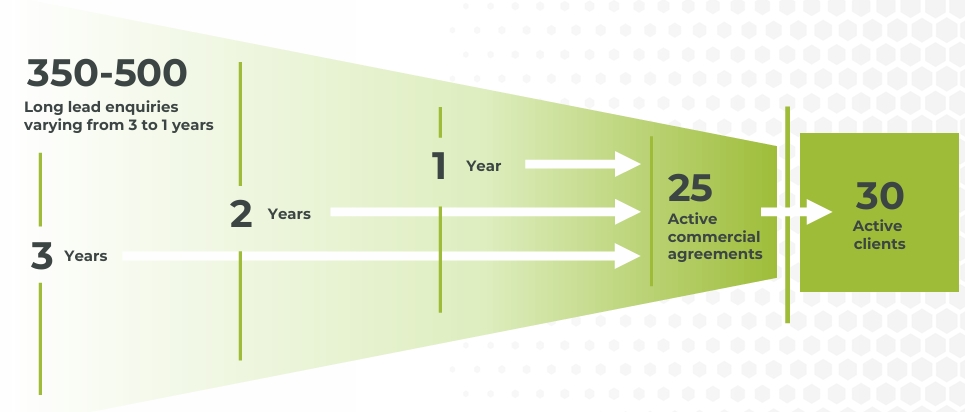
Pipeline of opportunities
Revenue increased 53% in the six months to December 2025, while operating cash outflows continued to trend lower as the company focused on commercial execution.
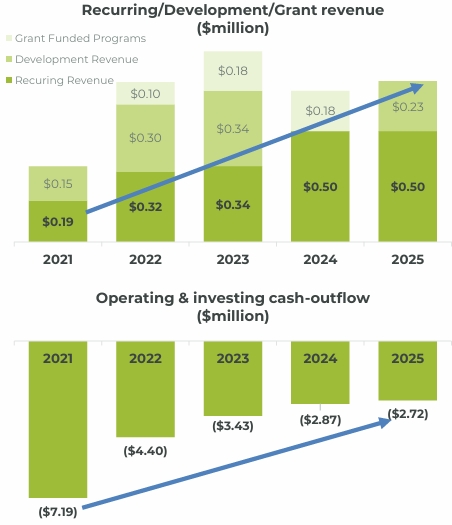
Financial Performance (from November 2025)
Construction's carbon challenge creates a major opportunity
Few industries face greater pressure to decarbonise than cement and concrete.
Cement production is estimated to account for around 8% of global carbon dioxide emissions, making it one of the world's most emissions-intensive industrial processes. At the same time, demand for housing, transport infrastructure and urban development continues to rise.
The challenge is reducing emissions without compromising strength, durability or cost.
First Graphene's additives are designed to reduce cement usage while maintaining or enhancing performance. Even relatively small reductions in cement consumption can have significant environmental benefits when applied across large-scale construction projects.
The company's partnership with UK construction materials producer Breedon Group has become one of its most advanced commercial initiatives.
Breedon recently completed an industrial-scale production run of about 600 tonnes of graphene-enhanced cement at its Hope Cement Works facility, one of the largest commercial production runs of its type globally. The process delivered carbon emission reductions of up to 20% compared with conventional cement while also improving performance characteristics.
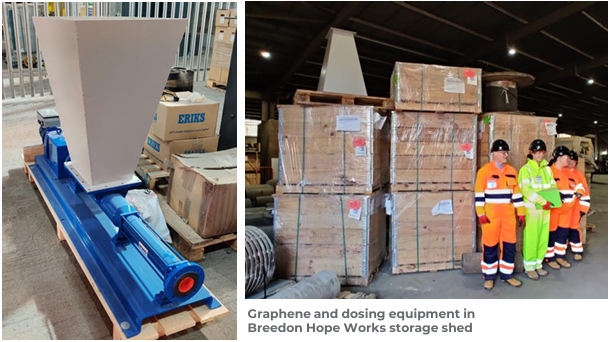
From cement production to finished products
First Graphene's construction strategy is increasingly moving beyond cement production and into finished building materials.
Earlier this year, the company and Breedon partnered with FP McCann, the United Kingdom's largest precast concrete manufacturer, on what it described as a world-first production trial of graphene-enhanced concrete roof tiles.
The five-month project used 40 tonnes of graphene-enhanced cement to manufacture more than 10,000 roof tiles. Testing demonstrated carbon emission reductions of up to 14%, while cement requirements fell by up to 8% without sacrificing performance or durability.
The trial also confirmed that graphene-enhanced CEM-II cement could produce roof tiles with the same strength as traditional CEM-I products while using fewer materials and at lower cost. For an industry under growing pressure to reduce emissions without compromising performance, the result highlights how graphene may help improve both sustainability and economics.
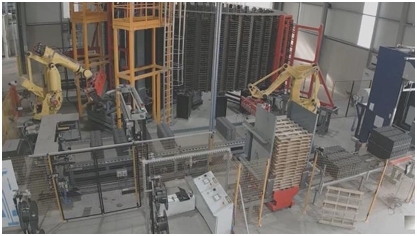
FP McCann’s tile plant at Cadeby
Additional construction-related opportunities are emerging elsewhere. In South Africa, trials involving graphene-enhanced waterproofing additives developed with Glade Chemicals and the University of Stellenbosch delivered a 33.3% improvement in water absorption performance compared with conventional waterproofing products. The technology is already generating recurring commercial orders from local customers.
Beyond concrete: New coatings platform broadens the opportunity
While construction remains a central focus, First Graphene recently expanded its commercial reach through the acquisition of Ionic Industries and Imagine Intelligent Materials.
The A$250,000 transaction provides access to graphene-enabled coatings technologies, intellectual property, production infrastructure and existing customer relationships developed over more than a decade.
Of particular interest are graphene-based coatings for geotextiles used in tailings storage facilities, farm dams, landfill liners and waste containment systems.
The acquisition also broadens First Graphene's exposure to environmental remediation, water treatment, sensing technologies, energy storage and advanced functional coatings, while providing a faster pathway into markets aligned with its existing materials expertise and customer base.
Positioning for the energy transition
Advanced materials are expected to play an increasingly important role in the energy transition, creating another potential market for graphene technologies.
One of First Graphene's highest-profile initiatives is the A$3.72 million HyPStore project, an Australia-UK collaboration focused on hydrogen storage systems.
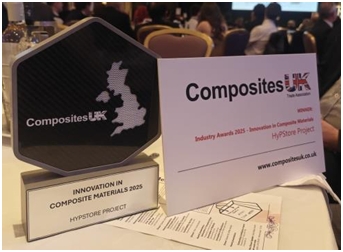
Composites UK award for the HyPStore project
The project, which recently entered its final integration phase, is investigating lightweight composite storage tanks incorporating graphene nanoplatelets to improve impermeability and structural performance.
Previous testing demonstrated reductions in hydrogen permeability of up to 48 times, while graphene-reinforced systems achieved substantial improvements in strength and stiffness under cryogenic conditions.
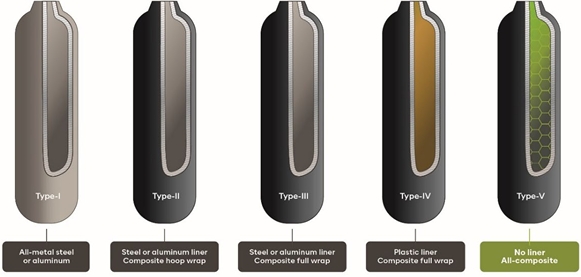
Five common pressure vessel types including the Type-V tank.
Beyond hydrogen, First Graphene holds an exclusive global licence from Halocell Australia covering graphene-enhanced carbon paste for perovskite solar cells, an emerging photovoltaic technology viewed as a potential next-generation alternative to traditional silicon-based panels.
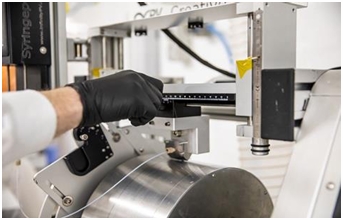
Perovskite solar cell from Halocell Energy
The company is also involved in projects exploring graphene-enabled electrodes, advanced manufacturing technologies and applications in aerospace and defence, highlighting the breadth of markets being targeted.
Building a global commercial footprint
Commercial adoption ultimately depends on access to customers.
Over the past year, First Graphene has expanded its international distribution network, securing agreements across several regions where infrastructure investment and industrial development are driving demand for advanced materials.
Recent agreements with Syron GreenThrust Dynamics have opened pathways into India, the United Arab Emirates and a range of South Asian nations, targeting industries including construction, coatings, energy storage and advanced composites. Under the arrangement, annual PureGRAPH sales are targeted to increase to 20 tonnes by the third year, potentially paving the way for future manufacturing activity in India.
The company has also strengthened its North American strategy through an expanded partnership with distributor SuperGrafeno, extending PureGRAPH distribution into Canada.
The focus initially centres on cement, concrete, bitumen and asphalt applications, where durability and sustainability are key drivers.
These agreements complement First Graphene's broader strategy of building multiple commercial channels across different geographies and industries rather than relying on a handful of large customers.
From promise to proof
The challenge facing First Graphene is ultimately the same one confronting the broader graphene industry: turning technical success into commercial scale.
History suggests that process rarely happens quickly. Many of today's most important industrial materials required years of testing, validation and gradual adoption before becoming mainstream.
What appears to be changing, however, is the growing number of applications moving beyond research programs and into commercial production. Across multiple sectors, graphene is increasingly being evaluated as a practical way to improve material performance while reducing costs or emissions.
First Graphene's strategy is built around supplying those markets rather than betting on a single breakthrough application.
Recent construction trials, international distribution agreements, strategic acquisitions and growing commercial activity suggest the company is steadily expanding its footprint across multiple sectors.
Whether graphene ultimately fulfils the lofty expectations attached to it over the past two decades remains an open question. But as demand for stronger, more sustainable and more efficient materials continues to grow, First Graphene is positioning itself for the possibility that the technology's commercial moment may finally be approaching.