
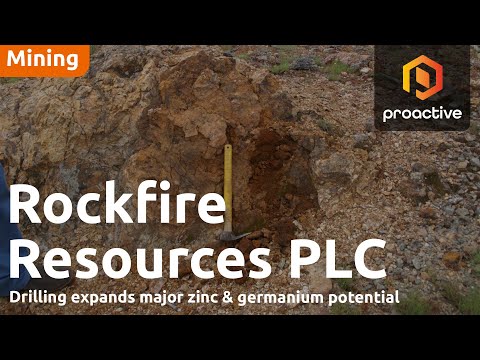
Rockfire Resources PLC (LSE:ROCK) chief executive David Price discusses the growing strategic importance of the company’s Molaoi project in Greece, where zinc, silver and critical mineral germanium sit within the same deposit.
In this Q&A, Price outlines why Europe’s push for secure critical mineral supply chains could elevate the project’s significance, particularly given China’s dominance of the germanium market.
He also covers recent drilling results, resource upgrade plans and the next steps toward feasibility studies.
Proactive: Hello you're watching Proactive, I'm joined by David Price, the chief executive of Rockfire Resources. David, very good to speak with you. For investors new to Rockfire Resources, how would you describe the Molaoi project, and why do you see it as strategically important in today's metals market?
David Price: G'day, Steven, thanks very much for having me on Proactive Investors. Look, Greece, the Molaoi project in Greece, it's a zinc project primarily. The zinc is the main focus. We also have lead and silver and a critical mineral germanium. The focus is shifting a little bit from the zinc and the importance of zinc onto the more critical mineral germanium, which is becoming quite a valuable byproduct at this stage.
Germanium is trading at about US$8.5 million a tonne, so it's a pretty nice byproduct to have there with the zinc. Greece itself is also a very good investment destination. It's not far away from England and you're in a first-world country. Clearly you've got safety aspects of being in Greece. You don't have to worry about personal safety or safety of your staff.
The Greek laws are well tested and well proven. The Greek government has been mining zinc underground for decades now. They're very familiar with mining zinc and underground mining requirements. Greece is also positioned at the continent's critical mineral raw material supply chain. Europe requires these critical minerals and it's a great place for Rockfire to be with germanium there.
Proactive: Is this a European critical mineral story essentially hiding inside a zinc deposit? China controls global germanium supply. Could you be sitting on a strategic source for Europe?
David Price: I think that's exactly right. Zinc is the focus of the deposit, but zinc doesn't sparkle like gold. Zinc is used in everything including galvanizing, cosmetics, lasers, toothpaste, sunscreens, fertilizers and fungicides. The world needs a lot of zinc and you don't get the wild price swings you see with gold.
We've also got 19 million ounces of silver at Molaoi. Then of course there’s germanium. Germanium is used in electronics and semiconductors, where it allows smaller chips with less electronic noise and wider temperature ranges.
It’s also important in driving assistance systems, autonomous vehicles and military applications including infrared systems and missile guidance systems. Not all zinc deposits contain germanium, so that's significant.
We're drilling now to upgrade the resource from inferred to indicated status and when we finish this drilling program we'll come out with a maiden germanium resource. We'll end up with one of only two quoted germanium resources globally.
Proactive: Do you think the market is fully appreciating the germanium you're sitting on? How significant could Molaoi become as a European source of germanium?
David Price: We're hoping it becomes a very big source of germanium for Europe. There aren’t many current germanium operations or sources in Europe and Molaoi could become the only one. As we develop the resource it will become more critical and more important to Europe.
Europe is looking to supply its own raw materials and germanium is one of those strategic materials. Rockfire is in a great position.
Proactive: Your latest drilling from holes 15, 16 and 17 returned strong zinc, silver and germanium mineralisation alongside high PXRF readings. What do these results tell you about the consistency and scale of the system?
David Price: A lot. Earlier in the year we had difficulty drilling through some highly fractured fault zones, which is common in good deposits. We moved the rig south and hit narrow zones of zinc, lead, silver and germanium. Even though the zones were narrow, the grades were very high.
That means even with minimum underground mining widths, the grades could still be economic. Importantly, the germanium remained at high grades even at the extremities of the tenement.
We then moved north and completed holes 15, 16 and 17. Hole 15 returned about 12 metres at 8.8% zinc and around 24 grams per tonne germanium on average, with germanium values up to 74 grams per tonne.
We're very happy with the drilling progress now. We’ll eventually move back and drill the broken ground later. We're also buying our own drill rig, which gives us full control over the drilling program.
Proactive: Looking ahead, what are the key catalysts investors should be watching over the next six to twelve months?
David Price: There’ll be continued drilling results. Next year we're hoping to move into feasibility studies. Some of the long lead-time aspects include ecological and hydrological studies, both of which require 12 months of monitoring.
The ecological study is nearly complete and the hydrological study is ongoing. We've already gathered extensive water monitoring data ready for feasibility work. We've deliberately ensured these long lead-time requirements are well advanced so they don't slow down progress later.
Proactive: What does your cash runway look like as you move toward feasibility studies?
David Price: We raised £3 million in January and the bulk of that is still in the bank account. We're fully funded for our drilling program and for purchasing the rig. At this stage we have absolutely no plans for raising additional funds.
Proactive: Sounds like a very exciting period ahead for the company. I hope you'll continue to keep us updated with your progress.