
Noviqtech Ltd (ASX:NVQ, OTC:NVQLF, FRA:63Q0) subsidiary Coralia has started a field and pyrolysis trial at the company’s flagship Great Barrier Reef Biochar Project in North Queensland.
The trial involves harvesting and chipping invasive Chinese Apple trees before transporting the biomass to Pyrocal’s pyrolysis facility in Toowoomba, where it will be converted into biochar under multiple operating temperatures.
Coralia has selected three areas across high, medium and low infestation densities, based on aerial surveys, local stakeholder engagement and ground observations, to provide representative feedstock samples from across the project area.
The work is designed to assess operational feasibility, feedstock quality, environmental performance and the potential for long-term carbon removal pathways.
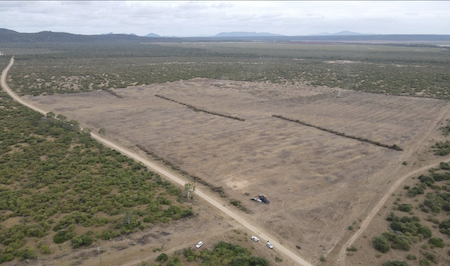
Aerial shot of project site post clearing and preparation of feedstock into windrows.
Trial to test full field-to-biochar value chain
The scope covers the full process from clearing and chipping through to feedstock testing, transport, pyrolysis, biochar analysis, stack testing and carbon accounting.
Operational data will be used to assess machinery productivity, logistics, moisture management, contamination control and the economics of the harvesting-to-pyrolysis value chain.
Biochar produced from the trial will also be supplied to Swinburne University of Technology for low-carbon concrete research, as well as agricultural trials and laboratory analysis.
Coralia is collecting trial data, chain-of-custody records and Life Cycle Assessment inputs to align with Puro.earth methodology requirements, with a preliminary assessment submission targeted for early July 2026.
The company expects feedstock laboratory testing, transport to Pyrocal and pyrolysis trials to begin in early June, with feedstock, biochar and stack test results due by mid-to-late June.
Completion of Puro.earth’s preliminary assessment is expected in August or September 2026, subject to operational, weather and third-party factors.
NoviqTech said the trial was intended to demonstrate whether invasive woody weeds could provide a scalable feedstock for high-integrity biochar carbon dioxide removal while supporting land restoration, biodiversity and agricultural co-benefits in the Great Barrier Reef catchment.