
NewPeak Metals Ltd (ASX:NPM, OTC:NPMFF, FRA:NPM) says its maiden drill program at the Tansey Gold Project in southeast Queensland has confirmed that gold mineralisation extends both below and beyond the historic South Burnett underground mine, while also identifying what appears to be a previously unrecognised parallel structure.
The four-hole diamond drilling campaign, completed earlier this year, returned multiple broad gold intercepts from the shear zone that hosts the historic workings, including:
- 43 metres at 0.75 g/t gold from 157 metres, including 16 metres at 1.41 g/t from 185 metres (SBD003);
- 41 metres at 0.68 g/t gold from 229 metres, including 9 metres at 1.14 g/t and 18 metres at 0.97 g/t (SBD001); and
- 28 metres at 0.56 g/t gold from 107 metres, including 10 metres at 0.81 g/t (SBD004).
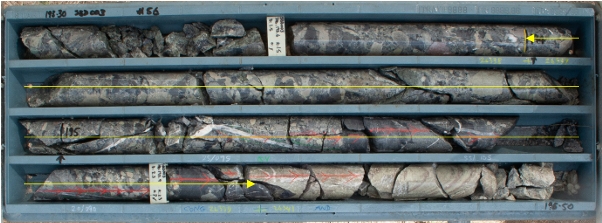
SBD003 core example. Yellow arrow indicates section between 194-196m which yielded 3.12 g/t Au.
NewPeak managing director Mark Purcell said the program had achieved its primary objective of demonstrating that mineralisation extends beyond the areas historically mined at South Burnett.
“We now know mineralisation at the historic South Burnett Mine extends beyond existing underground mine workings both along strike and down-dip on the shear zone,” Purcell said. “Brushing the top of what appears to be a parallel structure to the known shear zone was a welcome bonus and provides even more potential.”

The Tansey project, located about 60 kilometres west-northwest of Gympie, hosts several historic gold workings, including the South Burnett Mine, which operated between 1934 and 1942. Historical mining reached depths of around 80 metres before operations ceased due to wartime labour shortages, low recoveries and funding constraints.
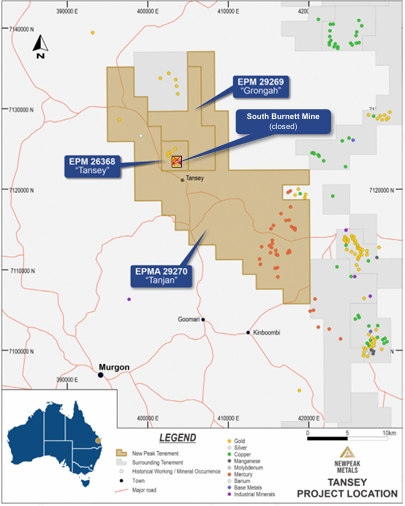
Tansey location, showing published metalliferous occurrences.
Extension of historic mineralisation
NewPeak drilled four diamond holes for a combined 1,179 metres between January and February this year, targeting extensions of the historic mineralised system adjacent to and beneath the old underground workings.
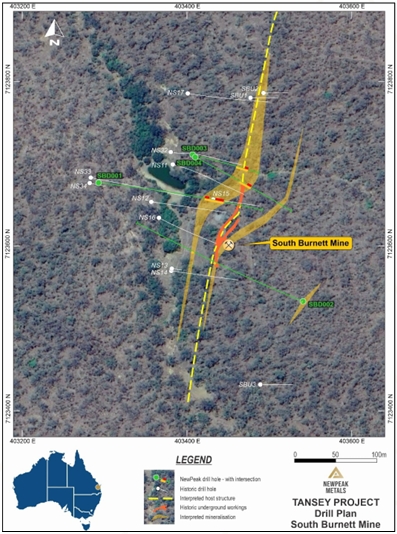
Plan of all drillholes near South Burnett Mine, Tansey.
Hole SBD001 was drilled beneath the historic workings and intersected the target shear zone about 90 metres down-dip from the old mine. The company said the shear appeared to split into multiple zones at depth, with mineralisation hosted in sheared and brecciated trachyte dyke material containing quartz-carbonate veinlets.
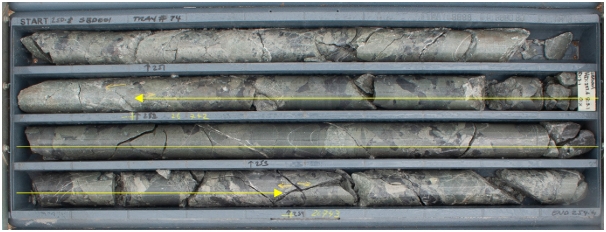
SBD001 core example. Yellow arrow indicates section between 252-254m which yielded 2.43g/t Au.
Meanwhile, SBD003 tested the northern extension of the system and intersected mineralisation about 30 metres north and 75 metres beneath the historic workings, returning the best overall intercept of the program. The strongest interval within the hole returned 3.12 g/t gold over two metres from 194 metres.
SBD004, drilled beneath the northern end of the workings, also intersected the main shear zone and returned an additional intercept from a secondary structure deeper in the hole, grading 3.1 metres at 1.1 g/t gold from 202 metres.
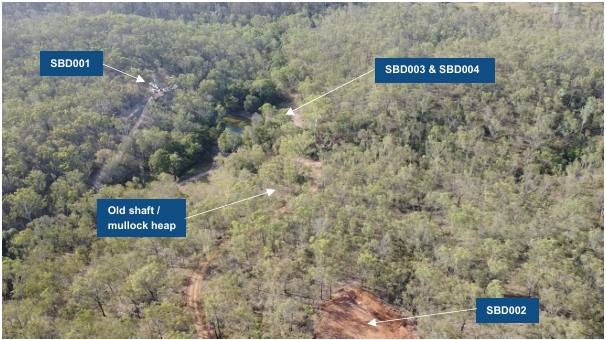
Aerial view of drillhole locations, looking north.
Parallel structure opens additional targets
One of the more significant outcomes from the program came from hole SBD002, which was redesigned during drilling as a scissor hole to test a potential parallel structure on the footwall side of the main shear zone.
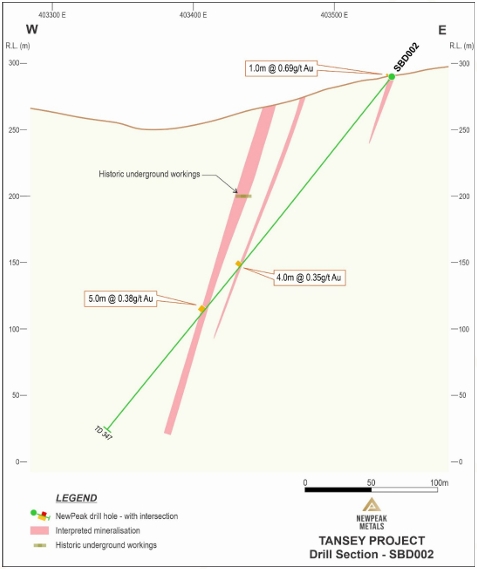
Cross-section of SBD002, showing highlighted intersections relative to an interpreted mineralised lode.
The hole intercepted a shallow mineralised structure immediately from surface, returning 1 metre at 0.69 g/t gold from 0.6 metres, alongside deeper mineralisation associated with the interpreted parallel structure.
NewPeak said the result supports the possibility of additional mineralised structures outside the historically mined shear zone and could point to higher-grade potential at depth in unoxidised rock.
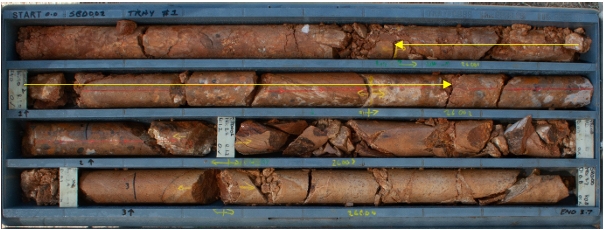
SBD002 core example. Yellow arrow indicates section between 0.6-1.6m which yielded 0.69g/t Au.
The company now plans to integrate the new drilling data with historic geochemistry, geophysics and geological datasets to identify additional structural “trap” targets both near the South Burnett Mine and across its broader Tansey tenement package.
Focus remains on Argentina drilling
While NewPeak said the results had materially improved its understanding of the Tansey system and supported follow-up resource-focused RC drilling, the company does not expect to resume onsite work in Queensland until after its current campaign at the Las Opeñas gold project in Argentina concludes later this year.
Future work at Tansey is expected to focus on tracing the shear zone back towards surface, extending drilling along strike and testing for deeper mineralisation beneath the historic workings.