
- FTSE 100 up 13 points at 10,505
- Asian and US tech stocks drive new global markets to all-time highs
- Energy prices and govt bonds ease on Iran optimism
- UK energy price cap to rise 13% to two-year high
5.12pm: London stocks edge higher
The FTSE 100 added 13 points to finish Wednesday’s session at 10,505, as oil dropped to a five week low on hopes the Strait of Hormuz will reopen. Crude oil was down about 4% at about $90 per barrel.
“Reports that a potential US-Iran agreement could reopen Strait of Hormuz shipping eased fears of major energy disruption, offering relief to markets and central banks, though investors remain cautious pending concrete details,” IG chief technical analyst Axel Rudolph said.
4.10pm: Consumer gainers offset by oil and utilities falls
The FTSE 100 is just staying marginally above water as we head to the close, with gains for consumer facing stocks offset by losses for the index's heavyweight sectors such as mining, oil and utilities.
Topping the leaderboard are JD Sports, jumping 6.4%, and Burberry, gaining 3.8%.
Marks & Spencer also rose strongly on the back of grocery data earlier.
Drinks and consumer goods groups are doing well too, including Diageo, Reckitt, Unilever and AB Foods.
Travel and aerospace stocks were also firmer as optimism grows for a US-Iran deal, with British Airways owner IAG, InterContinental Hotels and Rolls-Royce up around 3.1-2.7%.
On the downside, leading the declines are Tesco, BP, Centrica, Shell and BP.
Other utilities, finacials and mining companies are in the red too.
3.23pm: BP chair a big loss, IQE in demand, Diageo taking responsibilty
BP's sacking of chairman Albert Manifold adds another layer of uncertainty to the oil major’s investment case, analysts at Citi say.
However, the US investment bank believes valuation may still provide a floor for investors willing to look through the turbulence.
The departure of Manifold, which the BBC reported was due to concerns including "bullying" and "overbearing" behaviour, will be a loss, Citi says, as many investors had begun re-engaging with BP after several years of turmoil because of his role in driving change.
Manifold issued a statement to the media yesterday, saying: "I dispute entirely the characterisation of my conduct and I will not allow a false narrative to go unchallenged" and added that he was "removed without warning and without explanation".
Elsewhere, Deutsche Bank has restarted coverage of IQE with a 'buy' for the Cardiff-based compound semiconductor wafer manufacturer.
Analyst John Karidis says the company is benefiting from very strong demand across several end markets, citing booming conditions in data centres and AI cloud infrastructure, military and defence, and satellite communications.
And RBC Capital Markets has raised a toast to signs of Diageo management taking firmer control of its underperforming brand portfolio.
Analysts have set a 2,000p price target for the beer and spirits giant, implying meaningful upside from current levels around 1,600p.
RBC points to early evidence of a broader commercial reset under new chief executive Dave Lewis, including a long-overdue acceptance of Diageo's responsibilities as a category leader, rather than simply “controlling the controllables”.
2.47pm: Dow opens higher but Nasdaq retreats
US stocks have opened mixed, with the Dow Jones opening up 0.2%, while the Nasdaq hit a new high in the first minute it subsequently fell 0.2% and S&P 500 slipped 0.06%.
As that suggests, technology stocks led the fallers, with the Nasdaq 100's biggest drops coming from cybersecurity groups Zscaler, CrowdStrike and Palo Alto Networks, coming under pressure alongside AI-linked names including Palantir and Strategy.
Nvidia slipped 1.7% as investors took profits across the semiconductor sector, while Qualcomm and Intel also traded lower.
2.26pm: Oil dips as details emerge of possible Iran deal
Brent crude oil dropped below $95 a barrel for a few minutes after Iranian state media reported details of an unofficial draft peace framework with the US.
Markets feel like they have heard this before, but the price of oil has inched back up to $95.65, as details emerged.
The deal would see commercial shipping through the Strait of Hormuz restored to pre-war levels within 30 days.
Under the reported 'Islamabad framework' proposals, the US would lift its naval blockade on Iranian ports and withdraw military forces from the vicinity of Iran, while Tehran and Oman would jointly oversee shipping through the strategic waterway.
The Mizan news agency said any final agreement reached within two months could eventually be endorsed through a UN Security Council resolution.
Neither Washington nor Tehran has officially commented on the reports, though the developments come ahead of a cabinet meeting between Donald Trump.
Separately, Iran’s Revolutionary Guards navy says 23 vessels had passed through the Strait under its supervision over the past 24 hours, signalling some easing in shipping restrictions after weeks of disruption that sent oil prices sharply higher.
1.50pm: Imps buys US smokeless tobacco brand
Imperial Brands shares have turned from red to green after the tobacco group strengthened in the fast-growing US 'oral nicotine' market by snapping up a brand called Black Buffalo for an initial $150 million.
Based in North Carolina, Black Buffalo makes tobacco-free alternatives to traditional smokeless tobacco products.
"They closely replicate the taste, ritual, and branding of traditional products to emulate the experience of MST without tobacco leaf or stem."
The FTSE 100 group said the new addition will complement its existing Zone nicotine pouch brand.
1.09pm: Korea 'a tide that lifts most boats' for luxury sector
Burberry and JD Sports are top risers on the Footsie.
The former has received a boost by a note from JPMorgan, while the latter seems to be joining a wider sportswear rally in Europe.
JPMorgan analyst Chiara Battistini says booming wealth creation and tourism spending in South Korea, where the country has emerged as one of the brightest spots for luxury goods companies, helped by rising consumer confidence, surging semiconductor-linked wealth and growing tourist demand.
The country’s exposure for luxury groups was now larger on average than the Middle East and argued the market could become “a tide that lifts most boats” across the sector.
12.17pm: Iran says negotiations continue
There are solid gains for European stock markets in early afternoon trading, though oil prices have crept higher in the past couple of hours following comments from Iran.
No agreement has yet been reached with the US over the future of the Strait of Hormuz, despite ongoing indirect talks through Oman.
"Iran and Oman, as adjacent coastal states, are negotiating together to determine a new mechanism for passage through the strait of Hormuz," a spokesman for Iran’s national security council told reporters at at Moscow security conference.
Tehran's stockpile of highly enriched uranium was "not on the agenda of the negotiations" with Washington, the spokesman added, contradicting recent comments by Donald Trump that the material would be handed over to the US for destruction.
Separately, a senior official of Islamic Revolutionary Guard Corps said the "likelihood of war is low" with the US.
US stock futures are up, with the tech-heavy Nasdaq again set to forge furthest ahead, up 0.6%, while futures for the Dow Jones and S&P 500 are both up around 0.35%.
11.52am: Grocery growth
We've had monthly grocery market data from Worldpanel (the former Kantar) and NIQ (formerly known as Nielsen).
Grocery inflation eased, according to Worldpanel, who said the grey skies of early May dampened sales of summer essentials, flagging that inflation slipped to 3.1% from 3.8%.
Overall take-home grocery sales growth was 1.5% in the past four weeks, up from 0.9% in the previous period. Over 12 weeks, sales were up 2.3%.
Ocado and Lidl were the fastest growing grocers again, with sales up by 10.2% and 8.8% over 12 weeks, while Tesco saw 3.2% growth and Sainsbury’s 3.1%. Aldi saw only 0.6% growth and Morrisons 1.3%, while Asda was down 3.0%. M&S food sales were calculated at 9.3%.
NIQ saw monthly top-line sales growth pick up to 4.2% from -0.2% for pretty much the same period.
Mike Watkins, NIQ’s head of retail and business insight, noted that “After weak growth in the first two weeks of May, sales are no doubt going to pick up again as a result of the current heatwave and a sustained period of warm and sunny weather should now maintain this momentum through June.”
11.11am: Easing bonds helps shares
Europe's major share indices and US stock futures are all higher, thanks to a mix in demand for the tech sector and fall in oil prices.
Oil prices are down over 3% today, though no deal has yet been announced between the US and Iran to end the conflict, with Brent crude back below $97 per barrel, down from $105 a week ago.
"The UK 10-year yield is lower by 4bps today and is down by a whopping 34bps since the 10-year yield peaked on 18th May at 5.17%," says market analyst Kathleen Brooks at XTB.
"There is a clear link between the oil price and UK yields, so when the price of oil dips it drags the yield lower with it."
She says it is "ironic" on a day when the household energy price cap is set to rise by 13% in July to the highest level in more than two years.
Brooks says bond yields are not responding to this news for several reasons, including that the price cap is not rising as fast as it was in 2022, due to the increased use of renewable energy in the UK.
"Secondly, if there is a peace deal in the coming days, that includes reopening the Strait of Hormuz, then energy prices could fall further, which could limit further upside on energy bills in future.
"Added to this, although the rising price cap will put upward pressure on inflation, the second-round effects are likely to be minimal, since the UK economy is showing signs of weakness and the unemployment rate is rising."
UK gilts are attracting interest, "helped by a softer tone on fiscal rules and tax rises from Labour leadership hopeful, Andy Burnham, which has slightly reduced the political risk premium added to UK debt", says Brooks, as well as Tony Blair's warning to the Labour party to avoid a lurch to the left.
Looking ahead, Brooks say the market "will be looking for more news from the Middle East to sustain the positive risk sentiment."
10.19am: Risers and fallers
Some more movers.
Cohort has been fired 13.3% higher after the defence sector supplier said annual revenue and profit would come in ahead of market expectations following strong order intake and record backlog growth.
Order intake rose to about £313 million from £284 million a year earlier, exceeding annual revenue for the second consecutive year and lifting the closing order book to a record £620 million.
Hardide is up more than 14% after the surface coating technology group said a major North American energy customer had placed a £2.4 million order covering the rest of the company’s 2026 financial year requirements.
The AIM-listed company said the contract was larger than previously expected and would “materially” improve revenue and financial performance expectations for the year ending 30 September 2026.
Pets at Home fell 4% initially but is now up over 5%, as the pets and vets chain reported results in line with recent guidance and an acceleration in sales growth in the new financial year, as well as rejigging its shareholder returns policy.
A "rebased" shareholder returns policy sees the dividend cut to 7.4p from 13p, with an increasing emphasis on share buybacks, starting with a £50 million programme over the next 12 months.
Nanoco Group, the nanomaterials technology company, plunged 41% after announcing plans to cancel its listing on the main market of the London Stock Exchange and re-register as a private company.
9.31am: Hollywood Bowl tops risers
Hollywood Bowl is the top FTSE 350 riser, up over 11%.
Analyst Douglas Jack at Peel Hunt says this reflects the 10-pin bowling company making a "big step in expansion" in the first-half and announcing a £5 million share buyback.
Three openings are expected in the second half, one in Canada and two in the UK, before three to four more in the UK next year, and five openings in Canada.
"We maintain our forecasts," says Jack. "Our FY26E forecasts, which are close to consensus, assume 2% LFL sales growth and a slight decline in margins."
Second-half weather comparatives "are soft", he adds, "but a material re-rating may need higher sustainable LFL sales growth."
9.12am: FTSE lags rivals as world index hits sixth record in a row
The FTSE 100 is down 15 points to 10,476 after just over an hour's trading.
London is lagging its mainland European peers, with the DAX and IBEX are up 0.6% in Frankfurt and Madrid, with the pan-European Stoxx 600 up 0.3%.
Dulux paint maker AkzoNobel is top of the risers, up 15.5% after the Dutch group rejected a joint takeover offer from Nippon Paint and Sherwin-Williams.
Consumer-facing clothing and fashion stocks were also strong, with gains for JD Sports, Puma, Moncler and Puig Brands.
Carmakers featured prominently too, with Renault, Stellantis and auto parts supplier Valeo all revving up.
Earlier the MSCI Asia climbed 1.1% to an all-time peak, while the MSCI All Country World Index has reached a record high for a sixth consecutive session.
"Global equities are still in melt-up mode as AI enthusiasm and easing geopolitical risk overpower lingering macro concerns," says market analyst Patrick Munnelly at Tickmill.
Korea remains the standout, he says, with the Kospi index now up an "extraordinary" 100% this year, making it the world’s best-performing major index, helped by SK Hynix rocketing more than 1,000% over 12 months to become only the third Asian company to cross a $1 trillion market cap, as US-based Micron did last night too.
"Oil is helping the risk-on tone," he says, with Brent crude futures down 2.6% to just over $97 a barrel.
This is "on optimism that the US and Iran may finalise a peace agreement, reducing the immediate inflation scare from the Strait of Hormuz disruption", he says.
Government bonds are also in demand, sending yields lower, with the US dollar softer against most G10 currencies another sign of markets dialling down geopolitical risk a tad.
The New Zealand dollar is the exception, after the country's central bank signalled that rates may need to rise.
8.29am: Bonds in the background
UK government bond yields - aka government borrowing costs - have dropped this morning, which is part of the reason why bond-like stocks like utilities are down.
Look at this chart of 2-year, 10-yr, 20-yr and 30yr gilt yields - all down today to what is the lowest in over a month.
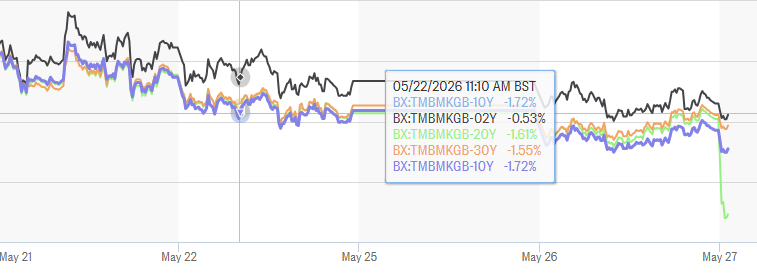
Could this be linked to an open letter from former PM Tony Blair?
The 5,700-word essay from Blair’s eponymous institute is a scathing critique of Labour’s direction, arguing the party lacks a coherent governing plan rather than suffering from Keir Starmer’s leadership style.
Blair attacks flagship policies on net zero, tax and workers’ rights while warning Labour risks “playing with fire” by drifting left.
The intervention has fuelled speculation over whether Blair is positioning Wes Streeting as the preferred standard bearer of Labour’s modernising wing.
Bloomberg says bon yields are retreating on "Iran optimism", with US Treasury yields and others also dropping.
8.15am: FTSE starts with handbrake on
The FTSE 100 has started with the handbrake on, down just over three points at 10,488, as selling slightly outweighs buying.
Melrose Industries is leading the fallers again, down 2.8%, despite fire authorities in California lifting all evacuation orders last night, saying there is no longer a threat of explosion, fire or chemical leak for the damaged tank at the GKN Aerospace facility in Orange County.
Energy companies Centrica, SSE and Shell are next, down 2.2%, 1.5% and 1.4%, followed by Glencore.
Other utilities are down too, with National Grid, Airtel Africa, Severn Trest, BT Group and United Utilities down around 1.1-0.7%.
Grocers Tesco and Sainsbury's have fallen as well, along with other defensive stocks such as tobacco giant BAT.
7.59am: Pets cuts dividend but launches buyback
Pets at Home Group has reported an acceleration in sales growth at its shops in the first weeks of its new financial year, as the pet care retailer backed market profit expectations for 2027 and rejigged its shareholder returns policy.
A "rebased" shareholder returns policy sees the dividend cut to 7.4p from 13p, with an increasing emphasis on share buybacks, starting with a £50 million programme over the next 12 months.
The FTSE 250-listed group said it was comfortable with analyst consensus forecasts for flat underlying pre-tax profit of £98 million for the 2027 financial year, roughly flat on last year, after reporting annual results largely in line with its most recent guidance.
7.34am: Energy price cap to bounce back
The UK energy price cap will rise by 13% from July to a two-year high after higher wholesale gas prices pushed up supplier costs.
Regulator Ofgem said the increase for the three months until September reflected volatility and higher wholesale prices in global gas markets stemming from the US and Israel's war on Iran.
The price cap, which applies to default tariffs, will increase annual bills for a typical household from £1,641 up to £1,663 under updated consumption assumptions.
Households on fixed tariffs, around 40% of customer accounts or roughly 22 million households, will not be affected by the increase.
The Ofgem energy cap for the previous April-June quarter dropped 7% for the average dual-fuel household. This reduction was primarily driven by government Autumn Budget decisions to remove specific policy costs from household bills, despite an increase to cover network upgrades.
Market pre-open:
The FTSE 100 is seen starting in a low gear at the open, with oil prices hovering just below $100 a barrel as markets cross their fingers over US-Iran negotiations.
On the futures market, a fall of around 5 points is predicted for the London index, while larger gains of around 70 and 30 are expected for mainland European peers in Frankfurt and Paris.
The previous day, the FTSE was the only European benchmark to close in green, finishing up 25 points at 10,491.39, with its early efforts to catch up on the large gains on the Continent from Monday petering out by the end of the day.
On Wall Street overnight, trading was uneven, as the Dow Jones dipped 0.2% but the Nasdaq jumped 1.2% and the S&P 500 0.6% to a new all-time high, a large part due to a 19% surge for memory chip maker Micron Technology.
Asian markets are mixed this morning, with Korea's Kospi up 3.7% and Japan’s Nikkei 225 rising 0.4%, both hitting record highs, while Hong Kong’s Hang Seng and China’s Shanghai Composite dropped 1.1% and 1.3%.
"It looks like geopolitical tensions are no longer bothering investors as much as they did in previous weeks," says market analyst Ipek Ozkardeskaya at Swissquote.
"Iran’s explicit dissatisfaction regarding the progress in talks over its nuclear program – or even US strikes – didn’t reverse hopes that the war will end soon."