
- FTSE 100 up 102 points at 10,432
- UK inflation eases to 2.8% in April
- M&S, British Land, Experian, Severn Trent report results
5.30pm: Winning day
London stocks finished Wednesday’s session higher, driven by retreating yields and crude oil prices, with the FTSE 100 up 102 points at 10,432.
Across the Atlantic, the Nasdaq was up 1.2%, the Dow Jones added 1% and the S&P 500 was up 0.8%.
“After several days of slipping, US stock markets turned their fortunes around ahead of Nvidia earnings,” IG's Rudolph said. “WTI slid back to the $100 per barrel mark, nearly 5% lower than this week's high."
4.10pm: FTSE comeback
As Manchester City were unable to do, the FTSE 100 has come back from behind and is on course for a winning day, up 0.7%.
Retreating bond yields have helped reverse the earlier declines across London and mainland European benchmarks.
Stronger gains are seen across the Channel, with Germany's DAX up 1%, France's CAC 1.4% and the Euro Stoxx 600 up 1.6%.
Easing of the UK gilt yield to just below 5% has been seen for the first time in four days.
Nvidia earnings are at the front of the market's thoughts, but that's not until after the closing bell in New York.
Axel Rudolph, technical analyst at IG, says stocks are up as "yields retreated and the price of crude dropped by over 3% on hopes of progress being made in the Middle East".
Leading gains in London are Marks & Spencer (up 6.5% on results), Rolls-Royce (4.25% on airline hopes), Weir (4.1% on broker backing).
Fueling the moves in yields and oil was an unconfirmed tweet from Saudi state-owned Al Hadath, alluding to a text agreement between Washington and Tehran.
Confirmation is key, but one headline suggested "work is underway in earnest to put the finishing touches on the text of an agreement between Washington and Tehran".
3.31pm: 22 years ago
This year will be one to remember for many reasons - for investors, maybe it will be the looming IPOs of SpaceX and OpenAI that are set to be the largest of all time.
Some 22 years ago (yes, the last time Arsenal won the league before this week), Google was preparing for its blockbuster IPO, which when completed in the summer of 2004 valued the company at about $23 billion.
At the time, plenty of investors thought that sounded excessive. SpaceX, meanwhile, is said to be preparing to list on the Nasdaq on 12 June at a target valuation of $1.75 trillion.
Elsewhere, in a Harvard dorm room, Facebook had just been launched (its IPO was not until 2012, at $104 billion).
Oil prices you ask? "Oil prices hit a 13-year high this week amid tight supplies and ongoing trouble in the Middle East," is an actual WSJ headline from 2004, as prices "soared".
The price was under $40 a barrel at the time, but up from around $30 at the start of the year, considered alarmingly high back then.
The FTSE 100 was trading around the 4,300-4,500 level as markets recovered from the dotcom crash and early-2000s recession.
Britain was deep into the consumer-credit and housing boom years, banks were on the rise, three years before the credit crunch and global financial crisis.
M&S was in the news in May 2004, fighting off a takeover attempt from Philip Green's Arcadia. Green lost but Marks brought in Arcadia's Stuart Rose later that year to help defend the company and lead a turnaround.
And in football finance, Roman Abramovich’s takeover of Chelsea the year before was beginning to reshape spending across the Premier League, leading to Arsenal vice-chair David Dein's famous quote that the Russian "has parked his tanks on our lawn and is firing £50 notes at us".
2.51pm: Wall Street opens higher
US stocks have opened on the front foot, as chipmakers and AI-linked stocks resumed their climb ahead of Nvidia’s earnings tonight.
The Nasdaq is up 0.6%, with the S&P 500 rising 0.4% and the Dow Jones 0.1%.
ARM Holdings is leading the Nasdaq 100 higher with an 8.8% jump, followed by Marvell Technology, up 7.2%, and Intel, which gained 5.4% as investors rotated back into semiconductor stocks.
Constellation Energy, Advanced Micro Devices and Lam Research were also among the strongest risers, along with ASML, Applied Materials and Micron as part of the AI infrastructure theme.
There are still signs of caution underneath the rally, with several heavyweight Dow components remaining under pressure: Salesforce, American Express, IBM, Home Depot, Walmart and Microsoft were all down at least 1%.
2.05pm: Ukraine backs UK oil sanctions
Vladyslav Vlasiuk, Ukrain’s commissioner for sanctions policy, has backed the UK's measures, saying they "overall significantly tighten restrictions".
Earlier, the adviser to president Volodymyr Zelenskyy, earlier posted on X saying Ukraine understands the rationale behind the UK’s decision but "disagree with the approach".
But he then deleted that post and posted a new one where he clarified things, saying the measures will reduce levels of Russian LNG, refined oil products and uranium, but that temporary exemptions as part of the phasing process allow Russia to generate some revenue.
To be clear, the UK has not lifted sanctions on Russian energy. The new measures overall significantly tighten restrictions, including on Russian LNG, refined oil products and uranium. Our concern relates specifically to temporary exemptions that may still generate additional…
— Vladyslav Vlasiuk ???????????????? (@vladvlas) May 20, 2026
1.43pm: Changes to Russian oil sanctions
Westminster is bubbling with talk of changes to sanctions on Russian oil, after some newspapers suggested that these were bring watered down.
PM Keir Starmer told the Commons that existing oil sanctions on Russia remain in place, but tougher measures are being phased-in, the same as they were under the previous government.
"Let me address the sanctions head on, because we have been united across this house on these issues since the beginning of the conflict.
"What we announced yesterday was a strong new package of new sanctions going well beyond existing sanctions, so it is a new package. This includes new bans on maritime services on LNG and new bans on refined oil products from Russia.
"We also issued two targeted short-term licenses to phase the new sanctions in and to protect UK consumers. That is standard practice.
"This government has phased in sanctions in this way before and the last government used exactly the same technique when they introduced sanctions. And when they did so, we supported them because we could see the sanctions were the right thing to do to bear down on Russia.
"So, these are new sanctions being phased in. This is not a question of lifting existing sanctions in any way whatsoever, and we will continue to work with our allies on further sanction packages."
Trade minister Chris Bryant said: "I want to make it absolutely clear that our sanctions regime today is tougher than it was yesterday or last week."
The 2026 statutory instrument will "for the first time, ban the import not only of uranium but also the import of Russian oil products processed in a third country.
"We are not lifting any existing sanctions at all," he stressed, and added that, like other countries, these are being phased in.
This phasing "is why, in the light of the situation in the Middle East, we have issued a targeted temporary licence to allow the continued import of diesel and jet fuel. These licences are temporary and targeted.
"We will review them regularly and repeatedly and will suspend them as soon as we possibly can.
"As a result of all of the measures that we have taken, and there will be less Russian oil on the market, not more. Russia will be poorer."
12.59pm: Grocery analyst not a fan of Treasury food plan
On the stories that the Treasury is asking major UK supermarkets to limit prices on some basic items, Shore Capital analyst Clive Black says they are "perplexing to say the least".
This is a "watered-down me-too version" of a SNP manifesto plan mooted earlier in the week.
"Whilst the UK Government is on the ropes electorally, it appears to be losing its mind in an orgy of neo-Soviet policy ideas, seemingly popular with elements of the electorate in Camden, but also displaying extensive naivety, ideology, and, it must be said, stupidity, that will ultimately only further deflect capital from the UK," says Black.
"Meanwhile, the hypocrisy of one of the biggest sources of UK food inflation, The Treasury, asking for voluntary price cuts is flabbergasting whilst anti-trust regulators and lawyers will be licking their lips; true madness! It is time to actually adopt a proper UK food policy that increases security of supply and feeds economic growth. Ugh!"
12.21pm: FTSE deadlocked, US futures for the win?
London stocks are in deadlock, but US futures are attempting a counter-attack after the previous day's sell-off.>
The Nasdaq is leading the line, ahead of tonight’s big-game Nvidia results, with futures jumping 0.6%.
Dow Jones futures are up 82 points, or 0.2%, while those for the S&P 500 have gained 0.3%.
Underneath the more sanguine mood, market watchers warn markets are still trying to defend lofty valuations against rising bond yields, higher oil prices and growing geopolitical tension.
ADM strategist Marc Ostwald said markets were juggling an unusually crowded fixture list, ranging from Middle East tensions and US-China diplomacy to Indonesian rate hikes, UK inflation data and the prospect of strikes at Samsung Electronics.
He adds: "While the Nvidia results offers some context to AI euphoria, there is a gradual realization that the rise in bond yields due to energy price pressures and major supply chain disruptions will make the colossal debt binge by AI hyperscalers all the more challenging (given the risk of project cost blowouts), along with a more sanguine consideration of what the huge investments in AI will actually deliver in terms of ROI, cost savings, efficiencies and innovations."
Daniele Hathorn at Capital.com says markets are showing signs of “2000-style equity optimism alongside 2007-style bond market stress”, with US equities near record highs.
11.40am: Supermarkets hit by grocery price limiting proposals
Shares in supermarkets Tesco and Sainsbury have dropped on reports that the government is urging retailers to voluntarily limit prices on staple groceries in return for an easing of regulations.
Echoing a recent SNP proposal (which was dismissed as "hare-brained" by Shore Cap analyst Clive Black yesterday), HM Treasury is said to have asked supermarkets to freeze price rises on key products such as eggs, bread and milk, offering in return an easing of packaging policies and a potential delay to rule changes around healthy food.
The BRC said the proposals would "force retailers to sell goods at a loss," with one unnamed retailer describing the idea as "crazy" and the act of a "desperate" government.
Some other movers from down the divisions too.
Shoe Zone, who I'm not sure sell football boots, surged 29% after chairman Charles Smith and Anthony Smith bought nearly 2.76 million shares between them at 50p each, spending a combined £1.38 million.
Shares in S&U, the specialist motor and property finance group, jumped 11% after a trading update showed first-quarter performance running ahead of budget despite a difficult macroeconomic backdrop. Rae Maile at Peel Hunt notes the estimated dividend yield of 6.2% on a well-covered payout added further attraction to the investment case.
11.11am: FTSE gunning higher
The FTSE has fought back from a deficit to a small lead.
Top of the leaders is now M&S, up 4.3% as investors seem to be more bullish than some analysts.
Babcock International, Polar Capital Technology Trust, plus copper and precious metals miners, and water companies, led by Severn Trent.
Not enough analysts are alluding to Arsenal's first league title in 22 years for this correspondent's liking (out to any financial comms teams reading - this will almost guarantee coverage today).
Thankfully, the FT has covered the news, proving it to be a legitimate financial story.
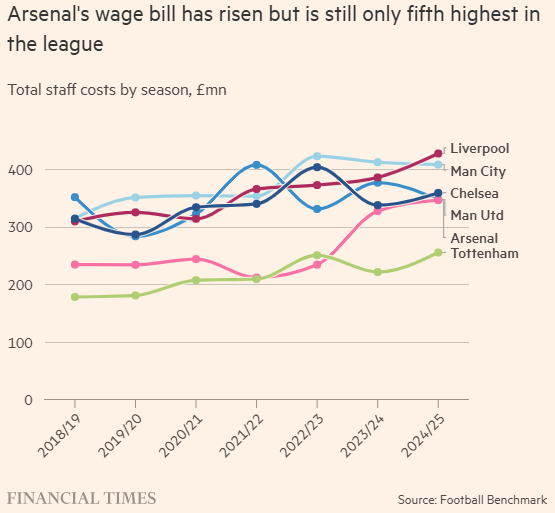
In suitable City-page fashion, the Pink Un's angle was less about the Gunners' glorious defending and more about the balance sheet behind the silverware, highlighting Arsenal’s €773 million net transfer spend over five years, a wage bill that reached £347 million last season and record revenues of £690 million.
It also noted that US owners, the Kroenke family, have seen growing success with their sports empire, now estimated to be worth more than $18 billion. There's a good chart on wages being lower than big rivals.
Elsewhere, today's inflation should be celebrated, says independent financial adviser Riz Malik at R3 Wealth.
The CPI news "would have been welcomed" more before the Iran war. "The saving grace is that it may give the Bank of England the reassurance to sit on their hands and not make the situation even worse for households and businesses across the country.
"For that reason," Malik says, "it could be time to join Arsenal fans and celebrate."
10.40am: House prices soften
UK official house price data was unchanged year-over-year in March, down from a 1.7% gain in February.
Growth in February was revised up from 1.2% previously.
In seasonally adjusted terms, prices fell by 0.2% month-to-month in March, down from a 0.9% gain in February.
February's rise was revised up from 0.6% before.
The ONS’ official house price index stagnating on a year-over-year basis was the worst reading since April 2024.
"Granted, base effects from a particularly weak April 2025 reading will mean that annual house price inflation will rebound when the next batch of data comes through, but the lag with which the ONS’ data operates means that the full weight of the latest energy price shock has yet to filter through to the official data," says Elliott Jordan-Doak at Pantheon Macroeconomics.
"Accordingly, we continue to think that house price inflation will remain subdued in the coming months, and retain our call for house prices to gain just 1.0% in Q4 this year."
10.16am: Market backdrop
With stocks slipping back in Europe and Asia this morning, and the US overnight, a broad selloff in bond markets is to blame, says market analyst Neil Wilson at Saxo.
With yields on longer-dated government paper at multi-year and multi-decade highs, can stock market darling Nvidia save the day, he wonders.
"My bet is the bond market is more intimidating to risk assets in the near-term," Wilson says, "with flow-driven selling likely to see further pullback for US equities, while the direction of travel in Hormuz still seems broadly encouraging for European equities."
The US 30yr bond yield touched 5.19%, its highest level in 19 years, while the benchmark 10yr yield rose to a one-year high at 4.687%.
"It comes amid rising inflation fears from the ongoing closure of the Strait of Hormuz on top of underlying fiscal worries about rising debt and deficit levels, Big Beautiful Tax Bill, tariff uncertainty."
HSBC says yields at these levels are in the "danger zone", but Wilson says in the US at least it’s against the backdrop of a resilient economy, robust labour market and rising corporate earnings, with President Trump now saying he’ll let new Fed chair Kevin Warsh "do what he wants to do" on interest rates.
Looking to the Middle East, two supertankers carrying 6mn barrels of oil exited the Strait this morning, with a third on its way via the same route ordered by Iran to use.
Wilson says he expects a "slow and uneven resolution to Hormuz," but risk assets "may struggle as extreme left tail risk is already priced out."
Reports today of Nato deploying to Hormuz to carry out safe passage missions is "a sign that Europe doesn't expect shooting to restart anyway".
9.25am: M&S beats forecasts
Some reflections on the M&S results, which see the shares up 1.5% so far this morning.
Deutsche Bank's Adam Cochrane notes that the retailer's Q4 was stronger than expected, with clothing LF sales up 4.3% and food sales rising 6.8%.
He laments the vagueness of the outlook, with no reference to consensus forecasts or current trading, only the rough guidance for "profit growth" compared to FY25's PBT of £880 million. This compares to a City consensus of around £960-970 million, "although the investor bar is likely lower than this".
"This suggests that, despite a small beat for FY26 consensus PBT, the FY27e expectations may nudge down today," he says, while noting that buy-side analysts (ie funds and other institutions) were "already looking for a £20-30 million downgrade in our view."
Jonathan Pritchard at Peel Hunt agrees it was a "strong finish" to the year, leading to adjusted PBT of £671.4 million ahead of the consensus forecast of £658 million, implying second-half growth in underlying PBT, despite the "cyber hangover".
Positives included that the Ocado Retail joint venture moved into a modest positive contribution, that M&S finished the year with net cash of £338 million and new large-format stores are performing ahead of plan.
"In our view the company remains on the path to delivering £1+bn of adjusted PBT, with the fully recovered M&S still not being priced in by the group’s low PE."
8.49am: Experian leads fallers, Severn Trent the risers
Some more details on the top and bottom of the FTSE.
Experian shares continue to lead the fallers, down 5.4% despite the credit checking group reporting record annual results and announcing a fresh $1 billion share buyback programme.
Guidance for the coming year of 6-8% organic sales growth compared to the City consensus of 8%, which chief executive Brian Cassin said was "prudent" bearing in mind current Middle East uncertainties.
Analyst Sam Dindol at Stifel felt the top-line growth and margin improvement made for "an impressive performance", while the outlook for total revenue growth of 8-11% and EBIT margin expansion of 50 basis points were at the higher end of the medium-term framework.
"We view this as a good update from Experian, given the buyback and outlook," the analyst adds, also agreeing that the shares are down "on AI disruption concerns".
At the top of the table, Severn Trent is up 2.3% after upgrading its 2028 adjusted earnings per share outlook to at least 250p, up from a previous target of 224p, after delivering what chief executive James Jesic called another year of exceptional growth.
The board proposed a total ordinary dividend of 126.02p per share, up 3.5%.
8.31am: CPI means no BoE hike in June
Some thoughts on the inflation numbers.
The Bank of England's monetary policy committee "will not hike rates in June with inflation and the labour market both surprising on the dovish side", says Rob Wood, chief UK economist at Pantheon Macroeconomics.
"But we still look for the MPC to hike rates in July – even though the chances of a summer hike have fallen too – as inflation will pick back up again," he says.
"Inflation will likely average 3.4% for the rest of the year – dropping to 2.9% in June and then reaccelerate to a high of 3.7% in September – and November if energy futures curves provide a good guide."
He notes that surging motor fuel prices meant that non-core components added three basis points to inflation compared to April, despite Ofgem cutting the utility price cap by 6.6% month-to-month. Food prices rose a little less than he expected and alcohol prices fell month-to-month.
"Food inflation should correct next month as April’s reading was miles below the signal from Eurozone and BRC food prices."
Sanjay Raja, Deutsche Bank’s chief UK economist, agrees that "the Bank of England will breathe a sigh of relief as they see the April CPI report".
However, he also agrees that the "inflation slump will likely prove fleeting, owing in large part to rising external price pressures".
"Given the prolonged closure of the Strait of Hormuz, energy prices remain elevated. Oil prices will likely rise a little further in the coming months. And gas/electricity prices will catch up to market pricing as soon as July – when the next Ofgem Price Cap kicks in."
8.15am: FTSE lacks pep at open
The FTSE 100 slipped at the open on Wednesday, falling 39 points at 10,291.
Credit-checking giant Experian leads the fallers, dropping 3.5% after results seemed to lack enough pep for investors.
Others at the Spursy end of the table include Tesco, RELX, Auto Trader, Sage and Compass.
Marks and Spencer is, like Arsenal in the league, topping the table, up 3.2% gain as its results seem to have impressed.
Likewise, Severn Trent's numbers seem to have gone down well, which sees sector peer United Utilities edge higher too.
Precious metals miner Fresnillo and copper producer Antofagasta are also finding support, while defence engineer Babcock joined the group of early winners.
7.46am: M&S profits tumble, but rebound expected
Marks and Spencer has gunned its dividend almost 17% higher, despite reporting a sharp fall in annual profits due to last year's cyber incident, as the retailer said the profit growth that returned in the second half is likely to continue this coming year.
Adjusted pre-tax profit for the FTSE 100 grocery and clothing chain came in at £671.4 million for the 52 weeks to 28 March, down 23.8% from a year earlier. Statutory pre-tax profit fell 28.8% to £364.6 million.
The cyber incident led to £131.3 million of related costs, while insurance proceeds of £100 million were recorded centrally within adjusted profit.
For the new financial year, profit growth is expected to resume, helped by further progress in the transformation programme and investment in value, quality and digital capabilities.
7.24am: Inflation eases
More details on the UK CPI report.
Annual headline CPI inflation slowed to 2.8% in April from 3.3% in March, below the consensus forecast of 3.0%.
Core CPI inflation, which excludes food, petrol and other more volatile prices, eased to 2.5% from 3.1%, also below the consensus estimate of 2.6%.
Services CPI inflation, a measure the Bank of England likes to monitor for the stickiness of inflation, decelerated sharply to 3.2% from 4.5% in March. The consensus was 3.5%.
This largely reflected Rachel Reeves's arsenal of measures in the autumn Budget, including an energy bill support package that reduced tariffs and removed green levies from energy bills, combined with lower global wholesale energy prices before the conflict in the Middle East, which together more than offset large water bill hikes.
ONS chief economist Grant Fitzner says it was "a notable fall in annual inflation".
"Smaller rises in water and sewage bills and Vehicle Excise Duty than seen last year also helped pull the rate down," he says. "Food prices, particularly for chocolate and meat products, and the price of package holidays drove inflation down further.
“These were only partially offset by a further increase in petrol and diesel prices, and an uptick in the cost of clothing and footwear.
"The annual cost of both raw materials and goods leaving factories continued to rise, driven again by higher crude oil and petrol prices."
7.17am: FTSE 100 to start in red
The FTSE 100 and other European markets are expected to start in red on Wednesday as market sentiment remains gloomy in the face of a lack of progress around Middle Eastern peace talks.
A decline of 41 points is expected at the open, after the London index finished 6.8 points lower at 10,330.55 the day before.
Fresh from the Office for National Statistics was news that UK consumer price inflation eased to 2.8% in April from 3.3% March, almost entirely thanks to the energy price cap that came in last month.
Overnight on Wall Street, selling dominated as the Dow Jones and the S&P 500 both dropped 0.7%, and the Nasdaq slid 0.8% as government bonds continued to exert pressure.
Like North London, after Arsenal won the Premier League for the first time in 22 years, Asian markets are red this morning, with the Nikkei down 1.4%, the Hang Seng sliding 0.7% and India's Sensex 0.1%.