
The speed at which you could make a transaction used to feel like a background detail, especially in the online leisure world. In today’s world, however, payment speed has become a major part of how people judge a digital service. Improvements to internet speeds and better CPUs have removed many of the bottlenecks that used to slow down many forms of online entertainment, meaning slow payment speeds stand out a lot more now than they used to.
Speed, however, is not just a software issue. A system that can process transactions very quickly will not help much if users find it confusing or unintuitive. A 2024 open-access study on QR code-enabled mobile payment adoption found that perceived usefulness, ease of use, convenience, social influence, innovation, and transaction speed all help shape consumer attitudes toward mobile payment. The takeaway is simple: speed works best when it is paired with clarity. A fast option that feels confusing still creates hesitation.
Where Faster Payment Habits Meet Online Leisure
Online leisure is a clean place to see this expectation because the journey is compact: sign in, choose an activity, fund the account, and continue. A site offering casino games online can be a useful place to start, and you should be able to find familiar card and crypto payment options.
For lifestyle players, that mix turns payment speed into a practical comfort signal. The user does not need to understand every technical detail behind a rail, wallet, or processor. They need to recognise the method, understand the likely timing, and feel that the next step is clear. In that sense, casino games online offer a straightforward example of how payment expectations show up in a digital leisure setting: the faster the account step feels, the more naturally the platform matches the instant rhythm people already expect from mobile services, retail apps, and banking tools.
The same point is easy to see in Cafe Casino’s Pay In More Ways post, which places Bitcoin, Ethereum, Bitcoin Cash, Litecoin, Tether, Mastercard, and Visa in one simple visual frame. It shows how payment choice is communicated in a lifestyle-friendly way: cards for familiarity, crypto for digital-wallet users, and a clear message that the platform supports more than one route into the experience.
Why Speed Feels Like Service Quality
A payment can be technically separate from a leisure product, yet users experience both as one flow. When the payment step is quick and easy to understand, the service feels more prepared. When it is slow, unclear, or filled with vague timing, the product around it can feel less current.g
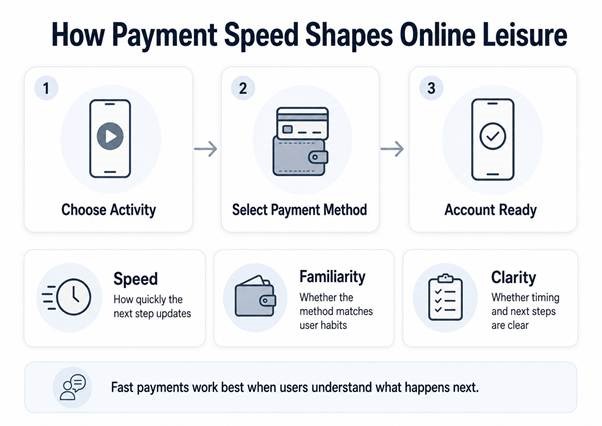
Image source: Educational visual created by the author for this article
This is why payment speed has become more than a technical metric. It affects confidence. A user may not think in terms of settlement systems or processing layers, but they notice whether a payment moment feels smooth, predictable, and proportionate to the leisure activity. The more casual the activity, the less patience people have for unexplained delays.
Choice Is Becoming Part of the Experience
Payment choice also changes how flexible a platform feels. Some users still default to Visa or Mastercard because cards are familiar and widely understood. Others prefer crypto because they already use digital wallets and want the same payment habit available across more online services. Neither group needs to be treated as unusually advanced. They are simply bringing different payment routines into the same leisure environment.
This matters for beginner-friendly entertainment platforms because the payment step is often the first confidence test. A page can look appealing, but if the account-funding route feels unfamiliar, people slow down. A clear set of options reduces that friction. It tells the user, in practical terms, that the platform has considered different comfort levels.
There is a useful distinction here. Speed is not only about being the fastest possible option. It is about matching the user’s expectations for the context. A transfer that updates quickly, a card option that feels familiar, or a crypto choice that is explained plainly can all support the same broader outcome: a smoother handoff from decision to activity.
The Finance Signal Behind The Leisure Habit
The bigger finance story is that payment expectations travel. People do not keep one mental standard for banking, another for shopping, and another for leisure. Once faster digital payments become normal in one area, they quietly raise the baseline everywhere else.
That is why online leisure is worth watching. It sits close to consumer behaviour, mobile access, and account-based digital services. It shows how payment infrastructure becomes visible to users only at the moment it helps them or slows them down. The best payment experiences are not loud. They are clear enough to disappear into the flow.
For finance readers, the lesson is that payment speed is becoming a behaviour signal. It shows where consumer patience is moving, how digital habits form, and why platforms increasingly present payment routes as part of the overall experience, rather than a back-office detail. That view also fits the broader research direction of this open-access review of intention and actual use in digital payments.