
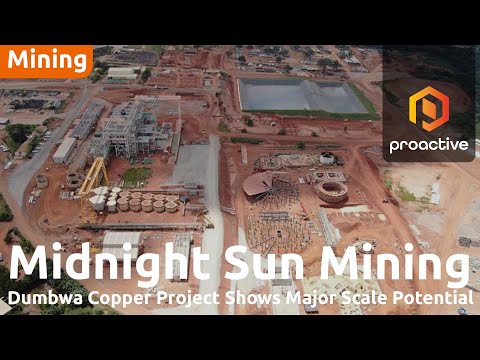
Midnight Sun Mining Corp (TSX-V:MMA, OTCQB:MDNGF) earlier this week reported a major batch of drill results from its Dumbwa copper discovery in Zambia, providing investors with a broader picture of the scale and continuity emerging at the project.
Speaking with Proactive, Vice President of Business Development Adrian O'Brien said the company released assay results from 99 drill holes after resolving earlier QA/QC laboratory issues that had delayed reporting since January.
The latest results significantly expand the known mineralized footprint at Dumbwa. O'Brien said the company now has roughly four kilometres of assayed strike length defined, while drilling has already extended to approximately 5.3 kilometres with another 60 to 70 holes awaiting assays.
He stated that the current drilling confirms the company’s exploration thesis and demonstrates that Dumbwa is developing into a large-scale copper system.
Proactive: All right welcome back inside our proactive newsroom. And joining me now is Adrian O’Brien. He is the vice president of business development for Midnight Sun Mining Corp. And Adrian, it's good to see you again. How are you?
Adrian O'Brien: I'm doing great. Always good to see you too.
Yeah. So big news out from the company today. Releasing some results. Long awaited results, I would say from your Dumbwa copper discovery in Zambia. And you've done a lot of work there. 200 holes, 42,000 metres, and you got a batch of results that came out here. So why don't we start there? There was a bit of a delay going on in these results obviously.
Absolutely. This is a situation of having to deal with QA/QC issues with the lab. We've been dealing with that since January and we've cleaned up the issue and as a result ended up with 99 holes to release today, which is an incredibly large batch of holes to put out in one shot.
So let's narrow it down a little bit for people and talk about what you're seeing from the majority of those holes, and that is that you're able to expand what you're seeing at the project.
Yeah, of course. The initial 29 holes only covered a fairly short amount of strike length. This now gives us four kilometres of actual assayed strike length to talk about at Dumbwa. And that means that we have scale. We can definitively say a few things now. Number one, the Dumbwa deposit is very big.
This is a scalable deposit with large scale in general. It's near surface and it's hanging together. Our model is accurate. It's what we expected geologically analogous or almost geologically identical to Lumwana, which is Barrick’s flagship asset next door, but with a couple of key differences too.
When you look at this, you see a few things that stand out that we included in that release. Number one, the strike length. This is four kilometres of drilled assayed strike length. But we're actually at 5.3 kilometres of drilled strike length now awaiting another 60 or 70 holes of assays. And we still have all the way to the end of that 11.2 kilometre phase one target that we're going to drill off by the end of Q3 or so.
So we've got a lot coming here, a lot of results, a lot of strike length to work with. And that's still only half of Dumbwa. The other big comparison is thickness. Lumwana is 40 to 60 metres thick, with 20 to 30 metres of overburden and about four kilometres long. This is up to 20 kilometres long and 200 metres thick. So you start looking at the geometry and the kind of grade we're looking at here. This is a big bulk tonnage situation and it's pretty exciting from our side.
And is that the kind of questions you're getting Adrian too about that? Because you put out almost a hundred holes, 99 in fact, and people are wondering how to interpret this. But obviously by having that type of strike length on such a small portion of the actual project itself, that shows some big potential.
It does, absolutely. You nailed it. And this is proof of thesis. This is now starting to scale. And look, it takes time. This is not a pure delineation drill program. This is an exploration program where we're defining the east-west and north-south extent of this giant system. And that takes time.
We're now starting to really understand where it sits in terms of the overall grade, where the higher-grade and mid-grade sections are, where lower-grade sections are, where crosscutting faults are. That all takes time. But what we're showing the world today is continuity and confirmation of a very large system that looks very much like its sister deposit next door, Lumwana. And that is very exciting.
And obviously you're not stopping. You still have a lot of drills going right now on the project. That's going to continue for a while.
Oh absolutely. We're still drilling. We currently have four rigs spinning. Another component of the release is that we have some areas where we now know we can extend the mineralization, or certainly have the chance to extend that mineralization to the east. So we're going to be moving one of the rigs down there and kicking off to extend those fences.
We're still going to be drilling 6,000 to 10,000 metres a month right through the end of August. So it's all systems go.
And the last thing I'll say to you is it was there in black and white, but the system remains open pretty well everywhere.
Exactly. You nailed it.
All right. Adrian, thank you so much. Good to catch up with you. I appreciate the update. A lot to talk about.
You got it. Really appreciate it. We'll talk again soon.
Quotes have been lightly edited for style and clarity