
- FTSE 100 up 47 points at 10,372
- UK GDP grows 0.6% in Q1
- Aviva, Burberry, Spire, National Grid, Future, Watches of Switz report
5.05pm: Winning day
It was another winning day for London stocks, with the FTSE 100 finishing the session up 47 points at 10,372.
IG chief market analyst Chris Beauchamp said another day of rising equity and oil prices continues to show the “topsy-turvy situation” in markets.
“So long as the AI mania persists, and US earnings remain at their impressive level, it seems unlikely that markets will begin to worry about rising yields and surging energy costs,” Beauchamp said.
“So long as the music keeps playing investors will have to chase the moves in equity markets, continuing the feedback loop that has driven such a rapid recovery. It is never wise to stand in the way of an oncoming train, and for now luck is running with the bulls.”
3.59pm: Miners and 3i weigh, while insurers in demand
The FTSE just dipped into the red for the second time today, after a brief soujourn in the first hour, but is now on the up again thanks to gains for insurers and other financials.
Miners have a large weight around the index's neck today, with Antofagasta, Fresnillo and Rio Tinto down between 2.7% and 1.8%.
3i Group remains the biggest faller, dropping over 13% after results showed weaker-than-expected sales at discount retailer Action, its largest investment.
Like-for-like sales at Action grew 2.4% in the 19 weeks to 10 May, compared with 6.8% over the same period a year earlier.
Burberry is down 5.8% after its profits jumped less than some analysts were hoping.
Defence, aerospace and airlines are also a weight, with Babcock down 3.2%, and both Rolls-Royce and IAG down around 1%.
Top of the risers is still Legal & General, up over 5% after getting a read-across boost from rival Aviva's results. Aviva is up 1.85% now, while another life insurance rival, Standard Life, is up 2.7% and general insurance specialist Admiral is up 3.5%.
Other risers include Imperial Brands, Halma, Whitbread and Barclays and Airtel Africa.
3.32pm: Bond markets calm today on Westminster wrangling
Some thoughts from the City on the day's Westminster machinations.
Wes Streeting's resignation comes with reports that he has the 81 votes required to trigger a leadership contest.
But in his letter, the now-ex-health sec said in his regisnation leter would't just be him up against Starmer.
"Labour MPs and Labour Unions want the debate about what comes next to be a battle of ideas, not of personalities or petty factionalism. It needs to be broad, & it needs the best possible field of candidates. I support that approach & I hope that you will facilitate this," he wrote.
Market analyst Neil Wilson at Saxo says a leadership contest "will unease bond investors" but the issue for bond vigilantes is about those to the political left of Streeting and Strmer, ie whether the likes of Angela Rayner launches a bid and and whether Andy Burnham has a path back to becoming an MP.
"The market response to the contest will depend on this," says Wilson.
Sterling moved lower on the news of the resignation, but rallied back to where it was within 30 mins or so, whilst gilt were steady and yields were almost unmoved.
"Perhaps that’s because a) Streeting is seen as more market friendly than just about all others, b) it’s a dialing down of the lame duck leader political risk premia we’ve seen amid this chaos, c) it's been well priced and fully anticipated by markets," the analyst added.
"How could it end well? If Streeting gets the 81 votes, secures the premiership and keeps Rachel Reeves as Chancellor there is a path to thread that is market positive, but otherwise things are looking tricky for gilts."
just noting Gilts remain unbothered by Labour internal strife ? yields are back to where they were on Monday and are moving in line with US yields. GBP a little lower, but also in line with other FX vs. US$. UK equities are higher than the start of the week. there is no panic going on here at all:
— BrokenBanker (@brokenbanker.bsky.social) May 14, 2026 at 3:16 PM
2.48pm: FTSE slips as Dow Jones lifted by Cisco
Some of the wind has gone out of the FTSE's sails after the US open.
Money has flowed across the Atlantic, it seems, with Wall Street stocks starting positively.
The Dow Jones has opened 0.6% higher, with the S&P 500 and Nasdaq advancing 0.4%.
Top of the Dow leader is Cisco, up over 13% after full-year guidance was raised after stronger-than-expected earnings was seen in the past quarter.
Boss Chuck Robins signalled accelerating demand for AI-related networking infrastructure and cybersecurity products, with 4,000 jobs to be cut as the tech giant shifts resources toward AI infrastructure, silicon, optics and security.
Nvidia and Goldman Sachs are next, up 2.2% and 1.4%
2.25pm: US retail sales mixed
US retail sales were 0.5% month-on-month in April, which was broadly as expected.
Higher prices lifted gasoline station sales by 2.8% month-on-month, while for both sporting goods and electronics grew 1.4%.
Auto sales dropped 0.4%, furniture sales fell 2% and clothing dropped 1.5%. Non-store retailers continue to post decent gains of 1.1%.
"Inflation data has been the main focus so far this week, but today it is retail sales," says James Knightley at ING.
"Consumer spending accounts for around 70% of all economic activity in the US and retail sales are responsible for a little over 40% of consumer spending. As such, this report is an important barometer of how the Middle East situation is impacting the real economy."
He says the data shows "a mixed outcome, but so far there is little sign that higher fuel costs are forcing consumers to cut back spending on other things, despite consumer confidence supposedly being at all-time lows. Nonetheless, we expect that pressure to build."
2.06pm: UK GDP to hold up in Q2, NIESR predicts
UK GDP is forecast to grow 0.6% again in the second quarter, according to the National Institute of Economic and Social Research (NIESR).
The independent research institute expects "shallow" monthly growth for April, May and June as disruption from the energy price shock ripples through the economy.
Earlier, official data earlier showed that GDP grew by 0.6% in Q1, although the ONS re-assessed its seasonal factors for this release.
Growth was 0.3% in March, with a muted initial impact of the Middle East conflict on economic activity in the first month of the war.
Fergus Jimenez-England, associate economist at NIESR, says the Q1 outturn was "relatively strong", but obviously largely reflects "old news".
He adds: "Although growth held up in March, there are signs of underlying weakness in the wake of conflict in the Middle East. Business confidence has taken a hit, input price inflation has risen, and job vacancies are falling.
"At the same time, today’s positive surprise alongside resilience in spending data and PMIs suggests that the UK economy is in a period of adjustment rather than outright downturn.
"While the outlook for growth is fragile, the initial effect of the energy price shock on the UK economy has been limited in terms of growth and larger in terms of inflation."
The NIESR economist says he and his colleagues expect the MPC to hike rates by 25 basis points in the third quarter.
1.21pm: Wes Streeting resigns as health sec
The more domestically focused FTSE 250 has spiked 1.1% higher, while the blue-chip index is coasting sideways.
Gilt yields have fallen further, on news that health secretary Wes Streeting has resigned.
This is likely to be in order to mount a leadership challenge.
Rightly or wrongly, the bond market is likely to be more relaxed about this as Streeting is on the right of the party, so if he ousts Keir Starmer as PM it should not bring in a new regime that wants to ramp up spending.
Let's see if the commentariat agree with me.
Wes Streeting has resigned “Labour MPs and Labour Unions want the debate about what comes next to be a battle of ideas, not of personalities or petty factionalism. It needs to be broad, & it needs the best possible field of candidates. I support that approach & I hope that you will facilitate this”
— Zoë Crowther (@zoecrowther.bsky.social) May 14, 2026 at 1:09 PM
12.13pm: UK stocks on the rise, US futures higher
Just after midday, the FTSE 100 and 250 are both heading on a leg higher, up 0.45% and 0.75% respctively.
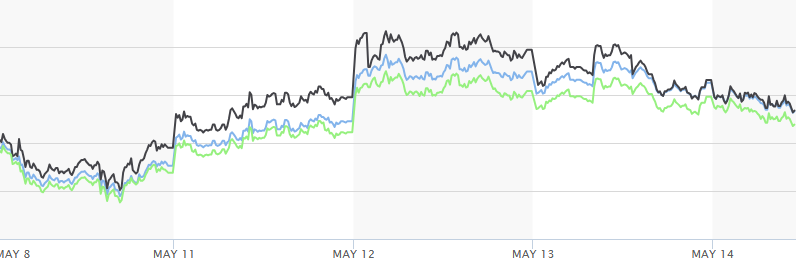
In the background, US stock futures are positive and gilt yields have been softening as the day has gone on (see chart for the 2- 10- and 30-year UK government bonds).
Westminster reporters are painting a confusing picture about Labour’s leadership crisis, with reports that potential challenger Wes Streeting was considering whether to challenge Sir Keir Starmer.
The Times' political editor posted that Streeting may delay any move amid uncertainty over support, though allies insist he has the numbers.
Prime Minister Starmer remains defiant despite 92 Labour backbenchers publicly calling for him to quit.
Angela Rayner, having said her tax issued have been cleared, has also reportedly refused to rule out standing if a contest is triggered, adding to mounting pressure on the PM.
Meanwhile, US markets are set for a stronger open, with Dow Jones futures indicating an initial gain of 377 points, or 0.8%, while S&P 500 and Nasdaq futures are both up around 0.3%.
11.41am: Competition in UK trading market ramps up as Revolut wins wider approvals
Revolut has won a 'variation of permissions' from the Financial Conduct Authority, securing approval to offer an array of products, including leveraged trading and private wealth services.
Its Revolut Trading Ltd (RTL) arm has secured the ability to provide a more sophisticated range of products for both retail investors, advanced traders and professional clients.
As well as a broader product suite, RTL said it is redesigning its trading model to offer more competitive pricing.
Victoria Laffey, head of operations at the unit, says: “These permissions are the missing piece allowing us to unite investment, advisory and portfolio management under one roof, making them even more accessible.
"Our mission has always been to remove the friction of fragmented financial services; and we can now put sophisticated wealth management products and tools in the hands of every type of investor, helping our customers build and manage wealth with confidence."
11.31am: Commodities watch
While Donald Trump is in Iran, Tehran has apparently started allowing Chinese ships to pass through the Strait of Hormuz, according to Gulf reports.
Iran has been allowing Chinese ships the pass since last night, the semi-official Fars newswire said.
Meanwhile, oil prices are softening, with Brent down below $106 a barrel and WTI crude slipping below $101.
In other commodities, gold has been holding firm, with analyst John Meyer at SP Angle saying the wider metals spectrum slid following the hot US producer price inflation data.
"This is a promising trend for gold, which has traditionally fallen as US Treasury yields rise... The dollar is failing to rally despite the higher yields, supporting precious metal prices," he says.
Elsewhere, the FT reported that building projects across Asia were being delayed on shortages of oil-related products, such as PVC-u plumbing piping.
The conclusion for Meyer: "the developing shortage of naptha which goes into nylon and PVC will likely cause builders to switch back to copper piping for housing and office projects. Unfortunately, any stalling of construction projects will likely have a negative impact on the market for raw materials."
11.05am: ITV up on deal talk
Shares in ITV are up almost 4% as a mixed trading quarter was offset after the broadcaster said remains "in active discussions" with Sky over a possible sale of its Media & Entertainment (M&E) business.
The update on the potential £1.6 billion deal had been closely watched by investors amid concerns that talks had hit the buffers.
"There have been concerns that talks were dwindling, however today’s announcement reignites investor hopes that a deal could still be on the table," says Victoria Scholar, head of investment at Interactive Investor.
With the stock at around a 15% premium to levels seen before initial discussions were first announced in November, she says a mooted £1.6 billion deal "would be positive for ITV shareholders since it would generate a significant cash return and shift the business’ focus away from declining linear TV towards its more successful content production".
10.16am: GDP thoughts
Some thoughts on this morning's UK GDP figures.
"The economy grew 0.6% q/q in Q1 26, with strength in private consumption. However, we do not think this is representative of the underlying strength of the economy and expect a sharp deceleration in Q2," was the short and not-so-sweet first look from Barclays economist Jack Meaning.
"Overall, we think this will not represent material news to the Bank of England," he says, especially given its view in the April monetary policy report that today's figures would not be representative of underlying growth, which the BoE pinned at 0.2% quarter-on-quarter.
"Looking ahead, we expect both the impact of the evolving terms of trade and domestic political uncertainty shocks and data seasonality issues to generate a sharp slowing in Q2, to 0.1% q/q."
James Smith at ING is one of those pointing at the "now-familiar pattern" that since 2022, UK growth figures have come in much stronger in the first three months of the year than the rest.
"Growth has averaged 0.6% in Q1 over that period, a sharp contrast to Q3 where the economy has typically flatlined.
"Why? It’s hard to say exactly what’s happening. But it seems that something’s not quite right with the way the data is being seasonally-adjusted, a legacy we suspect of higher inflation and the timing of annual price hikes.
"To its credit, the Office for National Statistics has confirmed today it has made some changes to previous years and is keeping its methods under review."
Julian Jessop, economics fellow at the Institute of Economic Affairs, notes that many business and consumer surveys suggest that most of the 0.6% increase in GDP was genuine.
"Unfortunately, the same indicators are already pointing to a much weaker second quarter as the fallout from the crisis in the Middle East starts to hit. The decent growth in the first quarter will be as good as it gets."
Mounting political uncertainty "will not help either", he adds.
"Nervousness in the financial markets over the fate of the Prime Minister is adding to the upward pressure on borrowing costs. The lack of any meaningful measures to boost growth in the King’s Speech is a worry too."
9.52am: FTSE underperforming European peers
Oil prices spiked earlier, with Brent crude futures topping $107 a barrel, but now back to just over $106.
What might have sparked the spike is news from the UK Maritime Trade Operations that an unnamed vessel had been seized by "unauthorized personnel" off the coast of the UAE and was seen heading toward Iranian territorial waters.
The UKMTO said it received a report of an incident approximately 38 nautical miles northeast of the oil port of Fujairah, with the ship's company security officer reporting "the vessel has been taken by unauthorized personnel while at anchor and is now bound for Iranian territorial waters".
The agency said it was continuing to investigate the incident.
Looking at wider markets, the FTSE is creeping higher, led by L&G, Standard Life, Barclays and Land Sec.
Over on the Continent, the DAX is up 1.2%, while other major benchmarks are showing gains of 0.6-0.7%
Investors are awaiting the latest developments in politics and geopolitics at home and abroad, says market analyst Dan Coatsworth at AJ Bell.
"Gilt yields were steady as a potential challenge to Keir Starmer’s premiership continued to bubble away in the background, while domestic-facing stocks regained some of the losses endured amid this week’s turmoil.
"However, the latest goings-on in Westminster could be overshadowed by global events as Donald Trump continues talks with Beijing.
"As well as progress on trade, markets are alive to the possibility the summit might pave the way for China to help the US on Iran."
9.08am: City views on Aviva
Aviva shares fell 1.1% in early trading but are now just above flat, following the insurer reporting strong wealth inflows and reiterating its medium-term targets. Rivals L&G and Standard Life gained 4.9% and 1.9% from investor read-across.
Analysts point to Aviva's weaker-than-expected general insurance growth and pressure on annuity margins.
Derald Goh at Jefferies says general insurance premiums were 3% below expectations, with the UK business the weakest area.
He also flags a sharp fall in profitability in the pensions risk transfer business, saying bulk annuity margins “seem to have collapsed to 1.2% owing to increased competition”.
Goh added that Aviva’s solvency ratio came in slightly lighter than expected, though he described wealth as “one bright spot” after net inflows jumped nearly 50% and beat forecasts by around 20%.
Abid Hussain at Panmure Liberum says the group’s bulk annuity volumes were a “lowlight” as management stayed disciplined in an increasingly competitive market.
Andreas Van Embden at Peel Hunt also highlights weaker bulk annuity activity, noting that the market remained “competitive with margins under pressure and less transactions during the quarter”.
However, he feels growth in wealth and UK general insurance continued to support the investment case, adding that improving underwriting margins in the UK property and casualty division reflected progress in integrating Direct Line.
8.50am: Burberry profit beats some forecasts but not others
Why are Burberry shares down 2.7% after beating forecasts?
Analyst James Grzinic at Jefferies said the "solid end to 25/26 was well anticipated" and not unsurprising after a strong finish from fellow coat-making rival Moncler.
Burberry's "significant" fourth-quarter gross margin beat, combined with the benefit of the cost savings programme, resulted in a 4% FY EBIT beat versus the sell-side analyst consensus (sell side = broker and bank analysts) "but likely a delivery slightly below the more bullish buy-side hopes" (buy-side = big fund investors).
Grzinic says there may be a "big debate" at today's conference call about how guidance for the new 2027 year's revenue growth and margin expansion is caveated by the uncertain geopolitical and macro environment, compared to a consensus forecast that expects 290 basis points of EBIT progress.
8.24am: HSBC, BP among morning's ex-div stocks
The FTSE 100 is also facing a near 20-point drag from stocks trading ex-dividend this morning, led by HSBC, BP, Unilever and GSK – four of the index’s 10 largest constituents.
HSBC accounts for the biggest single adjustment at 5.36 points as the bank's shares trade without entitlement to its latest 10-cent payout. It's shares are down 0.3%.
BP follows with a 4.06-point impact and its shares are down 1.2% compared to a 0.2% fall for Shell.
Unilever strips out 3.66 points and GSK removes 2.89 points, with Tesco, Coca-Cola HBC and Pershing Square Holdings rounding out the seven blue-chips that are having a technical impact on the index, independent of broader market moves.
With miners Rio Tinto and Glencore down due to market foreces, along with engine maker Rolls-Royce, only two of the top 10 are in green this morning.
8.15am: FTSE 100 stuck in tug-of-war at open
The FTSE 100 has lumbered only a few points higher in initial Thursday trading, tugged almost equally strongly by buyers and sellers.
Top of the leaderboard are Aviva's rivals Legal & General and Standard Life, after results from the former sent its shares down 1.1%.
Banks are prominent among the other risers, with Barclays, Lloyds and NatWest joined by tobacco maker BAT, property developer Land Sec, and utility Severn Trent.
National Grid rose 1.2% on the back of its update, where it committed at least £70 billion to its new five-year investment plan.
On the downside, 3i Group is the leading faller, plunging 21% on the back of its results.
Burberry is down 4.4% despite its strong-looking numbers.
Miners are also a weight, with Antofagasta and Anglo American down around 1.5%
8am: Burberry beats
Burberry Group has hailed its turnaround strategy for reaching a "meaningful inflection point" in the past year, as it returned to comparable sales growth and beat profit expectations for the 2026 financial year.
The maker of trench coats and scarves said fourth-quarter retail comparable sales rose 5%, ahead of analyst expectations of 4.6%, helped by a 10% increase in Greater China and a 10% rise in the Americas.
For the year to 28 March, revenue shrank 2% to £2.42 billion, broadly in line with forecasts, but adjusted operating profit rose to £160 million from £26 million a year earlier, beating consensus estimates of £153.6 million.
7.50am: Aviva mixed
Aviva has backed its full-year outlook as solid trading momentum continued into 2026, with strong growth across general insurance and wealth businesses, but lower bulk annuity sales.
The FTSE 100 insurer said general insurance premiums rose 19%, while its group undiscounted combined operating ratio improved to 94.1% from 96.6% a year earlier.
UK and Ireland general insurance premiums were helped by the integration of Direct Line and growth in personal lines, while commercial lines premiums fell 7% as pricing conditions remained competitive.
Retirement sales fell to £1.1 billion from £1.8 billion a year earlier as bulk purchase annuity volumes dropped in a competitive market.
7.39am: Spire minded to accept Toscafund offer
Spire Healthcare said it would be minded to recommend a possible 250p-a-share cash takeover offer from Toscafund, as the private hospital operator confirmed talks with its second-largest shareholder were continuing.
The proposal, which includes an option for shareholders to roll some or all of their holdings into an unlisted equity vehicle, is subject to due diligence and agreement on final terms.
The board said it remained confident in Spire’s standalone strategy but believed the proposal represented a value it would be prepared to back unanimously if a formal offer is made on the same financial terms.
A strategic review was announced in March.
7.26am: GDP based on broad improvement from services sector
Commenting on today’s first-quarter GDP figures, ONS director of economic statistics Liz McKeown said: “Growth picked up in the first quarter of the year, led by broad-based increases across the services sector."
Within the services sector, she says wholesale, computer programming and advertising performed particularly well.
“Production also grew slightly, while construction returned to growth, though only partly reversing weakness at the end of last year."
UK services output rose 0.3% in March, beating expectations for a decline and helping lift three-month services growth to 0.8%, ahead of forecasts.
Household spending strengthened in Q1, with private consumption rising 0.6%, though fixed investment disappointed as gross fixed capital formation fell 0.6%.
Trade remained subdued, with exports edging up 0.1% over the quarter while imports rose 0.6%, although business investment returned to quarterly growth with a 0.7% increase.
Industrial production fell 0.2% in March, as expected, but manufacturing output surprised to the upside with monthly and annual growth of 1.2%.
Construction was - surprisingly considering the recent commentary from some residential building companies - a strong sector, with output jumping 1.5% in March against expectations for a decline, though annual construction activity remained slightly negative.
7.18am: FTSE 100 called higher on GDP beat
Another solid start for the FTSE 100 is expected on Thursday as the UK's economic growth proved stronger than expected.
UK gross domestic product expanded 0.3% in March, the Office for National Statistics, more than the 0.1% decline that economists expected, and slowing only slightly from the 0.5% the month before.
For the first quarter of 2026, GDP growth improved to 0.6% on a quarter-by-quarter basis from the 0.1% at the end of last year, as forecast, while year-on-year growth improved to 1.1% from 1.0%, beating the 0.8% coinsensus estimate.
London's blue-chip benchmark is seen rising around 42 points higher this morning, having climbed 60 points to 10,325.35 by yesterday's close.
US tech stocks surged to new highs overnight, though the blue-chip Dow Jones slipped 0.1%. The tech-heavy Nasdaq Composite jumped 1.2% to a new peak and the S&P 500 rose 0.6% to notch its own all-time zenith.
Asian markets are lumpy this morning, with Tokyo's Nikkei and the Shanghai Composite index both down 0.7%, not putting on its best show for Donald Trump's first full day in China. The Hong Kong Hang Seng and Mumbai's Sensex both up.
"Easing geopolitical risk is supporting the market," says market analyst Kyle Rodda at Capital.com.
"US President Trump begins his visit to China as focus shifts from geopolitics to trade. The vacuum that has been created has allowed the markets to drift higher as the inertia from a remarkable US earnings season propels equities higher.
"There are still risks on the horizon when it comes to US and Iran tensions. Peace talks are tenuous and the Strait of Hormuz is still closed, choking global energy markets."