
For stroke patients, diagnosis still depends heavily on access to advanced hospital imaging — even though treatment outcomes can deteriorate by the minute.
That challenge is helping drive interest in portable brain scanning technologies that could help doctors identify and triage strokes earlier, particularly in emergency departments, regional hospitals and eventually ambulances.
Australian medtech company EMvision Medical Devices Ltd (ASX:EMV) is now moving to expand the role of its emu™ point-of-care brain scanner, adding acute ischaemic stroke detection into its pivotal US Food and Drug Administration (FDA) validation pathway alongside haemorrhage detection.
The move broadens both the potential clinical use case and commercial opportunity for the company’s first-generation bedside device, while potentially accelerating the pathway toward wider adoption of its future portable “First Responder” scanner designed for pre-hospital settings.
Expanding the clinical opportunity
EMVision said it was actively preparing to add an acute ischaemia detection endpoint into its ongoing pivotal validation trial after progress in its parallel Continuous Innovation Study helped move the feature from R&D into the validation pipeline.
Ischaemic strokes account for about 80% of all stroke presentations and require rapid intervention to improve outcomes. Unlike haemorrhagic stroke, which involves bleeding in the brain, ischaemic stroke is caused by a blockage cutting off blood flow, with treatments such as clot retrieval and thrombolytic drugs highly dependent on speed.
“Bringing forward validation of ischaemia detection in the Pivotal Trial is a step-change for our emu™ Brain Scanner, substantially expanding its clinical utility and commercial opportunity from first FDA release, while leveraging the same trial infrastructure for capital and time efficiency,” said EMVision chief executive and co-founder Scott Kirkland.
The strategy could also materially reduce both timelines and costs. Rather than running a separate future validation program for ischaemia detection, EMVision plans to leverage the same patient cohorts, infrastructure and regulatory pathway already being used in the existing trial.
The company said that approach could potentially save up to two years and avoid multimillion-dollar standalone trial costs.
Trial momentum builds
EMVision’s pivotal validation trial is progressing across leading stroke centres in the United States and Australia, including Mayo Clinic, Mount Sinai Hospital, Ronald Reagan UCLA Medical Center, Royal Melbourne Hospital and Liverpool Hospital. Princess Alexandra Hospital is also transitioning from the Continuous Innovation Study into the pivotal program.
More than 125 patients have now been enrolled across training and primary analysis cohorts, with recruitment expected to accelerate through expanded after-hours coverage and broader clinical engagement.
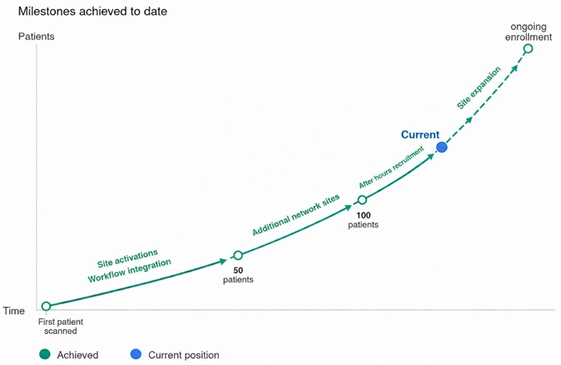
Source: EMVision
The trial underpins EMVision’s planned FDA De Novo clearance pathway and is primarily designed to demonstrate haemorrhage detection sensitivity and specificity above 80%.
But the broader strategic value lies in the trial’s ability to support sequential validation of additional diagnostic features — including ischaemia detection — without requiring a separate standalone study, an important advantage given the complexity of detecting hyperacute stroke outside traditional imaging settings.
Beyond the hospital
While the immediate focus remains FDA clearance for the bedside emu™ scanner, EMVision’s broader ambitions extend into regional and pre-hospital stroke care.
The company continues to position the first-generation device as both a standalone commercial opportunity and a precursor to its second-generation First Responder scanner designed for ambulance and emergency response settings.
That opportunity is also underpinning EMVision’s Regional Benefit Study, backed by A$3 million in non-dilutive CRC-P funding. The study is exploring how telehealth-supported deployment of the emu™ scanner in regional South Australia could help accelerate stroke diagnosis and treatment pathways in areas where advanced neuroimaging may otherwise only be available hours away.
The model combines bedside scanning with remote neurologist support through EMVision’s Zeus™ telemedicine platform, with the company viewing the regional Australian healthcare setting as a potential blueprint for underserved rural populations globally.
Building towards commercialisation
EMVision is increasingly moving beyond early-stage development and into the clinical validation and regulatory phase that will shape its commercial pathway.
The company finished the March quarter with A$18.4 million in cash reserves and a further A$6.2 million in available non-dilutive grant funding, supporting ongoing clinical programs as its Continuous Innovation Study continues building the proprietary data and algorithms underpinning future diagnostic features and indication expansion.
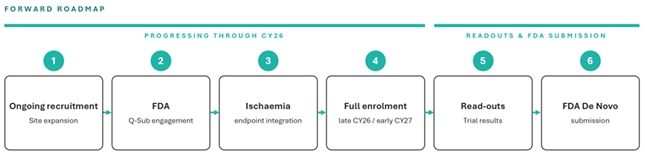
The broader opportunity extends beyond a single bedside device. EMVision is positioning its technology as part of a wider stroke care pathway spanning hospitals, regional healthcare settings and eventually pre-hospital emergency response.
Portable stroke imaging remains one of the more technically challenging goals in neurodiagnostics, particularly in time-critical care environments where access to advanced imaging infrastructure can be limited.
But as EMVision advances deeper into validation and FDA engagement, the company is steadily building towards a bigger ambition: bringing faster stroke diagnosis closer to the point of care.