
Australian Mines Ltd (ASX:AUZ) has submitted additional metal hydride samples to the National Laboratory of the Rockies (NLR) for independent testing by a US Department of Energy national laboratory team, as the company advances its proprietary solid-state hydrogen storage technology toward potential commercial applications.
The latest submission follows earlier testing undertaken through the Hydrogen Materials Advanced Research Consortium (HyMARC), which previously evaluated the company’s MH-May24 metal hydride formulation.
The new testing program is focused on optimising follow-on metal hydride formulations, independently assessing performance characteristics and validating reproducibility under external testing conditions.
The company is also assessing potential commercial pathways for safe, compact and dispatchable hydrogen storage technologies.
Potential target markets identified by AUZ include backup power systems using solid oxide fuel cell (SOFC) technology, data centres and AI-related energy infrastructure, remote and off-grid power systems, industrial energy storage and transport-related hydrogen applications.
Chief executive officer Andrew Nesbitt said the latest submission represented another step in progressing the technology.
“The submission of additional samples to NLR marks another important step in advancing AUZ’s metal hydride technology,” he said.
“Our objective is to continue improving and independently validating material performance, while assessing potential commercial pathways in markets where safe, compact and dispatchable hydrogen storage could be valuable.
“Fuel cell backup power, including for data centres and AI-related infrastructure, is one potential application within a broader hydrogen storage opportunity.”
Previous HyMARC testing supports performance claims
HyMARC previously assessed MH-May24 across several key storage parameters, including hydrogen absorption capacity, hydrogenation and dehydrogenation kinetics, and system characteristics such as volumetric and gravimetric energy density.
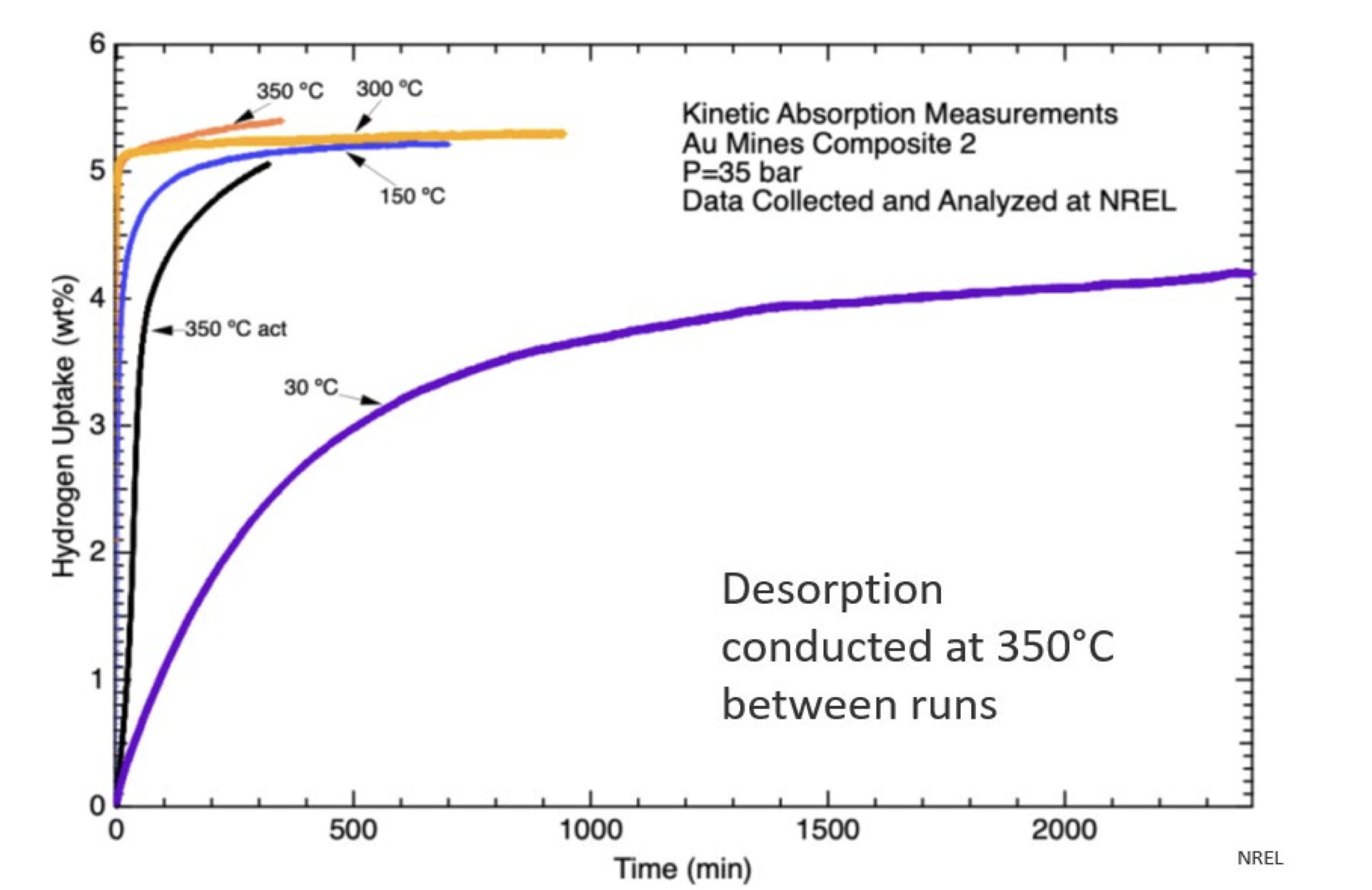
NREL: MH-May24 Kinetics.
According to AUZ, the independent testing results were consistent with the company’s previously announced performance data and demonstrated that MH-May24 could repeatedly absorb and release hydrogen — a key factor for long-term energy storage applications.
Under isothermal conditions and at a pressure of 38 bar, MH-May24 was reported to absorb 5.2 weight percent hydrogen at 200°C and 4.2 weight percent in less than four minutes at the same temperature.
The material also absorbed up to 4.7 weight percent hydrogen at 100°C and demonstrated hydrogen absorption capability at room temperature.
Under vacuum conditions at 250°C, MH-May24 desorbed 5 weight percent hydrogen in around 3.3 hours.
Energy density potential highlighted
AUZ said theoretical modelling indicated MH-May24 could achieve gravimetric and volumetric energy densities of 1.15 kWh/kg and 1.78 kWh/dm³ respectively.
The company said these theoretical system densities compared favourably with conventional lithium-ion batteries and compressed hydrogen storage at 700 bar, potentially offering improved energy storage performance.
Ongoing engagement with US laboratory network
AUZ is expected to continue engaging with the relevant US national laboratory team and broader HyMARC technical network as it advances development work.
The company believes these relationships may support future strategic knowledge sharing and provide potential pathways to additional funding opportunities for its metal hydride program.