
MOONLIGHT RESOURCES LTD (ASX:ML8) has extended near-surface gold mineralisation at the Leo Grande Central prospect, part of the Clermont Gold Project in Queensland, with Phase 2 drilling confirming continuity and expanding the system along strike. Located approximately 15 kilometres west of Clermont in Central Queensland, this flagship gold project is situated in a region of large (1Moz) deposits with a rich history of gold production.
Moonlight Resources is aiming to rapidly deliver a cornerstone maiden gold resource, leveraging favourable logistics, established infrastructure, and strong local support for new investment.
Initial results from 22 reverse circulation holes show the mineralised footprint growing to the south-east and north-west, supporting the scale potential of the Leo Grande shear zone.
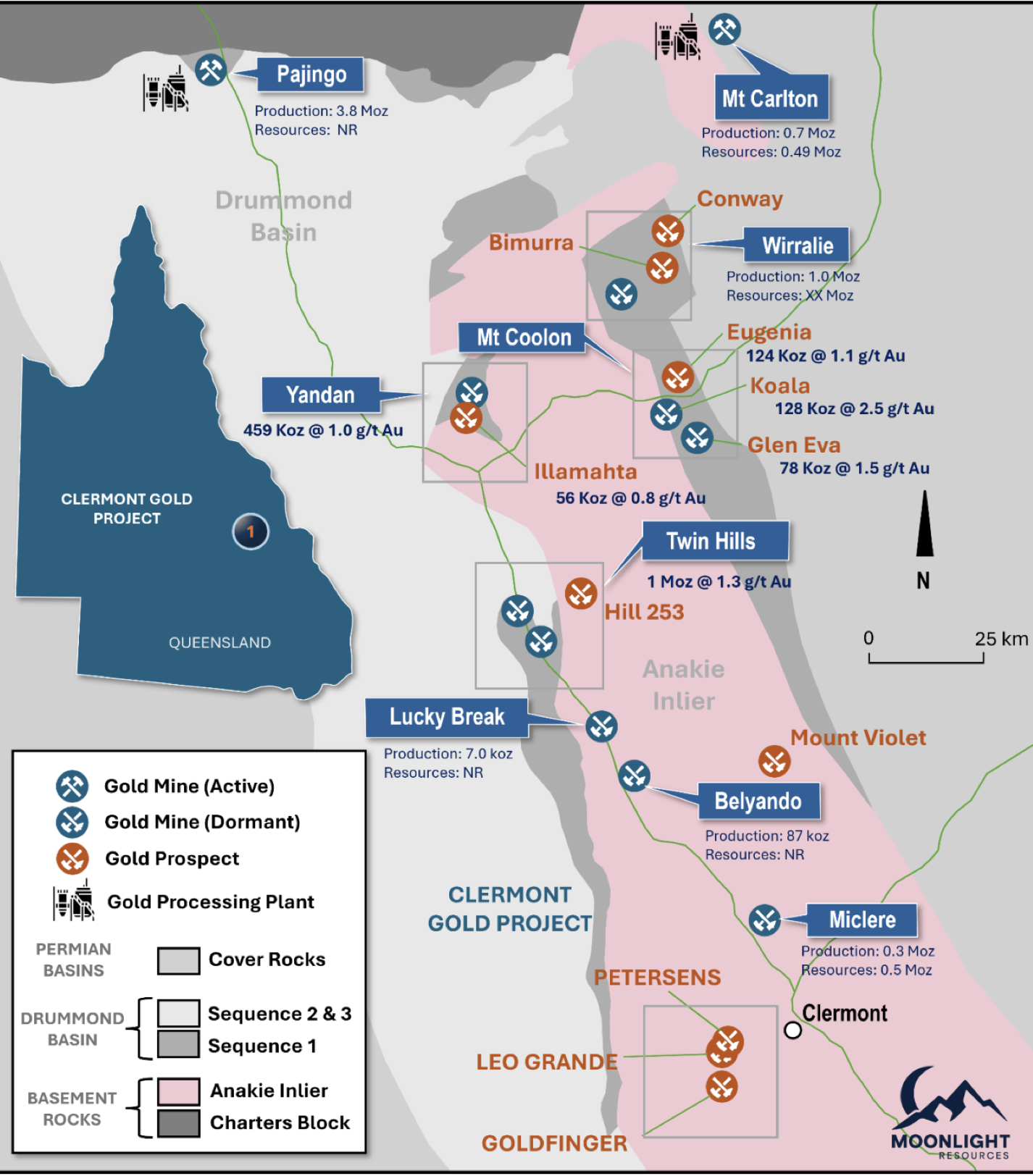
Location and Regional Geology of the Clermont Project.
“While the initial drilling results at Leo Grande have already demonstrated the presence of a broad, near-surface gold system, our focus is now firmly on defining the scale, continuity and additional growth potential," Moonlight managing director, Greg Starr, said.
"These initial Phase 2 results are an important step in that process. In particular, step-out drilling to the south-east has returned multiple broad intersections which support our interpretation that mineralisation continues along the Leo Grande Shear Zone towards Leo Grande South.
“Importantly, several holes have again ended in mineralisation, reinforcing the opportunity to extend the system at depth. Additional results from this phase of drilling remain outstanding and are expected to provide further insight into the scale and continuity of the mineralised system.”
Extensions push mineralisation along strike
Step-out drilling has extended mineralisation 200 metres to the south-east and 250 metres to the north-west of Leo Grande Central, increasing the overall strike length of the system.
At the south-eastern extension, drilling returned broad zones of near-surface gold, including:
- 42m at 1.01 g/t gold from surface
- 40m at 1.31 g/t from 76m, including 5m at 3.40 g/t
- 37m at 1.04 g/t from surface, including 7m at 2.00 g/t
These results indicate mineralisation is continuing towards the Leo Grande South area, with geological interpretation suggesting a further 0.6km of prospective strike.
To the north-west, drilling intersected additional broad zones, including:
- 18m at 1.55 g/t from 60m, including 3m at 7.80 g/t
- 37m at 0.81 g/t from 69m
- 20m at 0.77 g/t from 50m
Results confirm continuity and scale
The Phase 2 results reinforce strong continuity of mineralisation within the Leo Grande shear zone, with gold intersected across multiple sections and host lithologies.
Several holes ended in mineralisation, highlighting potential for further extensions at depth and supporting the interpretation of a large, open-ended system.
Drilling to date has tested around 850 metres of strike, with results demonstrating consistent, broad gold zones typical of an emerging bulk-tonnage target.
Builds on Phase 1 validation
The current program builds on a 2025 Phase 1 campaign that confirmed widespread near-surface mineralisation across the prospect, with all holes intersecting gold.
Previous standout results included:
- 40m at 1.30 g/t from surface
- 34m at 1.37 g/t from 6m
- 24m at 1.28 g/t from 2m
That work validated historical drilling and established the geological model now being expanded through systematic step-out and infill drilling.
Pathway to maiden resource
Phase 2 drilling is designed to increase drill density, test depth extensions and improve confidence in continuity, with the aim of progressing Leo Grande towards a maiden mineral resource estimate.
The broader program comprises up to 70 holes for about 6,000 metres, forming part of a fully funded 20,000-metre campaign across the Clermont Gold Project.
What’s next
Drilling at Leo Grande Central is ongoing, with further assay results expected from additional holes targeting strike and depth extensions.
Following completion, the drill rig is scheduled to move to the Goldfinger prospect for an initial 2,500-metre program, while regional exploration work continues across the wider project area.