
St George Mining Ltd (ASX:SGQ, FRA:S0G, OTC:SGQMF) has returned further thick, high-grade rare earths and niobium assays from ongoing diamond drilling at its 100%-owned Araxá Project in Minas Gerais, Brazil.
St George has completed 13,700 metres of drilling in the current Araxá campaign, excluding East Araxá, with drilling continuing around the clock.
The program is targeting both resource definition within the existing Mineral Resource Estimate footprint and expansion drilling beyond the current resource boundary.
Latest results
The 13-hole assay batch included:
AXDD103: 62.95 metres at 5.80% TREO and 0.57% Nb₂O₅ from surface, including:
- 43 metres at 8.02% TREO and 0.74% Nb₂O₅ from surface;
- 21 metres at 10.61% TREO and 0.67% Nb₂O₅ from 15 metres; and
- 4.4 metres at 20.14% TREO and 0.08% Nb₂O₅ from 21.65 metres.
AXDD104: 150.85 metres at 2.48% TREO and 0.26% Nb₂O₅ from surface, including:
- 55.2 metres at 3.47% TREO and 0.42% Nb₂O₅ from surface;
- 41 metres at 4.01% TREO and 0.40% Nb₂O₅ from 7 metres; and
- 2 metres at 8.04% TREO and 0.59% Nb₂O₅ from 41 metres.
AXDD096: 96.25 metres at 2.82% TREO and 0.44% Nb₂O₅ from surface, including:
- 31 metres at 4.59% TREO and 0.83% Nb₂O₅ from surface; and
- 19.15 metres at 5.17% TREO and 0.94% Nb₂O₅ from 10.75 metres.
AXDD108: 96.75 metres at 2.00% TREO and 0.63% Nb₂O₅ from surface, including:
- 26 metres at 4.20% TREO and 0.80% Nb₂O₅ from surface;
- 19 metres at 1.16% TREO and 1.04% Nb₂O₅ from 42 metres; and
- 1 metre at 1.41% TREO and 3.26% Nb₂O₅ from 54 metres.
AXDD107: 100.35 metres at 1.73% TREO and 0.33% Nb₂O₅ from surface, including:
- 19.35 metres at 5.65% TREO and 0.76% Nb₂O₅ from 7.75 metres.
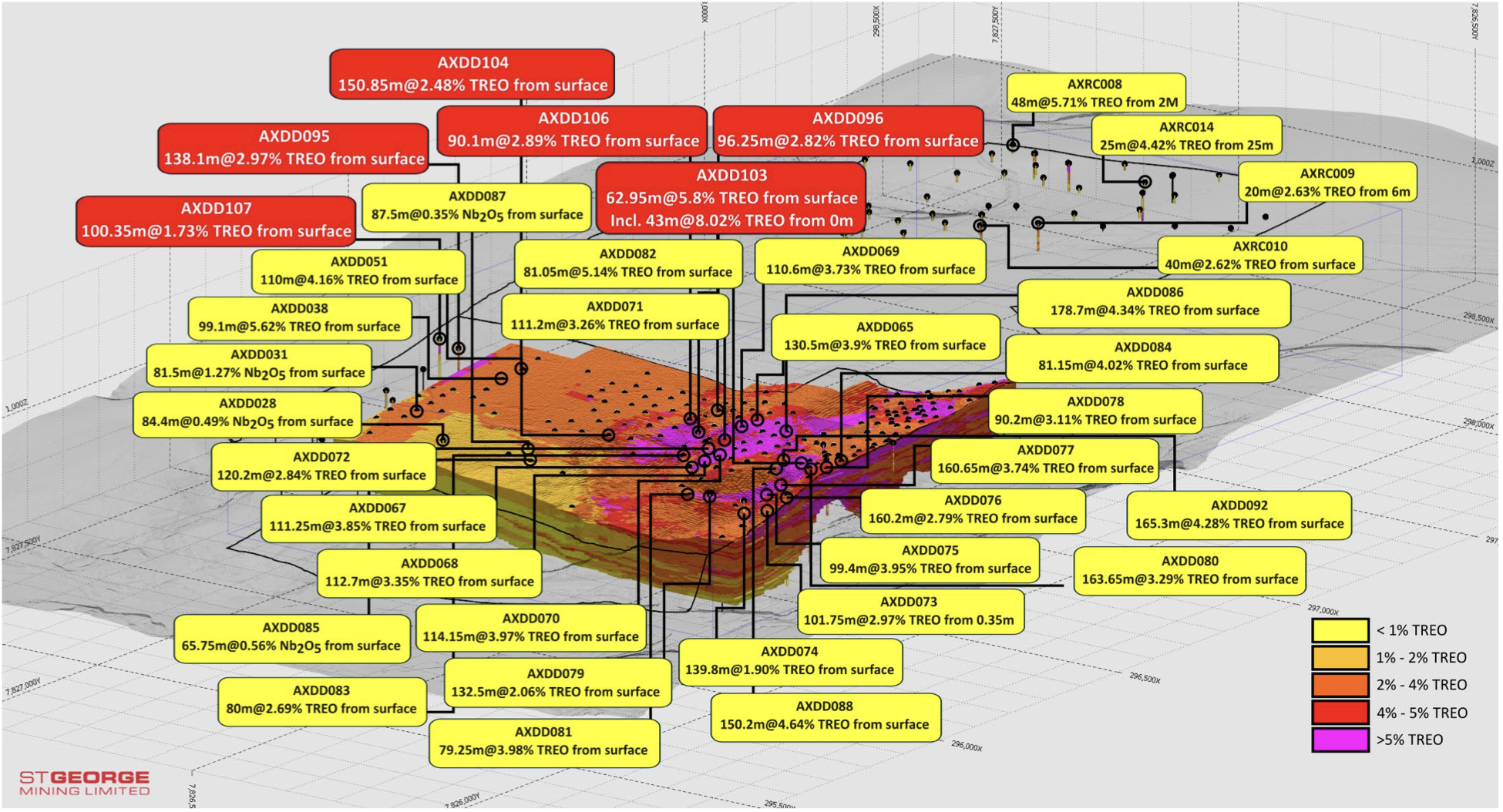
Oblique section showing the latest diamond drill holes as well as other significant drilling completed in the current campaign. The latest drill holes with red labels.
“It is pleasing to see the latest drill results continuing to deliver very high-grade rare earths and niobium from surface. Highest grades were 25.37% TREO in AXDD103 and 3.26% Nb₂O₅ in AXDD108," St George Mining executive chairman John Prineas said.
“Additionally, these results continue to confirm a very large volume of mineralisation with exceptionally thick mineralised intercepts. It is exciting to also see these thick, high-grade intercepts outside the existing footprint of the MRE — as highlighted by the 100m thick intercept in step-out hole AXDD107 — which emphasises that we have not yet reached the limit of the mineral system and further resource growth is likely from additional expansion drilling.
“Our Araxá MRE continues to be compared in scale and grade to the two largest producing rare earths mines outside of China — the Mountain Pass mine of MP Materials (NYSE: MP) and the Mt Weld mine of Lynas Rare Earths (ASX: LYC) — both of which are the same carbonatite-hosted style of deposit as our Araxá deposit.
“We have a compelling opportunity to join these two world leaders in the rare earths sector with our drilling demonstrating continuity and scale of the high-grade mineralisation that provides confidence for reserve modelling in the feasibility study work underway.”
Northern step-out drilling extends mineralisation beyond MRE
Step-out drilling has confirmed a significant northern extension to mineralisation beyond the current MRE footprint at Araxá.
Holes AXDD095 and AXDD107 were both drilled outside the existing resource boundary and returned broad mineralised intercepts in previously untested areas.
AXDD095 intersected 138.1 metres at 2.97% TREO and 0.45% Nb₂O₅ from surface, confirming thick, consistent mineralisation in the northern step-out zone.
AXDD107, drilled around 200 metres north of the current drill grid, returned 19.35 metres at 5.65% TREO and 0.76% Nb₂O₅ within a broader 100.35-metre mineralised envelope from surface.
Together, the holes extend the known mineralised footprint by around 240 metres north of the previous northernmost drilling, with the system remaining open in that direction.