
NewPeak Metals Ltd (ASX:NPM, OTC:NPMFF, FRA:NPM) has begun drilling at its Las Opeñas gold project in Argentina, launching a campaign designed to test the scale potential of a gold-dominant polymetallic system in one of the country’s most active mining regions.
The company confirmed that a minimum 2,500-metre diamond drilling program is now under way across about nine holes, with flexibility to expand depending on results and field observations.
The campaign is targeting extensions of previously identified gold and polymetallic mineralisation, building on historic drilling that returned broad intercepts — including 115 metres at 0.58 g/t gold from near surface — alongside silver, lead and zinc credits.
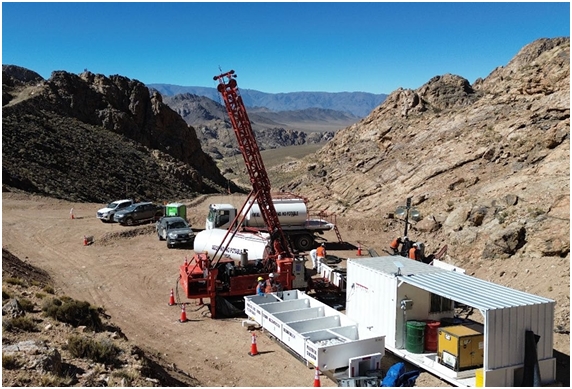
Rig setting up over first drillhole LODH-023
Managing director Mark Purcell said the start of drilling marked an important step after earlier logistical delays and positioned the company to test what could be a large-scale system.
“Following some unforeseen delays, primarily due to supplier availability after the demobilisation of higher-altitude projects for the winter in the nearby Vicuña district, drilling has now commenced at NewPeak’s 100%-owned exploration permits at the Las Opeñas gold project,” Purcell said.
“Las Opeñas has the potential to be a large-scale, gold-dominant polymetallic system situated in one of the best mining provinces not only in Argentina, but in the world, namely San Juan Province,” he added.
Program targets scale and depth potential
The current program is focused on extending known mineralisation both laterally and at depth, with the first hole targeting ground adjacent to — and deeper than — a historical hole drilled in 2012.
NewPeak is using a Sandvik DE710 rig capable of drilling beyond 700 metres, allowing it to test deeper zones where mineralisation may strengthen.
The drilling is expected to take around eight weeks, although timelines could shift depending on penetration rates, weather and whether additional metres are added. Samples will be sent to ALS laboratories in Mendoza for assay.
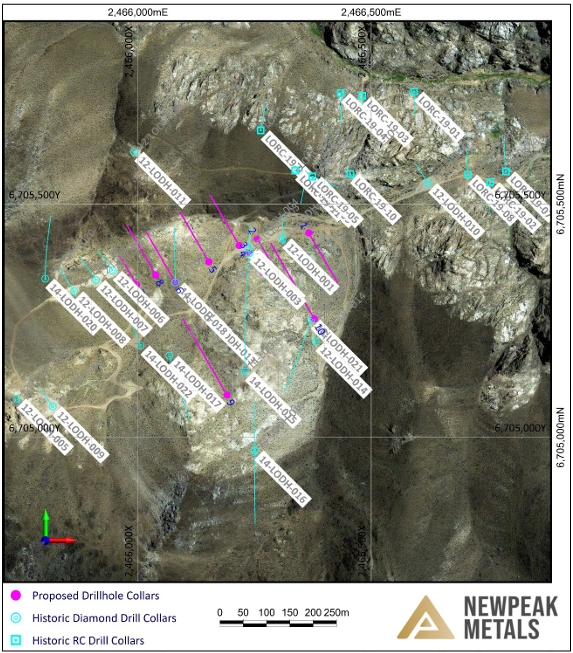
Planned drill hole locations; numbers adjacent to proposed collars depict current order of priority
Breccia-hosted system under investigation
Las Opeñas is centred on a reinterpreted breccia zone measuring roughly 800 by 600 metres, which has previously only been tested at relatively shallow depths.
Geological work suggests the system comprises two phases of mineralisation:
- Broad, silver-dominant mineralisation within phreatic breccias
- Gold-silver-polymetallic mineralisation hosted in discrete hydrothermal breccias, which appear to strengthen at depth
This combination, along with strong alteration and favourable structural setting, supports the view that the project could host a larger-scale mineralised system.
NewPeak also highlighted multiple historic drill intercepts across the Belleza breccia target, reinforcing the continuity and footprint of mineralisation across the prospect.
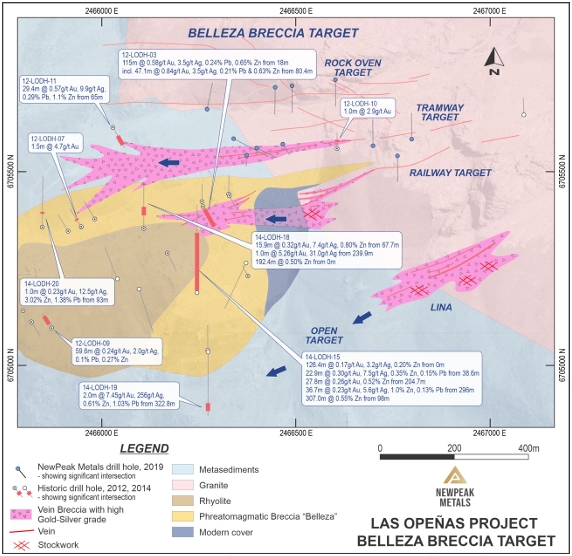
Historic drilling results in Belleza Breccia area at Las Opeñas
Strategic location in prolific mining belt
The project sits in San Juan Province, a well-established mining jurisdiction in Argentina, located about 70 kilometres southeast of the Veladero gold mine and roughly 110 kilometres from the Hualilan project.
Las Opeñas is positioned within a broader cluster of major deposits and operating mines, underlining its proximity to existing infrastructure and mineral endowment.
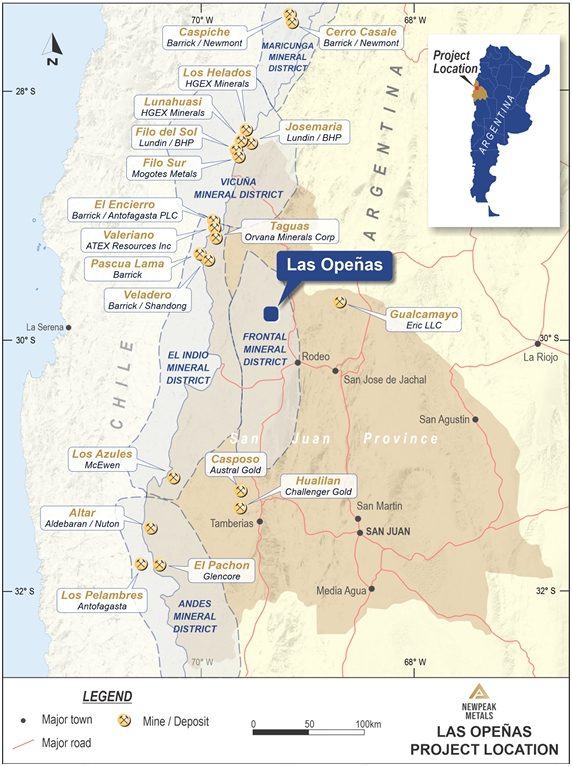
Location of Las Opeñas Gold Project
Near-term catalysts across portfolio
Alongside Las Opeñas, NewPeak is also awaiting assay results from its Tansey Gold Project in Queensland, where 1,179 metres of recent drilling targeted extensions of high-grade mineralisation.
Purcell said results from Tansey are expected in mid-to-late May, noting that industry-wide delays in assay turnaround times have affected timing.
He added that the company could be approaching a pivotal period across its portfolio, with drilling under way in Argentina and results pending in Australia.
“NewPeak feels like it could be on the verge of not one, but two exciting gold discoveries within the next three to five months, and given its current market capitalisation, it is extremely well placed for upside,” he said.