
- FTSE 100 declines 16 points to 10,364
- NatWest falls 3.5% on Q1 report
- Pearson surges 5.8%
- Manufacturing PMI jumps to 53.7
- US futures trade higher
4.55pm: Stocks start month with slight reverse
The FTSE 100 finished Friday’s session roughly 15 points lower at just under 10,364 as across the Atlantic US stocks hit record highs.
The London index ended up with a virtually flat April and has started May with a slight decline, as UK yields remain close to multi-year highs.
This following the highs in oil prices this week and the BoE's "active hold", as Andrew Bailey put it.
But on the other side of the Atlantic the S&P 500 and Nasdaq 100 have hit new records.
4.10pm: Looking ahead as FTSE closes gap
The FTSE is almost back to parity for the day, wiping out almost all the losses that threatened to sully May Day.
Perhaps it is benefiting from a slight easing in government bond markets today. Yesterday saw the 10-year gilt yield traded above 5%, ie around 2008 levels, though it remains around that level today, which should be pressing on equities. The 30-year yield hit a high earlier in the week of 5.75% peak, a level not seen since 1998, and today is only slightly lower.
At the end of the week, attention turns to the next one, where a slew of UK results and US tech earnings loom.
After the bank holiday Monday off, Tuesday kicks off with HSBC and International Workplace Group; then Wednesday sees Next,
Renishaw, Smith & Nephew and Trainline.
Things gets busier on Thursday with Balfour Beatty, Coca-Cola HBC, Harbour Energy, Helios Towers, HgCapital Trust, Hiscox,
InterContinental Hotels Group, JD Sports Fashion, Morgan Sindall Group, Rathbones Group and Shell.
Friday finishes with Airtel Africa, IAG and Rightmove.
Across the pond, there will be numbers from Palantir (on Monday), Advanced Micro Devices, PayPal, Shopify, Disney, along with transatlantic Arm Holdings.
"One theme reinforced this week is that AI capex, or capital spending, isn't slowing, as outlays could approach $700 billion in 2026," says analyst Joe Mazzola at Charles Schwab.
"Markets are rewarding AI spending that shows near-term monetization, as seen with Alphabet, and punishing spending without clear incremental returns - something analysts criticized after viewing Meta Platforms' results. Expect sharper demands for AI return on investment disclosure next quarter."
3.29pm: FTSE battles back
London's blue-chip index has fought its way almost back to dry land for the day, while the mid-caps of the FTSE 250 have broken into sunshine and flowers, up 0.3%.
Almost three-quarters of FTSE 100 stocks are now in green, led by Ladbrokes owner Entain's 4.8% gain, with Premier Inn parent Whitbread up 4.1% and energy distributor DCC rising 3.8%.
Metlen Energy, Pearson, Unilever, L&G and M&S are also all up between 3% and 2%, with bIg guns like Rolls-Royce and Compass not far behind.
NatWest Group remains firmly in red.
Leading the 250 are NCC Group, Goodwin, Raspberry Pi, Oxford Nanopore and Rotork.
3.12pm: Rolls, Weir, Apple
Some broker notes of note.
Deutsche Bank has stuck with its positive view on Rolls-Royce after what it called an upbeat first-quarter update, with engine flying hours already at the lower end of the company’s full-year guidance range.
Analyst Christophe Menard says the statement "gives the impression that the company truly stress-tested its business against the possible market backdrop and came out with a positive assessment", Menard concluded.
Weir Group's trading update yesterday has seen the shares fall around 15% this week, with another 3% fall today, but analysts at UBS and Panmure Liberum say the shares look much too cheap, overweighing some growth concerns.
Panmure Gordon's Alex O'Hanlon acknowledged that softer organic orders could concern investors, but felt the company's strong order book and visibility for the year ahead offer a solid foundation, upgrading to a 'buy' rating from 'hold'.
UBS analyst Ed Hussey expressed caution, with the orders update prompting a reduction in growth forecasts and the price target 15% to 3,400p, but highligted 6% cash yield, strong margins and good exposure to metals like copper and gold.
Apple's quarterly results, as well as coming in ahead of market expectations, were special, says Dan Ives at Wedbush as China was a standout, with revenue in the region climbing 28% to $20.5 billion.
Ives said China "is a key theme for Apple as this core region has been a persistent growth headwind".
2.45pm: US stocks open higher
Wall Street stocks have opened higher, helped by strong early gains for Apple.
The Nasdaq has started with a gain of 0.7%, while the S&P 500 has risen 0.5% and the Dow Jones 0.25%.
Apple is up 3.4%, while Nvidia, Microsoft and Oracle among other tech giants have all made good early gains.
A 5.7% drop for Amgen has held the Dow back.
2.02pm: FCA faces four legal challenges to motor finance scheme
The UK financial regulator said it will defend its motor finance compensation scheme after a series of legal challenges from lenders and a consumer group.
The Financial Conduct Authority said its aim remains to ensure customers receive compensation quickly while preserving stability in the market, where £39 billion was borrowed in 2024.
Four challenges have been lodged. One comes from Consumer Voice, while lenders Volkswagen Financial Services, Mercedes Benz Financial Services and Credit Agricole Auto Finance have also taken action.
The FCA said: “We will defend the scheme robustly as lawful and the best way to resolve such a widespread, long running and complex issue.”
1.22pm: Iran presents new proposal
Iran presented a new proposal to the US yesterday, via mediators from Pakistan.
Oil prices are unmoved by this, given the lack of concrete progress in recent weeks, with the FTSE also remaining roughly where it shifted to at the start of the session.
Brent futures are sitting just above $111 a barrel today, down from the $126 reached yesterday.
Is this a new, new proposal?
As, earlier in the week, it was reported by local media that there was a new proposal to end the ongoing war, focusing on reopening the Strait of Hormuz while postponing a deal on Iran’s nuclear programme.
Essentially, Tehran has offered to reopen the Strait on the condition that the US lifts its naval blockade on Iranian ports and agrees to end the war.
A central feature of the offer, Al-Jazeera reported, was that talks over Iran’s nuclear activities would be postponed until after the war ends.
12.43pm: Worst April for high street in a decade
Sales of discretionary retail items, such as fashion, lifestyle and homewares fell 1.6% in April compared to the same month last year, according to the BDO tracker.
It was the worst April in a decade, excluding the pandemic lockdown, when stores were shut.
All three categories of discretionary spend recorded a decline in total sales for the first time since March 2018 too, Covid aside.
In-store sales performed particularly badly, falling 1.8%, with BDO attributing this to weak consumer confidence and rising living costs, making it the eighth month of sub-inflation sales growth.
"April is traditionally a positive month for the sector, as new spring and summer ranges arrive in store and consumer demand typically strengthens. Against that backdrop, these figures are particularly concerning," said BDO retail expert Sophie Michael.
"Despite periods of warm, sunny weather this year, consumer behaviour remains firmly restrained.
"There is no sugarcoating the outlook for retail as rising fuel prices continue to have knock‑on effects across household budgets, driving up the cost of essentials such as food, fuel and energy from an already high base."
She sees little evidence to suggest a meaningful improvement in the near term.
12.26pm: Havoc in currency markets
Today's main focus is the "havoc" in currency markets, says Kathleen Brooks, research director at XTB.
This is due to energy price spikes.
Japan's yen popped higher once again, extending sharp rises from Thursday on rumoured intervention by the Japanese authorities.
USD/JPY is down nearly 2% so far this week, and is trading at 156.60, the lowest level since late February.
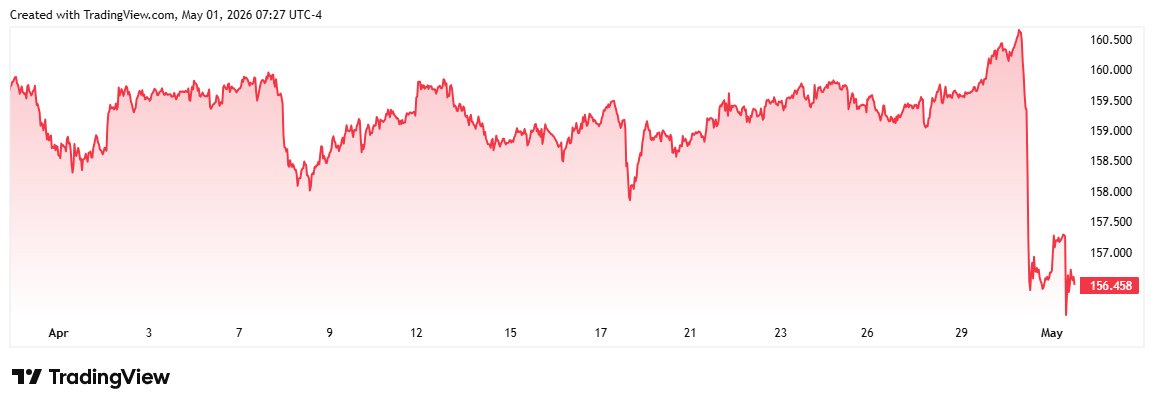
"A 2% move may sound mild, especially compared to the wild gyrations in oil and stock markets in recent months, however, after remaining relatively calm compared to other asset classes this year, FX is now on the move," says Brooks.
"This has huge implications for inflation and growth rates around the world and central bank policy. The BOJ intervened to stem the yen’s decline to contain inflation caused by the energy price spike, after USD/JPY reached a high above 160.50 earlier this week."
Bloomberg is also reporting that Japanese officials are willing to intervene in the crude oil futures market too, in an attempt to stem oil price volatility.
"If this were to happen, this would be a whole new level of intervention in financial markets. It would be a difficult thing to pull off, as oil price moves are due to global supply and demand considerations," Brooks adds.
Elsewhere in the currency space, the pound is up 0.1% to $1.3615, around its highest level versus the US dollar since mid-February.
The EUR/USD has risen over 1.6% last month as the support for the dollar withers even though the blockade in the Strait of Hormuz carries on.
Brook says US indices, having posted their strongest monthly gain since Covid, as the impact of the war in the Middle East and the oil price is "having a less noticeable impact on financial markets even as the blockade of the Strait of Hormuz remains in place and as Iran and the US trade threats about ending the ceasefire".
Wall St was boosted by a strong first quarter earnings season, particularly from the likes of Google, Apple, and Eli Lily.
"This does not mean that a rising oil price is not a major focus, but in the coming weeks, rising oil prices may have a bigger impact in the FX market and interest rate futures market, compared to the global stock market, which could get a boost from positive earnings revisions in the coming weeks."
12.10pm: FTSE still underwater, Wall Street futures mixed
The FTSE remains in the red as we tick past midday, while US futures are mixed.
Dow Jones and S&P 500 futures are pointing 0.2% and 0.1% higher, while those for the Nasdaq are down 0.15%.
A premarket gain of over 3.5% for Apple is a key factor, plus manufacturing data from S&P and ISM.
There are earnings today from the likes of Exxon Mobil, Chevron, Colgate and Dominion Energy.
10.30am: Reality reigns
There's a mix of factors weighing on the FTSE 100 as the week draws to a close, with the index now down 68 points at 10,310.74, according to AJ Bell's Russ Mould.
Continuing concern about the situation in the Middle East, profit taking in the utilities sector and weakness among precious metals miners are all contributing. United Utilities Group PLC (LSE:UU.) and Severn Trent PLC (LSE:SVT) are down 3.2% and 2.7% respectively, while Endeavour Mining has shed 5.7%, reversing most of yesterday's strong gains.
“The latest US earnings season has been robust, which has helped prevent global markets from suffering big losses despite the impact of the Iran conflict," Mould said. “But oil prices remaining above $110 per barrel are a reminder of the stakes for the global economy and the fact that there looks to be no path to the Strait of Hormuz reopening in the near term.
Brent crude futures are currently 1% up at $111.54 a barrel.
9.50am: UK factories are booming - for now
UK manufacturing is having a moment. The sector's PMI hit 53.7 in April, a near four-year high, with output, new orders and employment all rising, according to S&P Global. It's the sixth month running above the 50-point mark that separates growth from contraction, and new orders are growing at one of their fastest rates in around four years, with demand coming in from the US, China, Japan and India.
But before anyone gets too carried away, there are some serious catches.
The conflict in the Middle East is causing real headaches for supply chains. Restrictions on the Strait of Hormuz are snarling up deliveries, with supplier lead times lengthening at the fastest rate in almost four years. That's feeding through to costs in a big way: input price inflation has hit a near four-year high, rising at one of the fastest rates in the survey's 34-year history.
S&P Global's Rob Dobson didn't pull his punches, warning that some of the recent strength in production is down to customers buying early to get ahead of expected price rises and supply disruptions. Once that effect wears off, he cautioned, "growth in the sector could cool while inflationary pressures remain on high heat."
Business confidence is already feeling the strain, dropping to its lowest level in a year as firms fret about geopolitical uncertainty and policy concerns.
9am: Pearson impresses
Pearson appears to be the standout performer this morning, and is now top on the leaderboard with a 5.8% jump to 1,144p. The education group reported a solid start to 2026, with underlying sales growth of 4% in the first quarter coming in line with expectations.
Virtual Learning was the standout, surging 21%, while Enterprise Learning & Skills grew 8%, and both Higher Education and English Language Learning edged up 2%. The only weak spot was Assessment & Qualifications, down 1%, though Pearson expects that to reverse from the second quarter.
Chief executive Omar Abbosh said the company is making good progress on its AI strategy, including a Communication Coach integrated into Microsoft 365 and new AI-focused courses and certifications.
Pearson confirmed it remains on track for full-year guidance, targeting mid-single digit underlying sales growth and adjusted operating profit of £640 million to £685 million. The £350 million share buyback continues, with £219 million already completed.
8.40: House prices perk up
UK house prices saw a modest but steady lift in April, with annual growth rising to 3% from 2.2% the month before. On a monthly basis, prices edged up 0.4%, taking the average UK home to £278,880.
What stands out is the market’s resilience, according to Nationwide chief economist Robert Gardner. This comes despite weaker consumer confidence and ongoing global uncertainty, including higher energy prices. Demand signals have softened somewhat, with fewer new buyers entering the market, but prices have held firm.
A key support has been household finances. Debt levels remain relatively low compared to income, and many households still have savings buffers built up in recent years. Affordability has also improved, helped by wage growth and earlier declines in mortgage rates.
Looking ahead, the picture is less certain. Economic growth could slow, and inflation may rise, but if current pressures ease, any housing market slowdown may be temporary.
8.15am: Weak ending to the week
The FTSE 100 fell close to half a percent at the open before retracing some of its losses to trade 39 points down at 10,339.93 as investors took some cash off the table ahead of the bank holiday weekend.
United Utilities Group PLC (LSE:UU.) saw the biggest decline, down 4.1%, followed by NatWest Group PLC (LSE:NWG), which fell 3.5% in opening trades despite reporting first-quarter profit ahead of expectations and upgrading its income guidance for 2026.
Endeavour Mining PLC (LSE:EDV, TSX:EDV, OTCQX:EDVMF, FRA:6E2) and Fresnillo PLC (LSE:FRES) shed 2.9% and 2.4% respectively, with the former retracing some of the week's strong gains.
Among the gainers, Diageo PLC (LSE:DGE) is up 2.1%, Unilever PLC (LSE:ULVR) has gained 1.9% and Pearson PLC (LSE:PSON) is 1.1% firmer after reporting 4% underlying sales growth in the first quarter, in line with expectations.
7.45am: April ends with a bang
April turned out to be a remarkable month for equities, even as government bond yields climbed to multi-year highs on stagflation fears, Deutsche Bank's Jim Reid has noted in his regular morning commentary. The S&P 500 delivered a total return of 10.5% - its best monthly performance since the vaccine euphoria of November 2020 - closing at a record high. The Philly Semiconductor index was the standout, surging 38.4% for its best month since February 2000. Europe held its own, too, with the Stoxx 600 gaining 5.6% and emerging markets jumping 14.7%.
Trading is expected to be subdued today, with much of Europe on holiday and the UK facing a long weekend.
Oil remains a focal point, with Brent crude climbing to $111.58 a barrel as US-Iran tensions show no signs of easing. Reid noted that Trump "showed no sign of backing down," while Iran's new Supreme Leader signalled the country would maintain its missile and nuclear capabilities and threatened new restrictions over the Strait of Hormuz.
Meanwhile, futures traders are now betting the FTSE 100 will open about 29 points lower.
7.15am: Marking time
The FTSE 100 is expected to open little changed on Friday ahead of the UK's three-day weekend, with futures pointing to a decline of around 6 points at the open - a modest pullback after Thursday's strong session, which saw the index climb 165 points to 8,378, driven by bumper earnings from Rolls-Royce.
Swissquote market analyst Ipek Ozkardeskaya noted that earnings are outshining war warriors as another month ended with no light at the end of the tunnel for the Iran war.
In the US, Thursday’s close marked the end of the best month for US stocks since 2020, with gains driven by economic data and Big Tech earnings. The S&P 500 added 1%, the Nasdaq was up 0.9%, and the Dow Jones added 1.6%, led by Caterpillar, which beat estimates with a 22% rise in Q1 revenue, supported by data centre and power infrastructure demand.
"As we enter May – traditionally a softer month – earnings resilience continues to offset geopolitical and inflation concerns," said Ozkardeskaya. "US futures point to a positive open, while many European markets are closed for Labour Day. AI optimism remains the base case unless geopolitics deteriorate."