
A sudden geopolitical shock has exposed just how fragile the global helium market really is — and why new supply is becoming a strategic priority.
Tensions in the Middle East have effectively choked off a major portion of global helium flows, with the closure of the Strait of Hormuz and damage to key Qatari infrastructure removing roughly a third of supply from the market almost overnight. Most of the world’s helium is produced as a by-product of liquefied natural gas (LNG) processing, meaning disruptions to gas exports in the Gulf cascade directly into helium shortages.
Helium’s essential role in semiconductors, medical imaging and advanced computing has exposed the vulnerability of critical supply chains to energy geopolitics, recasting the gas as a strategic resource rather than a niche industrial input.
Against that backdrop, companies capable of bringing on new, independent supply are drawing renewed attention — and few are as directly leveraged to this theme as Noble Helium Ltd (ASX:NHE, OTC:NBHEF, FRA:GN1).
At the centre of Noble’s strategy is its North Rukwa Project in southwestern Tanzania, offering exposure to what the company describes as a basin-scale, primary system in the world’s most credible Tier-1 helium exploration province, outside traditional LNG-linked supply chains. With a drilling campaign set for the June quarter, Noble is approaching a potentially defining moment.
Helium moves into focus as supply tightens
Helium demand is already forecast to rise sharply over the next decade, driven by high-growth technologies including artificial intelligence, quantum computing and advanced manufacturing.
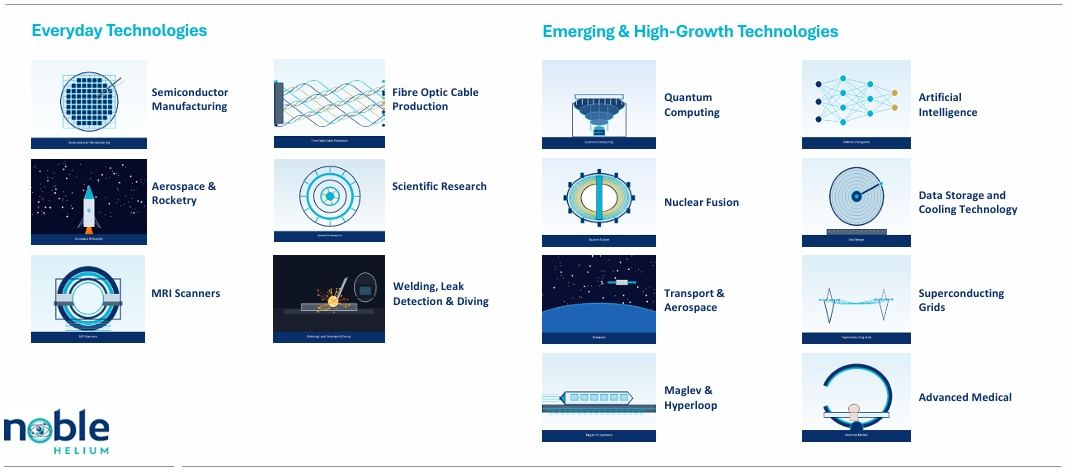
Helium – a fundamental enabler of the tech economy
Global consumption is expected to increase by more than 80% by 2035, while the market itself could nearly double in value. Yet supply remains constrained, both structurally and geopolitically.
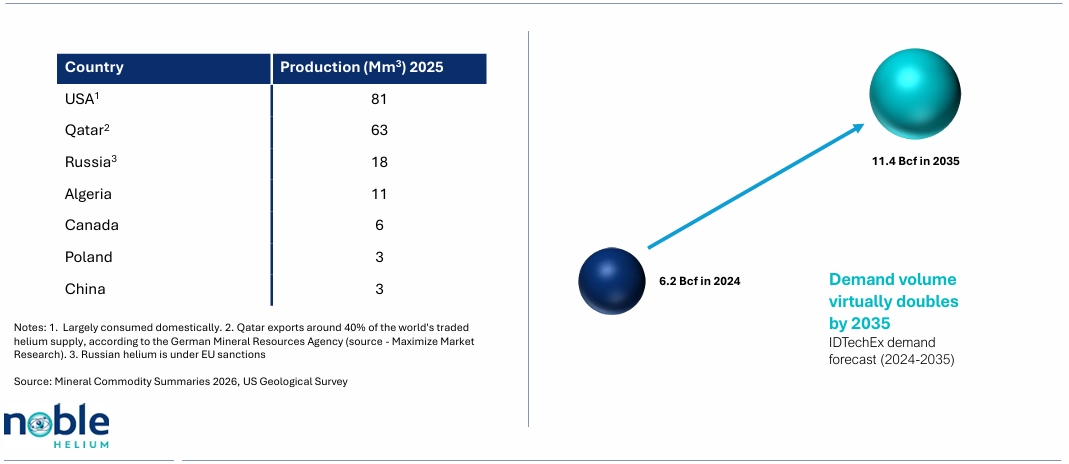
Global helium demand volumes to double by 2035 AI, quantum computing and data centres
A key inflection point came in early 2026, when the Gulf conflict forced the shutdown of Qatar’s Ras Laffan complex — one of the world’s largest sources of LNG-linked helium — removing a significant share of global supply almost overnight. Combined with ongoing constraints elsewhere, the outage exposed how concentrated and fragile the helium market has become, pushing prices sharply higher.
That shift is central to Noble’s investment case. The company is targeting “primary” helium — not a by-product of LNG production — which can be developed independently of oil and gas markets. It’s a meaningful distinction in a market where co-production dependencies have historically driven volatility.
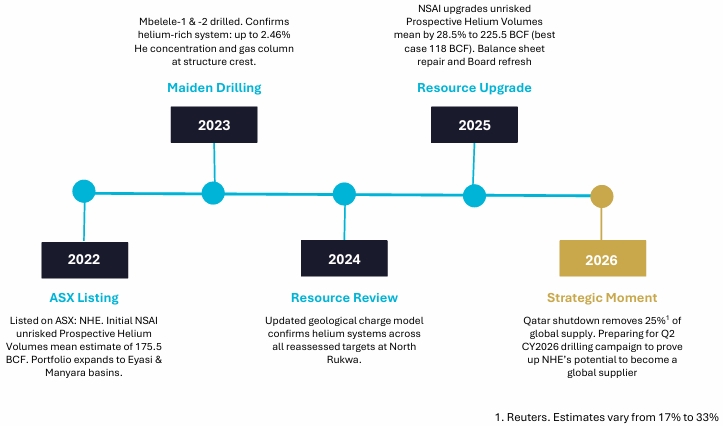
Noble Helium, driven by a new board, has overcome recent challenges and is drill ready
A basin-scale play with global ambitions
Noble’s approach is anchored by its dominant position in Tanzania’s Rukwa Basin, where it holds the largest acreage footprint. The company’s latest independent assessment estimates unrisked prospective helium volumes at a mean of 225.5 billion cubic feet (Bcf), with a best estimate of 118 Bcf — early-stage figures that point to significant upside if drilling delivers.
The geological setting is a key part of the story. The Rukwa Basin sits within the western branch of the East African Rift system, where unique geological conditions are believed to support the generation and trapping of helium in a gas-phase environment, rather than dissolved in hydrocarbons.
Surface measurements at North Rukwa have indicated helium concentrations of roughly 3–18% — far above the ~0.03% typically seen in LNG-linked production — supporting the case for a standalone helium system.
If proven, the basin has the potential to reposition Tanzania among the world’s leading helium producers — a prospect that has drawn increasing industry attention.
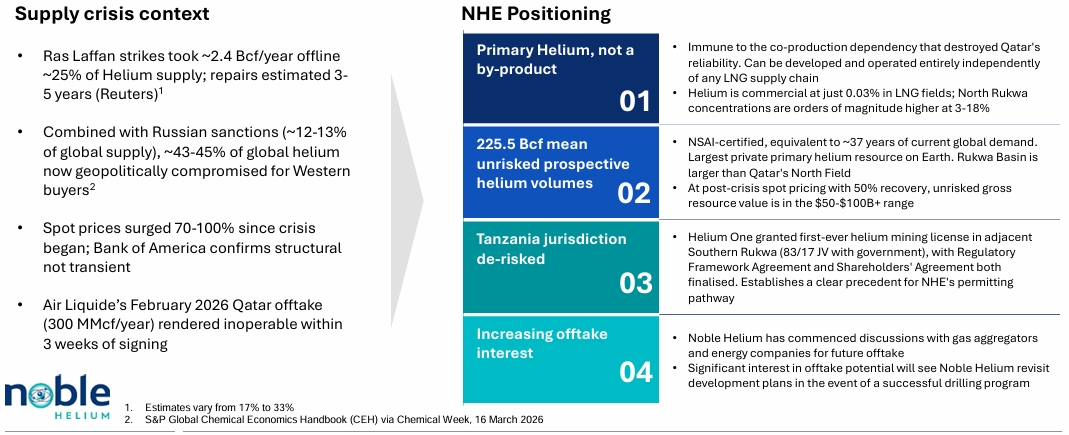
A structural shift in global helium –why North Rukwa matters now: The March 2026 Qatar crisis has removed ~25% of global helium supply for 3-5 years
Drilling campaign set to test the model
Noble Helium is now preparing a multi-well drilling program targeting its western margin prospects, an area seen as the most immediate pathway to commercialisation. The campaign will test up to four gas-phase helium targets, including the Mbelele and Kinambo prospects, where previous work has already confirmed a helium-rich system.
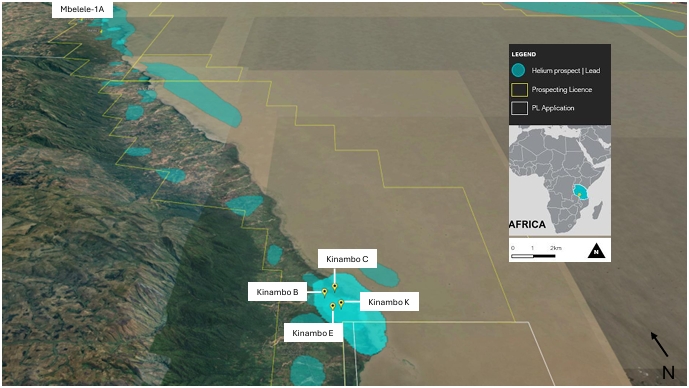
Western margin drill campaign will test up to four gas phase helium targets
At Mbelele, earlier drilling encountered helium concentrations of up to 2.46% at depth, alongside indications of higher concentrations in shallower zones.
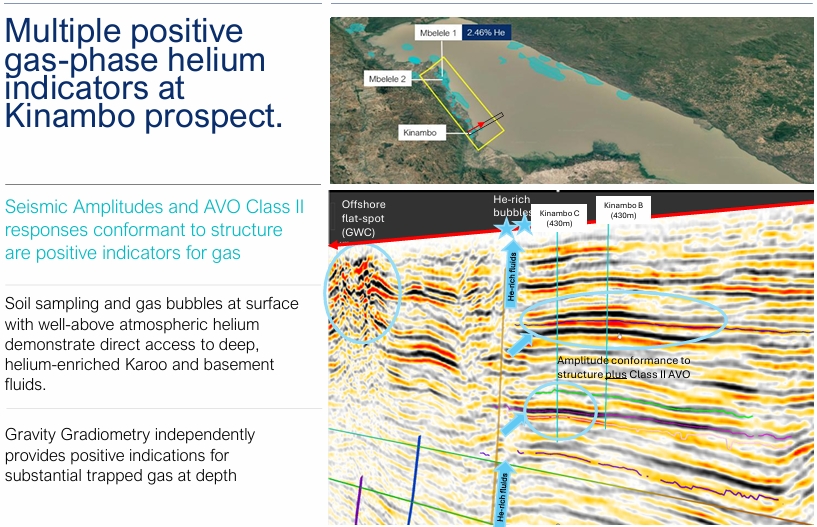
At Kinambo, multiple lines of evidence — including seismic responses, soil sampling and gas seeps — point to the potential for trapped gas accumulations.
Importantly, these western targets are relatively shallow and cheaper to drill, offering a more direct route to early production.
The company is targeting a phased development approach:
- Western margin — near-term appraisal and potential early production
- Eastern margin — deeper, higher-impact targets with larger-scale potential
- Multi-stage growth — reinvesting early cash flow to expand the resource base
If successful, even a single well could validate the broader geological model and significantly de-risk the wider basin.
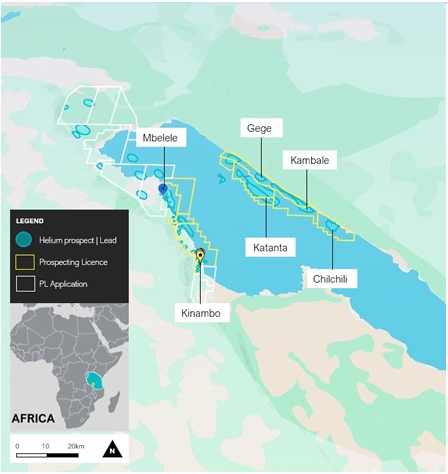
A staged pathway from discovery to development
Noble’s broader strategy reflects the early-stage nature of the project, with a focus on de-risking through incremental progress rather than a single large-scale development leap.
The company outlines a five-stage pathway:
- Appraise — prove up helium along the western margin
- Install — deploy small-scale production infrastructure
- Build — expand resource and production capacity
- Grow — define larger eastern margin opportunities
- Develop — establish a major production hub
This staged approach is designed to balance risk and capital requirements, while creating optionality around partnerships, farm-ins or offtake agreements.
Noble has already begun discussions with potential gas aggregators and customers, signalling early interest in future supply.
Leadership reset and funding in place
The upcoming drilling program follows a period of restructuring for the company, including a refreshed board and a repaired balance sheet.
Executive chairman Dennis Donald brings a track record in energy development, having previously co-founded Warrego Energy, which was sold for $440 million in 2023. The broader team combines experience across exploration, development and commercialisation in global energy markets.
To fund the next phase, Noble recently raised $12 million through a placement, with proceeds earmarked primarily for drilling and associated technical work at North Rukwa.
A critical test ahead
That funding positions Noble to move into what it describes as a “company-defining” campaign — the first meaningful test of whether North Rukwa can begin translating its geological potential into a commercial pathway.
A successful result would not only validate the project but also sharpen its relevance in a market anxiously searching for new, reliable helium supply.
With drilling set to begin in the June quarter, the next phase will be closely watched.