
FireFly Metals Ltd (ASX:FFM, TSX:FFM, OTC:MNXMF) has spent the past two years doing what the market loves to reward in early-stage mining stories: drilling, growing and steadily proving up a high-grade system.
In 2026, the narrative is starting to change.
The company’s Green Bay Project in Newfoundland, Canada, is moving beyond its roots as an exploration success built on high-grade copper and gold intercepts. The focus is now shifting to its potential as a large-scale mining operation, with the technical groundwork for that transition beginning to take shape as the story moves into its next phase.
Scale builds, but grade remains the differentiator
At its core, FireFly’s story remains one of rapid resource growth, with the company continuing to expand the Green Bay system at pace.
The latest figures point to a system now hosting around 1.7 million tonnes of contained copper equivalent at grades above 2% CuEq — a meaningful step up from earlier estimates and a level that begins to place the project in a more globally competitive context.
But scale is only part of the appeal. A defining feature of Green Bay has been its exceptionally high-grade core, with zones approaching 3.8–3.9% copper equivalent. The system is hosted within volcanogenic massive sulphide (VMS) mineralisation, typically associated with clusters of high-grade deposits, which helps explain both the grade and the broader district-scale potential.
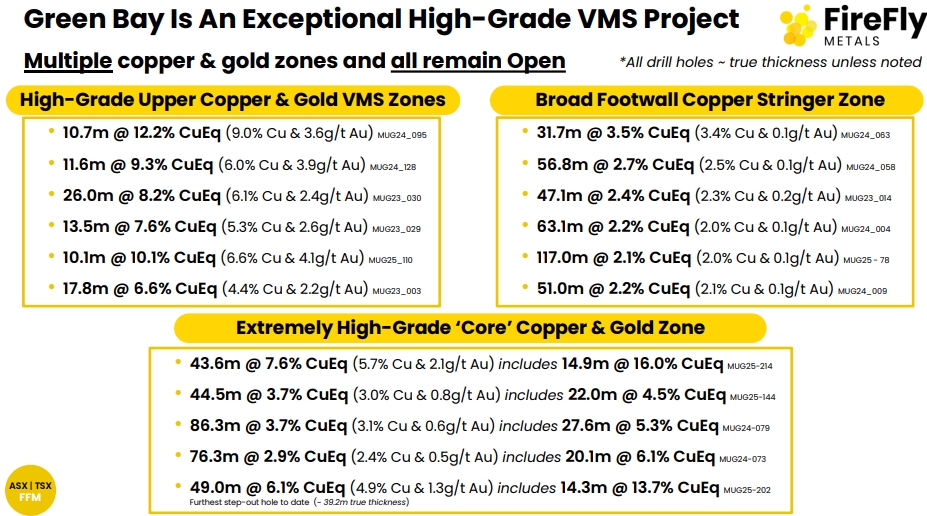
Source: FireFly Metals
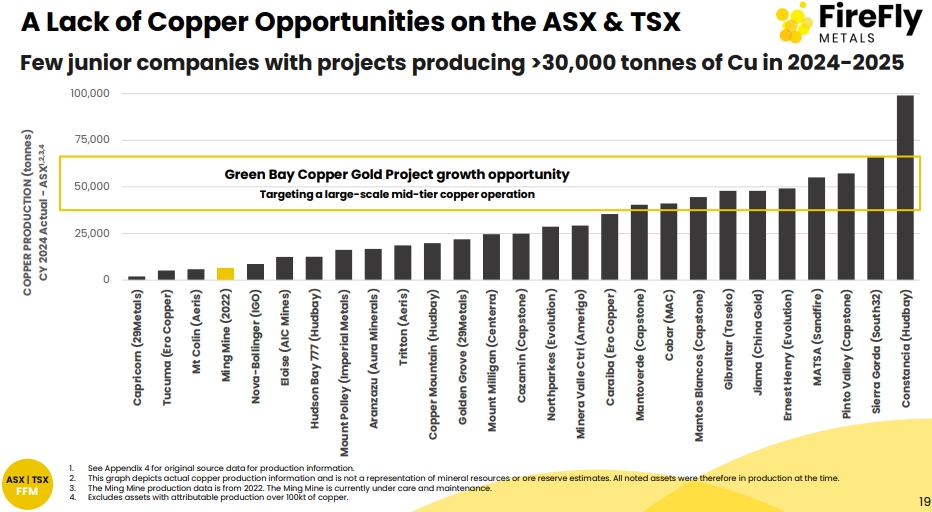
Projects combining this level of size and grade are relatively uncommon in modern copper discoveries, particularly in established jurisdictions.
Recent drilling continues to reinforce FireFly’s thesis, with thick, high-grade intercepts extending mineralisation both along strike and at depth. Just as importantly, much of the system remains open, leaving room for further growth.
That open-ended nature has underpinned the company’s aggressive drilling strategy to date — and continues to support the idea that Green Bay could evolve into something significantly larger than its current footprint.
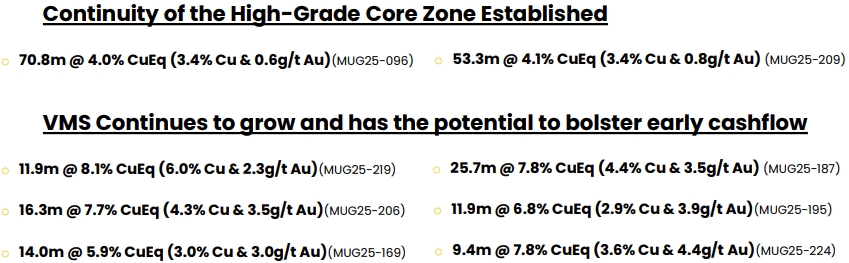
Recent Results Highlight the High-Grade Potential
From tonnes to confidence: The shift towards mineability
If the past two years have been about adding tonnes, the next phase is about improving confidence in those tonnes.
FireFly is now placing greater emphasis on converting resources into higher-confidence categories, particularly Measured and Indicated (M&I) material — a critical step in advancing any project towards development:
- only M&I resources can underpin ore reserves;
- economic studies require a high proportion of these higher-confidence tonnes; and
- they ultimately determine how much of the resource can be turned into a mine plan.
Recent drilling has increasingly focused on infill work within the high-grade core zone, aimed at tightening geological understanding and supporting future economic studies.
This marks a subtle but important shift in strategy: from proving the system exists to proving it can be mined.
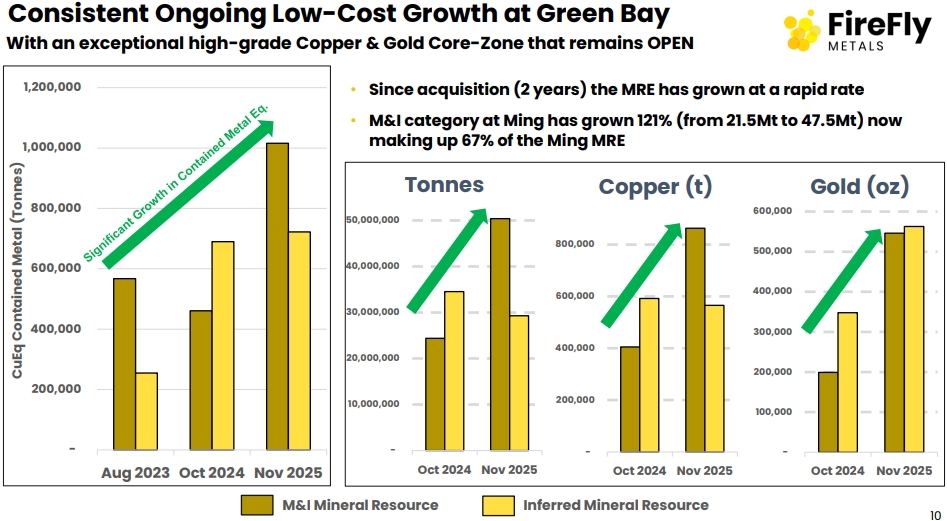
Laying the groundwork for a development decision
Alongside resource work, FireFly has begun outlining the early contours of what a mining operation at Green Bay could look like.
The project benefits from a significant head start in this regard, with:
- existing underground development and infrastructure;
- proximity to a deep-water port;
- access to low-cost hydroelectric power; and
- location within a Tier-1 mining jurisdiction.
Those advantages have long supported the investment case, and attention is now turning to the next phase, with economic studies targeted for 2026 and early-stage work progressing across mining methods, processing, and site design.
Initial planning has already identified a potential mining approach, with work commenced on metallurgical testing, environmental approvals and infrastructure layout.
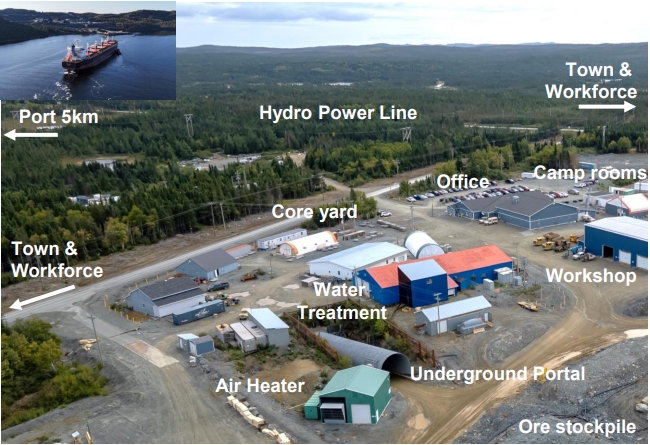
Even at this early stage, Green Bay is being positioned not just as a discovery, but as a development project with a pathway to production.
A stronger balance sheet to support the next phase
The company’s financial position has also evolved alongside its technical progress.
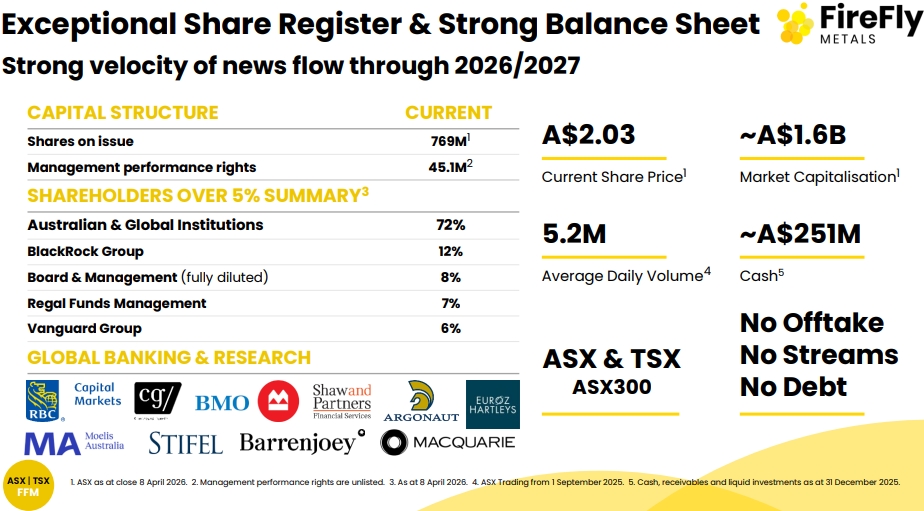
FireFly now holds a substantial A$251 million cash balance following recent capital raisings, while its market capitalisation has risen sharply over the past year. That re-rating reflects both exploration success and growing confidence in the broader development narrative.
Importantly, the company remains well-funded to continue its aggressive drilling and study programs through 2026 and beyond, without immediate reliance on additional capital.
That funding position is critical at this stage. Advancing from resource growth to development studies is capital-intensive, and the ability to maintain momentum without dilution pressure is often a key differentiator among emerging developers.
Unlocking value beyond Green Bay
While Green Bay dominates the investment case, FireFly has also taken steps to simplify and sharpen its portfolio.
The company has now secured shareholder approval and cleared all conditions for the sale of its Pickle Crow gold project in Ontario to Bellavista Resources, with completion expected shortly. The transaction will see FireFly shareholders receive Bellavista shares via an in-specie distribution, preserving exposure to the asset’s upside while separating it from the core business.
That move reinforces a broader strategic focus — directing capital and attention towards the copper-dominated Green Bay system, while still allowing shareholders to benefit from the gold asset’s exploration potential.
It also signals a more disciplined approach to portfolio management as the company transitions to a development-focused strategy.
A district-scale opportunity still taking shape
Beyond the defined resource, FireFly continues to highlight the broader exploration upside across the Green Bay district.
Multiple regional targets remain largely underexplored, with additional drilling planned alongside ongoing work at the Ming underground mine. The company is increasingly framing the project as part of a wider mineralised system with potential for further discoveries.
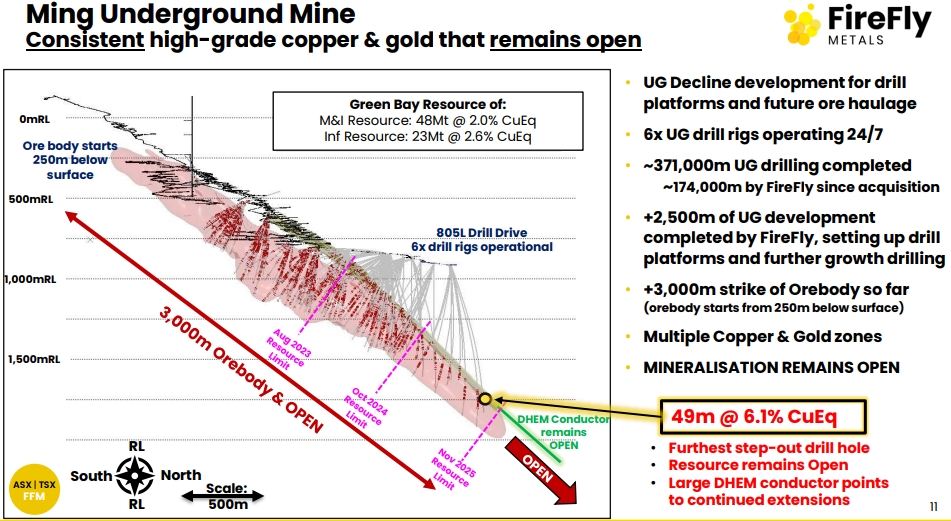
That district-scale perspective adds another layer to the story — one that could extend the project’s life and scale well beyond current expectations if exploration success continues.
For now, however, the focus is firmly on the known resource and its path towards development.
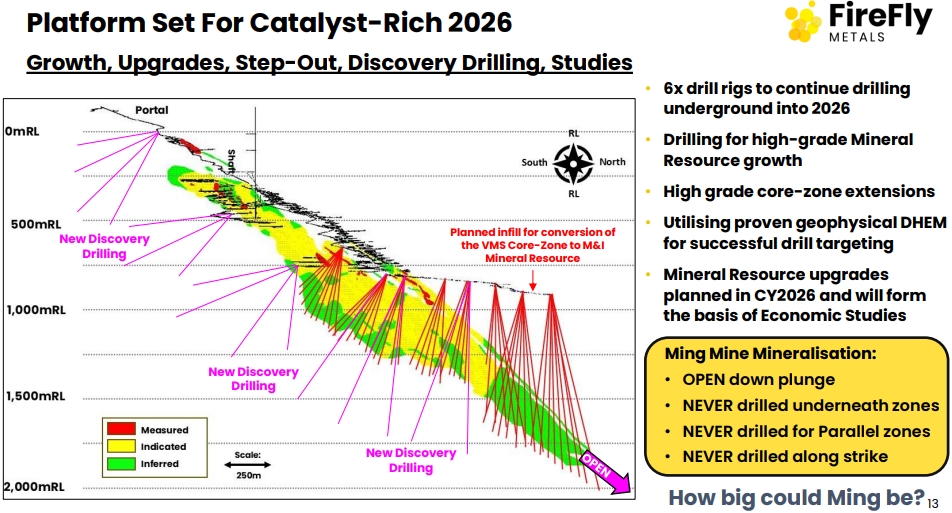
A defining stretch ahead
Exploration stories rarely follow a straight line, but certain phases tend to matter more than others.
For FireFly, the combination of continued drilling, resource conversion work and the commencement of economic studies places the company at one of those inflection points.
The high-grade nature of the Green Bay system has already captured market attention. The challenge now is to demonstrate that those grades — and the growing resource base — can translate into a viable, long-life mining operation.
If that transition holds, the story moves beyond discovery and into something more substantial. And for investors, that is where the next phase of value is likely to be defined.