
- FTSE 100 down 21 points to 10,476
- Oil prices elevated despite Pres Trump extending ceasefire
- UK inflation rises to 3.3% in March
- Reckitt, Bunzl, Aberdeen, Quilter, JD Sports release updates
5.15pm: European stocks struggle
While US stocks moved higher, it was a different story across the Atlantic with the FTSE 100 finishing Wednesday’s session down 21 points at 10,476.
4.14pm: Another down-day in London
London's blue-chips are heading to another negative conclusion, while the mid-cap FTSE 250 is also flat and mainland European markets are in the red too.
Airlines and aerospace-related stocks are a big drag today, as Lufthansa cancelled 20,000 flights due to the elevated oil prices and a growing shortage of jet fuel.
The German airline said axing these "unprofitable" short-haul flights would save 40,000 metric tonnes of jet fuel, which it said had doubled in price
And the European Commission announced a package called 'AccelerateEU' that included optimising the distribution of jet fuel between EU countries in order to avoid shortages.
Earlier, Air France-KLM said it would increase long-haul ticket prices to address surging fuel costs.
Worries about the prospects for US-Iran talks are also weighing on European equities, while Wall Street is making gains thanks to the tech sector, including a recovery for Apple after falling on the back of CEO Tim Cook's notice being given the day before.
"There is the inescapable view that, with the US and Iran not looking likely to start talking, a resumption of hostilities is a distinct possibility," says Chris Beauchamp, market analyst at IG.
He also flags earnings from Boeing, which have "added to the impression that, were it not for the war, markets would be basking in a very solid Q1 reporting season.
"A smaller loss and an increased backlog puts the firm in a good place for the rest of 2026, and now the focus shifts to Tesla to see if the company can put its recent travails behind it."
3.39pm: Mortgage rates start to fall
Several banks have started to lower their mortgage rates, though shares in housebuilding companies are not yet moving much.
HSBC, Barclays and Virgin Money have announced they will be reducing selected fixed rates.
Barclays was first to move, followed by HSBC, which said cuts to some residential and buy-to-let mortgage rates would be effective from Thursday.
Virgin then said it would cut rates by up to 0.45% on 2-year, 5-year and 10-year fixes.
"Cuts this big are great to see and will start to generate confidence across the market. Lenders are now reducing rates as aggressively as they increased them," says morgate broker Katy Eatenton at Lifetime Wealth Management.
"If more lenders follow suit, this may get the property market moving again after what has been an exceptionally turbulent March and April."
Craig Fish, director at Lodestone Mortgages, says Virgin Money's cuts "are a clear sign that lenders who moved too aggressively on pricing during the recent swap rate volatility are now having to reprice. When business dries up at the door, the market finds its level."
He says the cuts of up to 0.45% are meaningful though, and will be welcomed by borrowers.
2.48pm: US tech leads Wall Street higher at open
US stocks have opened higher, led by the tech-powered Nasdaq, up 0.8%, followed by the Dow Jones at 0.7% and the S&P 500 rising 0.6%.
Tech stocks leading the early gains include bitcoin investors Strategy, which is topping the Nasdaq 100 risers, up over 7% as bitcoin climbs to its highest level since early Fenruatry.
Next are names including ARM Holdings, Seagate and Western Digital, while chip names including Micron and AMD also moved higher.
2.16pm: FTSE is 'optional'?
While the FTSE 100 has rebounded to within 3% of its highs and the FTSE 250 is up around 9% from March lows, UBS says the recovery is narrow and driven by sector rotation rather than broader strength.
The Swiss bank's equity strategy team describes the UK as an "optional" market, one where global ownership is dominant, the domestic investor bid is thin, and valuation re-ratings must be earned rather than assumed.
Its primary concern is structural crowding: the UK effectively trades like a portfolio of just 11 to 15 stocks, compared with more than 50 in continental Europe, meaning that underperformance from a handful of large-cap names (see miners, oil giants, banks etc) can overwhelm the entire index.
Sector leadership has shifted materially in recent weeks, with energy rolling from the top of the rankings to the bottom, while financials and materials have moved into leadership positions, real estate is improving, and industrials are turning again.
1.11pm: Crypto trading rings targeted
The UK financial watchdog, HMRC and police organised crime specialists have carried out the first operations to disrupt illegal peer-to-peer crypto trading in London.
Eight premises were targeted for suspected of illegal peer-to-peer crypto trading, where individuals buy and sell crypto directly with each other, rather than using a centralised exchange.
The Financial Conduct Authority (FCA), HM Revenue & Customs (HMRC) and the South West Regional Organised Crime Unit (SWROCU) issued cease-and-desist letters and obtained evidence to support "a number" of ongoing criminal investigations.
There are currently no registered peer-to-peer crypto traders or platforms operating in the UK, the FCA pointed out, saying traders using these methods in the UK are "doing so illegally and pose a financial crime risk".
Detective Inspector Ross Flay of SWROCU said: "As law enforcement, we want to stop these traders providing a route for criminals to move, disguise and spend illegal money."
12.55pm: Brinksmanship in the Gulf
US stocks have been called higher ahead of the open, with futures for the Dow Jones and S&P 500 up 0.5%, while Nasdaq 100 futures are set to lead, up 0.7%.
As a remimder Wall Street saw a weaker session yesterday, with the three main indices all closing down around 0.6%, with the Dow ending at 49,149, the S&P at 7,064 and the Nasdaq Composite at 24,259.
While the ceasefire has been extended, the real-world consequences of the Gulf war are being seen in more ways, says market analyst Joshua Mahony at Scope Markets.
"For Europe time is of the essence, with airlines such as Lufthansa, SAS, KLM, and Iberia cancelling flights owing to the growing Jet Fuel shortages.
"Unsurprisingly, IAG trades lower on the FTSE, with concerns growing around fuel supplies at Heathrow which stands as the primary British Airways hub."
He says the ceasefire extension has seen "a somewhat mixed response" from markets, with Trump’s decision to extend in the absence of any tangible talks "serving to highlight just how weak his position currently is".
"Despite warning that he won't extend, this time around he can't even say that he has seen any progress that provides the basis for this concession."
Mahony says Trump's threats "appear empty and in the absence of any negotiations, it is down the Trump to concede further or escalate".
"For Iran, there is a clarity that each passing day deals additional damage to the global economy, with US inflation on the rise and Trump’s popularity waning."
11.37am: Two vessels seized by Iran in Hormuz
Brent crude has climbed almost to $100 a barrel again after Iran’s Revolutionary Guard seized two vessels in the Strait of Hormuz.
According to the state-linked Tasnim news agency, the two ships were directed to sail to Iranian shores after they were "operating without the required authorisation and for manipulating navigation systems".
The two ships, the MSC Francesca and Epaminondas, were two of the ships reportedly fired upon earlier.
A third vessel, the Euphoria, which is said to be UAE-owned and Panama-flagged, came under attack eight miles west of Iran, according to Vanguard and the UKMTO.
The Iran Navy says the MSC Francesca and Epaminondas were "seized" and directed towards the Iranian coast.
10.57am: UK public's gloom deepens
Another gauge of the UK economic mood.
Net economic optimism in Britain has fallen to the lowest levels ever recorded, according to Ipsos, which first began collecting this data in 1978.
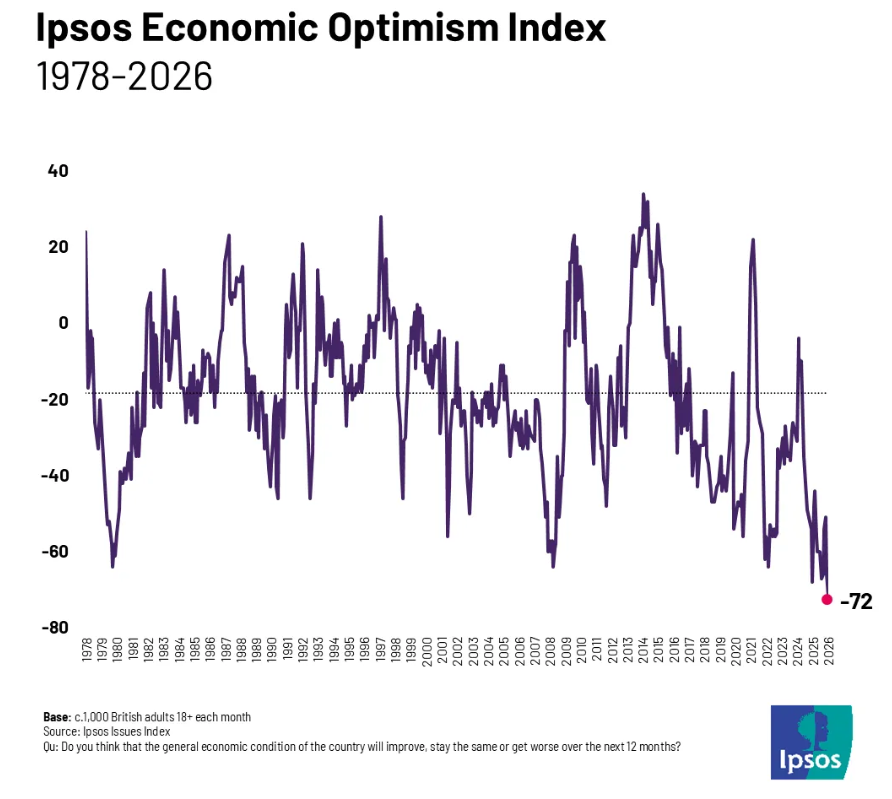
Almost eight out of 10 (78%) of British adults expect a worsening of the country's economic condition over the next year, the survey found.
The economy is now more mentioned as an important issue facing the country, at 33%, overtaking immigration, which has fallen five percentage points to 32%.
The Ipsos economic optimism index net figure of -72, is four points below the previous historic low of -68 recorded in April 2025 after Donald Trump imposed his tariffs, and is lower than the January 1980 recession under Margaret Thatcher after the winter of discontent (a score of -64); the global financial crisis of July 2008 under Gordon Brown (-64),; and the cost-of-living crisis triggered by the COVID-19 pandemic and the invasion of Ukraine in June 2022 (-64).
"Dissatisfaction with the state of the country has been entrenched for some time," says Gideon Skinner, senior director of UK politics at Ipsos.
"Even though Britons recognise the role played by global events on the cost of living, the government is held responsible too, and Labour need to convince the public that they can deliver a more optimistic outlook for the economy if they want to turn their political fortunes around."
10.24am: Ships fired at in Strait of Hormuz
Oil prices are climbing after reports of firing in the Strait of Hormuz.
At least three container ships were hit by gunfire, according to the United Kingdom Maritime Trade Operations.
One incident occurred 15 nautical miles north-east of Oman, with the vessel sustaining “heavy damage” to its bridge, but all crew members reported to be safe.
Other maritime reports say it was the Islamic Revolutionary Guard that had fired at two ships.
The UKMTO said it received a report that a cargo ship was also fired at, about 8 nautical miles northwest of Iran, although it did not say where the shots were fired from.
In a report issued this morning, UKMTO said: “A master of an outbound cargo ship reports having been fired upon and is now stopped in the water. Crew are safe and accounted for. There is no reported damage to the vessel.
“UKMTO is aware of high levels of activity in the SoH (strait of Hormuz) area and encourages vessels to report any suspicious activity.”
9.46am: FTSE flat, gains for oil and miners offset by Reckitt and co
The FTSE 100 is being supported by commodities companies, with BP and Shell joined by precious and base metals miners.
BP is top of the leaderboard, up 2.1%, with Fresnillo and Rio Tinto up over 1.5%. Shell and Glencore are not far behind, while utilities are in demand too.
SSE is climbing for a second day, up 1.3%, and is joined by National Grid.
Bunzl is second among the risers, up 2% as it reported a solid first quarter, with operating profit consistent with management expectations.
Broker Peel Hunt says: "Despite the more uncertain trading backdrop and ability to manage cost inflation, FY26 guidance was maintained. This will likely reassure investors."
At the other end, Reckitt is still the biggest faller, down 5.5%, and has dragged down sector peer Haleon.
Analyst Guillaume Delmas at UBS says Reckitt's Q1 total LFL sales growth of 0.6% came in around 100 basis points below consensus forecast of 1.6%.
The miss was driven by Core Reckitt, where the 1.3% LFL was below the consensus of 2.9%, as growth from three out of four categories came in below expectations.
Other heavyweights in the red include Rolls-Royce, Diaeo, IAG and RELX.
9.36am: House prices up 1.2% on a year ago
The UK's official house price index rose 1.2% year-on-year in February, up from a 1.0% gain in January.
Growth in January was revised down from 1.3% previously.
In seasonally adjusted terms, prices rose by 0.6% month-to-month in February, up from a 0.3% fall in January. January's fall was revised worse from being unchanged before.
Average house prices increased to £290,000 (0.8%) in England, £210,000 (2.5%) in Wales, and £187,000 (2.3%) in Scotland.
Average rents increased to £1,434 in England in March, up 3.4% compared to a year ago, in Wales they were up 4.8% to £830, and up 2.1% to £1,022 in Scotland. In Northern Ireland, average rents increased 5% to £880 in the 12 months to January.
9.09am: Inflation not enough to lead to BoE hikes
There's so much commentary on inflation in my inbox so I should probably share some, after headline UK CPI shot up to 3.3% from 3.0%, while core CPI slowed to 3.2%.
Sanjay Raja, chief UK economist at Deutsche Bank, says food prices were a little stronger than he expected (with foods such as yoghurt, chocolate and fish all seeing bigger gains), with airfares also jumping 10% month-on-month.
Core goods inflation remained subdued on the back of weaker clothing prices, furniture prices, car prices, and IT goods.
"The good news", he says, was that if stripping out more volatile elements, services inflation remained broadly unchanged, while CPI is still expected to take a big step down in April due to the lower Ofgem price cap this year.
"The bad news? The drop won’t be as big as we previously anticipated. Just two months ago, we thought headline CPI could make its way to 2% y/y in spring. Instead, given the energy shock, we expect price momentum to stick around 3% y/y for much of the year."
Adam Hoyes, analyst at Rathbones, agrees and says: "We think investors would be wise to take heed from recent events and prepare for a world of higher and more volatile inflation over the longer term."
With core and services inflation not rising, he adds: "One crumb of comfort for rate setters at the Bank of England will be that there were few signs of higher energy costs putting upward pressure on prices elsewhere in the economy yet."
Hoyes also agrees that the ‘second-round effects’ that drive persistent inflation will be weaker than after the energy price shock in 2022, given how different the economic backdrop is.
"With a much cooler labour market, workers don’t have the same bargaining power to demand higher wages. Monetary and fiscal policy are both much less supportive than they were back then too. All else equal, that means the Bank of England has a bit more breathing room to wait and consider its response."
This is echoed by economist James Smith at ING, who says: "The Bank of England is still flying blind, with the conflict unresolved. But the limited amount of survey data available so far suggests little cause for alarm on inflation.
"And against a fragile jobs market, we don’t expect a rate hike next week, nor this year."
8.49am: Effects of Iran war showing in more places
Last night was a Trump "Taco Tuesday" special, says market analyst Neil Wilson at Saxo, after the US president extended the ceasefire agreement with Iran.
With the ceasefire set to last until such a time as leaders in Tehran submit a "unified proposal" to end the war, with the blockade of the Strait of Hormuz to remain in place, he says "the direction of travel is what matters here, and the extension of the ceasefire shows us where that lies".
The economic impact from the Middle East disruption is starting to show up in some company updates, Wilson says, and national inflation figures.
"The Strait remains shut and we are seeing the real-world impact in the latest UK inflation data, where CPI rose to 3.3% because of a jump in fuel prices.
"Clearly the conflict in the Middle East is already hurting consumers here. It’ll be a bit of lumpy inflation but yesterday’s labour market report indicated we shouldn’t be in for wage price spirals. This is not 2022 - labour market is in a far worse place, workers lack the bargaining power they had then, rates are already restrictive, not at zero lower bound, and we don't have the huge post-pandemic demand shock.
"The Bank of England ought to look through this temporary supply shock and I don’t think the market is correct to price in a hike."
8.15am: FTSE starts slightly lower, miners provide support
The FTSE 100 has started Wednesday with a small decline, reflecting a mix of buying and selling, and an uncertainty about the geopolitical backdrop.
After the first quarter of an hour, the index is down seven points to 10,491.
Reckitt Benckiser is leading the fallers, down 6.3% after reporting a weak first quarter.
JD Sports Fashion has dropped 4.3% after saying that chair Andrew Higginson will step down in July after four years in the role.
At the other end, miners are providing support, led by Fresnillo and Antofagasta, up 1.8% and 1.5%.
8am: Aberdeen performance rescued by Interactive Investor
Aberdeen Group reported net outflows in the first quarter as market weakness and planned redemptions weighed on assets, though its Interactive Investor (ii) platform delivered record growth.
The asset manager's assets under management and administration fell to £547.7 billion at the end of March from £556 billion at the end of last year, reflecting net outflows of £2.9 billion, the disposal of its financial planning business and mixed markets.
Performance was led by ii, where net inflows reached a record £3 billion, up 88% compared to a year ago, and customer numbers swelled 14% year-on-year to 513,000.
7.46am: Reckitt makes slow start
Reckitt Benckiser has reported subdued first-quarter growth as a weak cold and flu season and softer European demand weighed on sales.
The FTSE 100 maker of household and health brands from Dettol and Finish to Mucinex, Strepsils and Nurofen generated like-for-like revenue growth of 1.3% in its core business in the three months to March, or 3.1% if excluding seasonal over-the-counter products.
This was well below the full-year guidance of 4-5% LFL growth.
7.34am: UK inflation rises
UK consumer price inflation accelerated to 3.3% in March, from 3.0% in February, as forecast.
Excluding fuel and food prices, the core consumer prices index was up 3.1% in March, down from 3.2% in February.
Services CPI inflation accelerated to 4.5% in March, from 4.3% in February, above the consensus forecast.
ONS chief economist Grant Fitzner said: “Inflation climbed in March, largely due to increased fuel prices, which saw their largest increase for over three years.
“Airfares were another upward driver this month, alongside rising food prices.
“The only significant offset came from clothing costs, where prices rose by less than this time last year.
“The monthly cost of both raw materials for businesses and goods leaving factories rose substantially, driven by higher crude oil and petrol prices.”
7.25am: Strange ceasefire
After the mixed messages from President Trump overnight, this is "not your average ceasefire", says market analyst Kathleen Brooks at XTB.
"It looks like Trump is willing to give the Iranians more time to agree to the US’s peace deal, however, it remains unclear if the Iranians will bend for the President," she says.
"While the ceasefire has been extended, note that the US is still blockading the Strait of Hormuz and no peace talks are currently scheduled after Vice President JD Vance pulled out of meeting Iranian officials in Pakistan this week."
It is "hard to see any resolution" at this stage, Brooks adds, which makes the market’s mild reaction more surprising.
"Although this is a ceasefire like no other, the market is still betting that the war will end, and the Strait of Hormuz will reopen."
However, the longer the Strait remains closed, the more signs we may see of nervousness in the market, she says.
7.17am: FTSE 100 called lower as Trump extends ceasefire
The FTSE 100 has been called 24 points lower ahead of opening trades on Wednesday as markets digest some mixed messages from Donald Trump overnight.
After a day when London's blue-chip index fell 111 points or 1.05% to 10,498.09, and US equity benchmarks all fell around 0.6%, the US president posted on social media that he would be extending the ceasefire with Iran.
He said Washington has been asked by mediators Pakistan to extend until Iran can come up with a "unified proposal" and "discussions are concluded, one way or the other".
The US President said this extension was becuase "the government of Iran is seriously fractured”, but added in other posts that the US would continue its blockade.
Oil prices spiked, with Brent surging back above $100, before easing back to $97.85 a barrel this morning.
Asian markets are mixed, with the Hang Seng down 1.4% in Hong Kong, but Tokyo and Shanghai gauges up 0.4-0.5%.
In the UK, fresh inflation data shows a jump to 3.3% in March from 3% the month before, driven by the rising price at the pump and higher air fares and food prices.