
ICENI GOLD LIMITED (ASX:ICL) has reported encouraging results from its maiden reverse circulation drilling program at the Goose Well prospect within its 14 Mile Well Gold Project in Western Australia, with drilling returning a series of shallow and deeper gold intersections across the Main and North target areas.
The 19-hole program for 2,150 metres tested two priority areas and confirmed gold mineralisation within the 1.7 kilometre by 1.3 kilometre Goose Well Intrusive Complex. Significant results included 10 metres at 0.96 g/t gold from 37 metres in hole FMRC0032, including 1 metre at 7.53 g/t from 38 metres; 14 metres at 0.60 g/t from 226 metres in FMRC0039, including 2 metres at 2.30 g/t from 234 metres; 8 metres at 0.62 g/t from 63 metres in FMRC0038, including 3 metres at 1.38 g/t from 68 metres; and 32 metres at 0.44 g/t from 6 metres in FMRC0022, including 1 metre at 3.78 g/t from 26 metres.
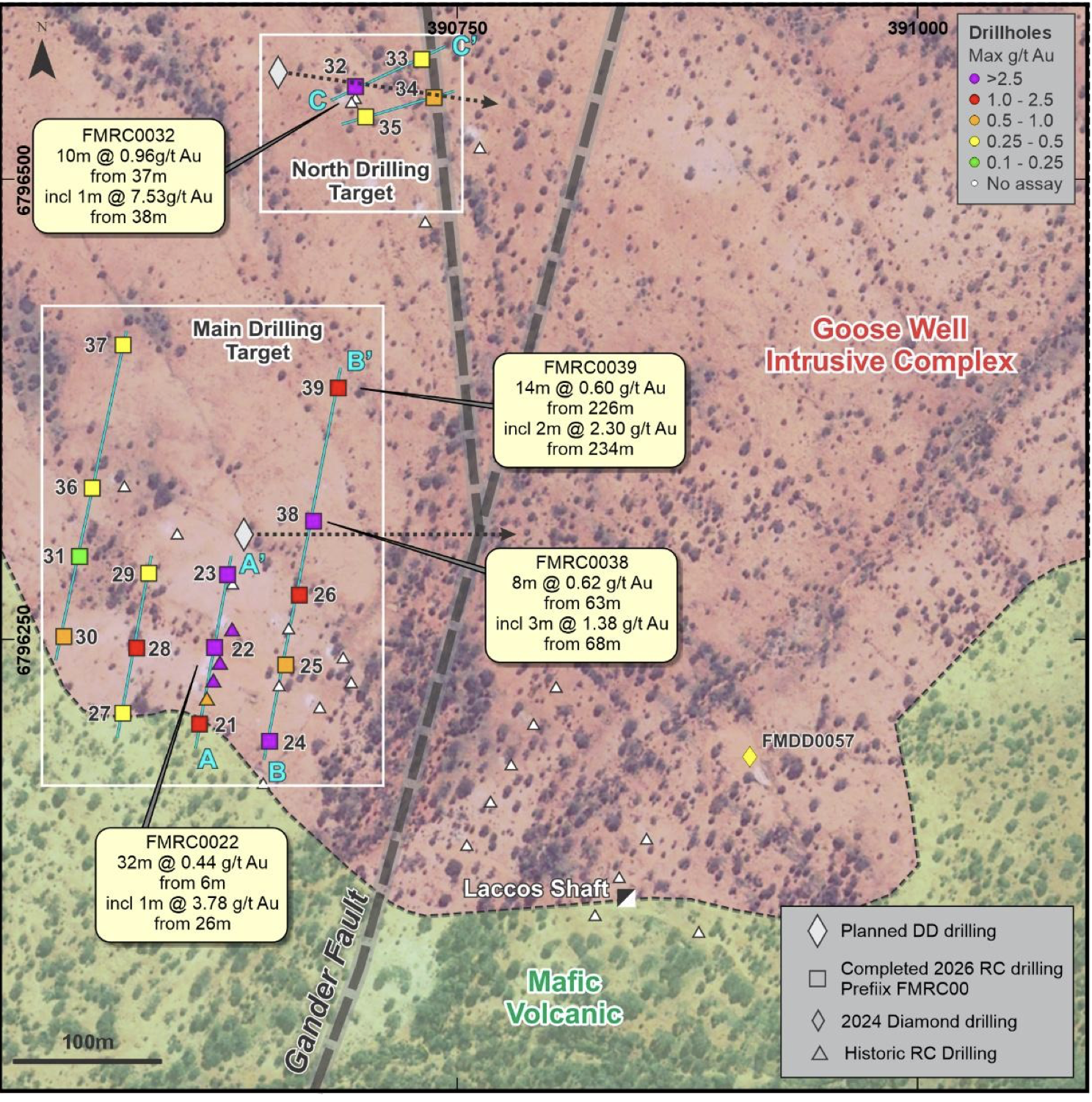
The results support its view that mineralisation is hosted in discrete higher-grade quartz veins within a broader lower-grade stockwork system developed in monzogranite and syenite intrusions. Broader anomalous intervals across multiple holes also point to a mineralised system extending beyond the headline intercepts.
Results strengthen structural interpretation
At the Main Target, 15 angled RC holes were drilled across about 160 metres of strike and 120 metres down-dip. Iceni said the strongest mineralisation appears to occur on the easternmost section near the untested north-south “Gander Fault”, a structure identified from aeromagnetic data, soil anomalies above 15 parts per billion gold and mapped quartz veins.
At the North Target, 4 RC holes validated a historic target associated with a north-northwest-trending mineralised shear zone. Iceni said mineralisation there also appears to be linked to the broader north-south structural trend, which may represent a splay off the Gander Fault.
The company added that several lamprophyres intersected in drilling may also be related to these deeper regional structures, strengthening the case for a larger mineralised system at Goose Well.
Diamond drilling to follow in May
The RC campaign was designed mainly to validate historic intercepts and, as a result, was drilled on a similar orientation to earlier work. Based on the new geological interpretation, the company now considers that orientation suboptimal, with holes likely intersecting veins at oblique angles and potentially understating true width and grade. It also noted that 1-metre compositing may have diluted narrower higher-grade zones.
“We are very pleased with the results from the maiden drill program at Goose Well and excited about the greater opportunity along the Gander Fault that this has generated. The focussed first-pass generative RC drill program targeted the most advanced and obvious mineralised zone, where historic resampling validated previously reported economic gold intercepts from private data acquired with the tenements," Iceni managing director, Wade Johnson, said.
“Results from this program support the tenor of these historic intercepts and, importantly, highlight significant exploration upside across the broader 1.7km x 1.3km footprint of the Goose Well Intrusive Complex (GWIC) supported by surface sampling and the broad distribution of gold nuggets.
“The next stage of work will comprise of diamond drilling at the North and Main target areas, gaining a detailed understanding of the key mineralising structures associated with the Gander Fault within this complex structural setting, that will be critical to unlocking the system’s full potential. The diamond drill rig has been secured and is expected to arrive on site next month.
“The company is methodically and rapidly progressing the geological framework at Goose Well to discover a new gold system, having barely scratched the surface of this large and underexplored intrusive complex.”
To refine its understanding of the system, Iceni has planned 2 diamond drill holes for about 350 metres. The program, due to start in May, is intended to test continuity of the interpreted mineralised structures, define vein orientations and true thickness, and better understand the relationship between intrusive phases, lamprophyres and the Gander Fault.