
Gelion PLC (AIM:GELN, OTC:GELNF, FRA:X0S) this week outlined progress in its battery technology development and an expanded collaboration with TDK, as chief technology officer Louis Adriaenssens detailed the significance of recent announcements.
Adriaenssens said the company has successfully transitioned its technology into pouch cell format, marking an important step towards commercialisation. He added that Gelion’s cathode technology is compatible with standard lithium-ion battery components, including graphitic anodes, electrolytes and separators, which could ease integration into existing manufacturing processes.
He further noted that TDK has recognised the potential of the technology, leading to an expansion of the partnership. According to Adriaenssens, the collaboration has already validated compatibility between the two companies’ technologies and established a shared vision for future development.
Here, we take a closer look at what Adriaenssens shared when he joined the Proactive studio.
Proactive: Louis very good to speak with you. Could you explain the significance of the 31st of March announcements in layman's terms, please?
Louis Adriaenssens: Yeah, sure. I think there is there's two main components. The first is that our technology has transferred seamlessly to pouch cell format. And the second, perhaps more significant, aspect of it is that our cathode technology is highly compatible with all of the complementary components from standard lithium ion batteries. So this would be graphitic anodes, standard electrolytes, and standard separators.
What's really great about it and what we were able to say in the announcement is that TDK also recognized the potential here. And we are expanding our collaboration to take advantage.
Proactive: What's TDK’s position in the battery market, Louis?
Louis Adriaenssens: Yeah, sure. So they are most famous for the batteries that go into personal devices, for instance your mobile phone, your laptop, your tablets. They also service other parts of the energy storage sector, including residential energy storage.
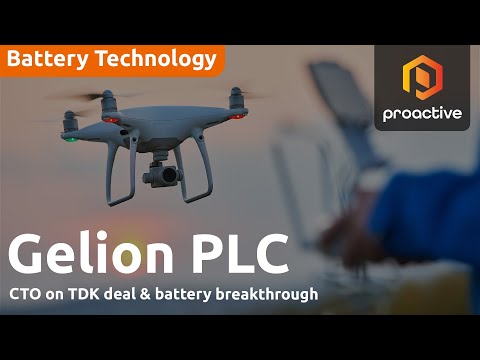
From Gelion’s perspective, what’s most important is that they service about 70% of the drone market. Gelion’s batteries have all of the characteristics required for drones — domestic supply chain, lightweight batteries, high power. That’s one of the reasons why we were specifically aiming to collaborate in the first place.
Proactive: What have you now achieved with this partnership?
Louis Adriaenssens: I think there’s two main things. The first is we have validated the technology compatibility between TDK technology and Gelion’s technology.
The second, which is really important, is that based on these results we now have a shared vision. We understand what we’re trying to do together.
We can see the potential for this technology, not just in drones, but also for the broader market. We’ll be aiming to develop this technology so that we can hit a huge number of different markets that energy storage currently sits in.
Proactive: So Louis, what catalysts should investors look out for in the next six months or so?
Louis Adriaenssens: I think the things that will really get people excited are results from actual prototype cells. The cells we’ve made so far — the two-layer pouch cells — show that our technologies work well together.
The next cells will be large enough to be significant to a commercial market. They’ll allow us to define performance metrics like energy density, power density, and we’ll also have safety testing. Those are probably going to be the most significant results coming out of this collaboration in the next six months.
Proactive: So what does success with TDK look like for Gelion investors?
Louis Adriaenssens: In the long term, success would be TDK making gigawatt hours worth of cells that employ Gelion’s cathode active material.
In the short term, it’s about those prototype cells and using the results to engage in commercial outcomes such as meaningful collaborations and agreements with major offtake partners — whether that’s automotive, personal electronics, or other sectors.
Long term, we want gigawatt-hour scale production with TDK. Short term, we’re taking steps toward that.
Proactive: Well Louis, I hope you'll keep us updated with your progress. Thank you very much for your time today.
Louis Adriaenssens: No problem. It’s been a pleasure to speak with you, and I can’t wait to talk to the public again about these exciting results.