
First-pass drilling at Strickland Metals Ltd (ASX:STK)'s Obradov Potok prospect within its Rogozna gold and base metals project in Serbia has confirmed carbonate replacement-style lead-zinc-silver mineralisation, supporting its view the target sits on the outer halo of a potentially larger copper-gold skarn system.
Assays from 2025 drilling returned a best broad hit of 46 metres at 0.3% lead, 0.6% zinc and 2.4g/t silver from 882.8m in hole ZRPD25003, including 2m at 0.3% lead, 2.6% zinc and 2.8g/t silver from 910.8m. Hole ZRPD25004 also returned several narrower but higher-grade intervals, including 2.9m at 3.2% lead, 1.7% zinc and 19.2g/t silver from 848.4m, with a higher-grade sub-interval of 1.5m at 5.1% lead, 2.1% zinc and 32.6g/t silver. Hole ZRPD25006 delivered multiple narrower zones, including 8m at 0.2% lead, 1.3% zinc and 1.9g/t silver from 677.7m.
The significance of the results lies less in grade at this stage than in what they suggest about the broader system. Strickland said the mineralisation confirms carbonate replacement mineralisation along the same ENE-WSW structural trend that runs from Jezerska Reka to Gradina and Copper Canyon, an interpreted corridor extending about 6 kilometres.
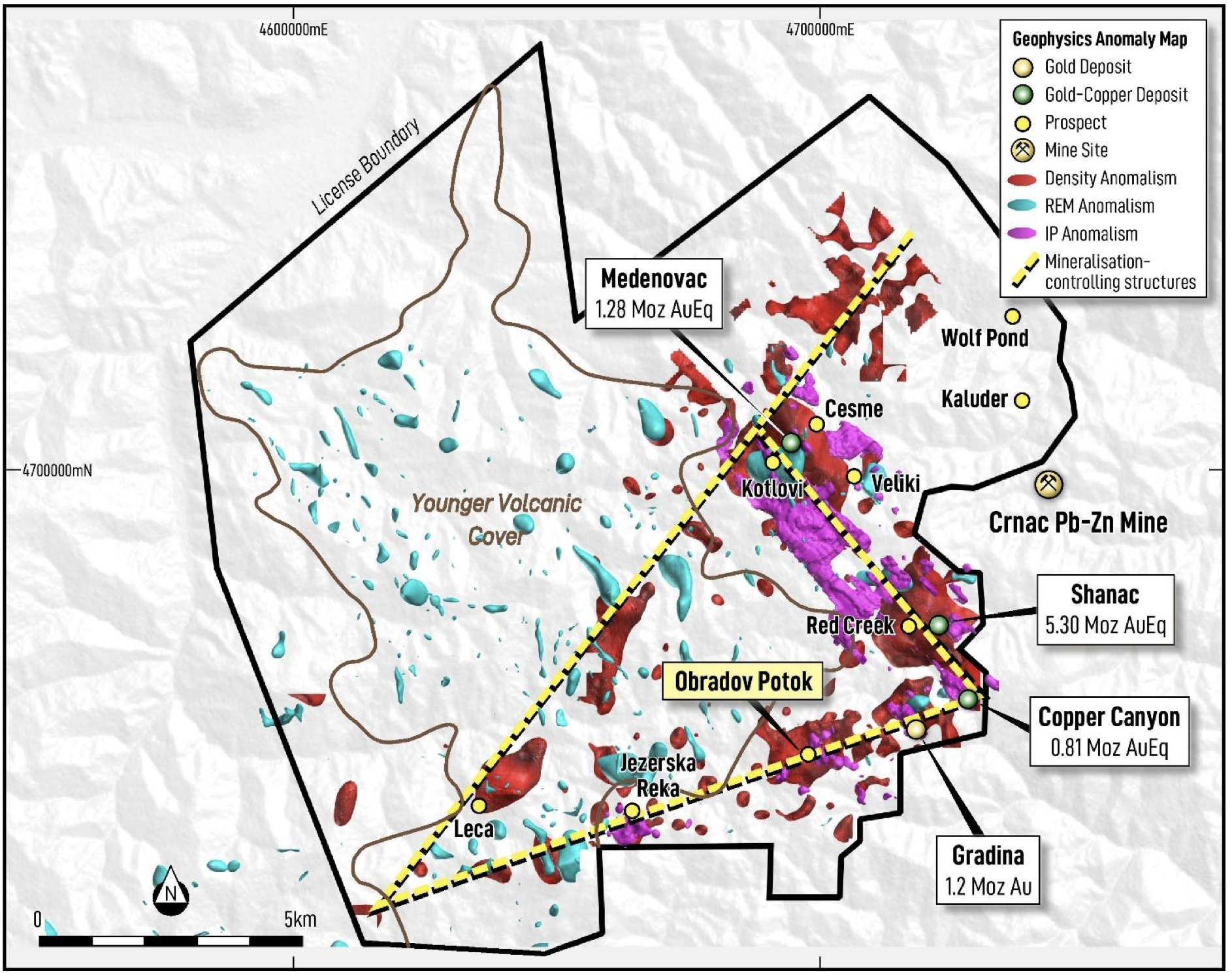
Rogozna Project – Geophysical Anomalies, Deposits and Prospects. Note the association of known mineralisation with density anomalies.
“Scout drilling completed last year has elevated Obradov Potok as a priority target for follow-up exploration, with results confirming significant zones of carbonate-replacement lead- zinc-silver mineralisation. This represents another important breakthrough by the team – validating our exploration model and reinforcing the potential for a major new discovery," Strickland’s managing director, Paul L’Herpiniere, said.
"Obradov Potok was initially targeted due to the presence of strong geochemical anomalism in soils, together with IP and gravity anomalism within the network of ore-controlling structures, which are increasingly recognised as critical to hosting large-scale mineralisation across the Rogozna Project. Importantly, the target area also sits along strike from the cornerstone Gradina and Copper Canyon deposits, further enhancing its prospectivity.
"Following recent discoveries at Red Creek and Kotlovi, these results continue to highlight the scale and endowment of the broader Rogozna system. We are looking forward to undertaking follow up drilling as part of the 2026 field season targeting the interpreted core of the system at Obradov Potok, where we see a compelling opportunity to make a major new discovery.”
Results strengthen skarn model
The company believes this style of mineralisation is consistent with the outer zone of a skarn deposit, where lead-zinc-silver mineralisation can vector towards a more proximal copper-gold core.
That interpretation is supported by geophysical work. Obradov Potok is associated with a major gravity anomaly which Strickland says is similar in scale to anomalies linked to the Gradina, Shanac and Copper Canyon deposits elsewhere at Rogozna. The company also said the better intersections so far appear linked to the intersection of ENE and NNW structures, which are emerging as the key ore-controlling trends across the broader project.
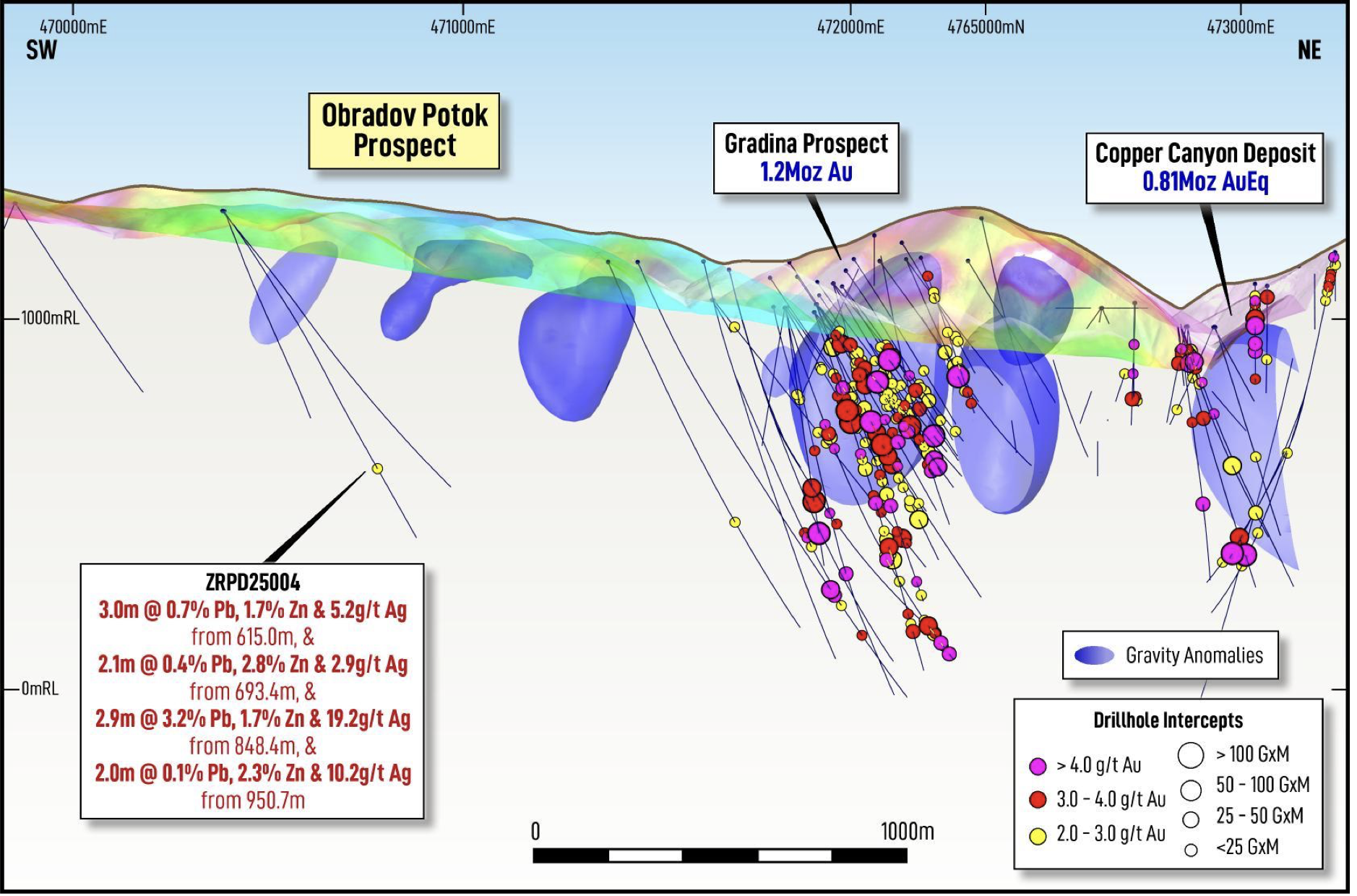
Long section view of Obradov Potok to Gradina/Copper Canyon along the inferred major ENE-trending ore-controlling structure, with drill-hole ZRPD25004 highlighted and showing the associated density anomalies modelled from the inversion of gravity data.
The drilling has now pushed Obradov Potok higher up the priority list for follow-up work. Strickland plans to drill the interpreted core of the copper-gold skarn system and further test the structural intersections identified through gravity data and recent drilling. Planning for the 2026 field season is well advanced, with drilling due to begin in Q2 2026.
On funding, Strickland said it remains well backed for the next phase of exploration, with cash and liquid investments of $38.2 million at 31 December 2025 and a further $55 million raised through a recently completed institutional placement.
Separately, the company said modelling work for the 5.3Moz AuEq Shanac deposit is continuing, with an updated mineral resource estimate due in April 2026. Rogozna currently hosts a total inferred resource of 8.6Moz AuEq across Gradina, Medenovac, Shanac and Copper Canyon.