
White Cliff Minerals Ltd (ASX:WCN) has reported strong metallurgical testwork results from the Danvers deposit within its Rae Copper Project in Nunavut, Canada, confirming high copper and silver recoveries alongside the production of high-grade, saleable concentrates using conventional processing methods.
Testwork delivered copper recoveries exceeding 90% across all composite samples, with peak recovery reaching 95.4%. Silver recoveries were also robust, with results of up to 93.3%, supporting the potential for valuable by-product credits in any future operation.
Importantly, the metallurgical program produced high-grade concentrates averaging around 40% copper and 150g/t silver, with saleable concentrate grades above 28% copper achieved early in the cleaner flotation circuit. The company noted this eliminates the need for a third cleaner stage, simplifying the processing flowsheet.
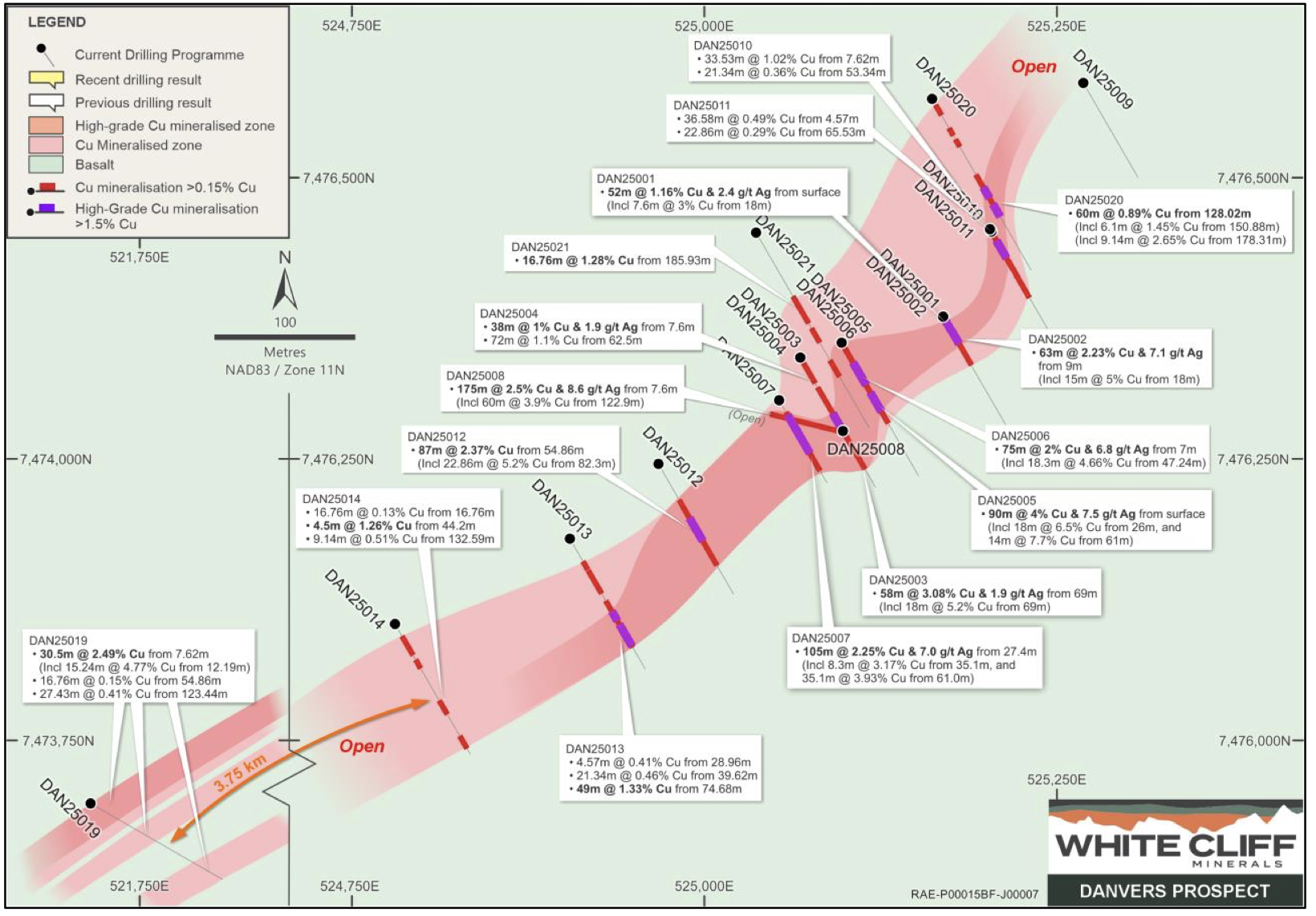
Map of drillhole locations and copper intercepts from the 2025 reverse circulation drilling program at the Danvers I deposit, Rae
Copper Project. 3.75km between DAN25014 and DAN25019 hosts several high conductance features within the major Teshierpi Fault Zone
which will be drill tested in phase I of the 2026 program.
Cleaner flotation testing further demonstrated that regrinding does not materially improve outcomes, with similar concentrate grades achieved both with and without regrind. In fact, higher recoveries were recorded in the non-regrind scenario, reinforcing the viability of a simplified processing route.
“As RC drilling recommences at Danvers, these outstanding metallurgical results significantly enhance the project’s development credentials and underscore its potential to deliver a high-value copper product. The dominance of high-grade chalcocite–bornite mineralisation highlights the opportunity for the production of a premium, clean concentrate via conventional, low-risk processing methods, with minimal deleterious or penalty elements," White Cliff Minerals managing director Troy Whittaker said.
"Importantly, these results coincide with White Cliff’s aggressive exploration campaign targeting the highly prospective Teshierpi Fault Zone, where drilling is aimed at unlocking additional chalcocite-dominant vein and breccia systems. The Company believes this work has the potential to materially expand the scale and quality of mineralisation at Danvers, further strengthening its position as a compelling copper development opportunity “
Simple flowsheet and strong recoveries support development pathway
Across variability composites covering low-, medium- and high-grade material, copper recoveries consistently exceeded 90%, highlighting the robustness of the process across different ore types and supporting scalability of the Danvers system.
The mineralogical profile is dominated by chalcocite and bornite, with copper speciation indicating 78.1–88.6% of copper hosted in secondary sulphide minerals and only minor oxide content. This sulphide-dominant system is considered highly favourable for conventional flotation processing.
The company said the testwork confirms a straightforward flotation flowsheet with no requirement for regrinding and no significant deleterious elements identified, indicating potential for a clean, smelter-friendly concentrate with favourable commercial terms.