
Environmental Clean Technologies Ltd (ASX:ECT) has expanded its licence agreement with William Marsh Rice University to include the application of Flash Joule Heating (FJH) to PFAS-contaminated adsorbents such as granular activated carbon (GAC).
The move marks a strategic extension of the company’s PFAS remediation platform, building on its existing Rapid Electrothermal Mineralisation (REM) technology, which targets PFAS in contaminated soils.
By incorporating FJH for use on spent adsorption media, ECT is positioning to address a broader segment of the PFAS treatment chain — specifically the destruction of contaminants captured during water treatment processes.
GAC is widely used as a filtration medium across industries, particularly in water treatment systems where it removes contaminants including PFAS from drinking water. However, once saturated, the material requires disposal or treatment, traditionally via off-site incineration.
That process carries logistical and environmental risks, including potential PFAS emissions during combustion and exposure during transport.
The expanded licence leverages additional intellectual property developed at Rice University under Professor James Tour and reflects a logical progression of its existing technology base.
The company identified the opportunity following a technical assessment of PFAS treatment pathways aimed at expanding its addressable market, supported by ongoing collaboration with Rice and internal evaluation led by chief technology officer Justin Sharp and the advisory board.
Independent peer-reviewed research has demonstrated that FJH can achieve more than 99.9% removal of PFAS from contaminated carbon media such as GAC under controlled conditions, with favourable energy use and emissions outcomes compared to incineration.
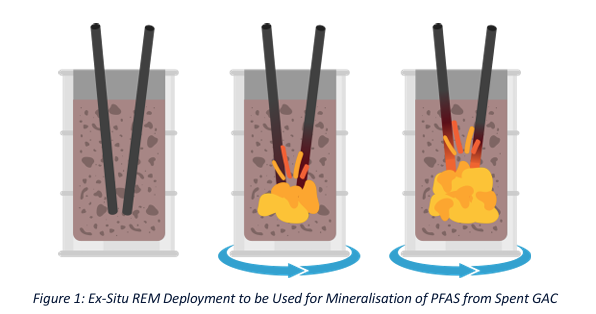
“This expansion is a strategic progression of our existing REM platform and reinforces our position in PFAS destruction technologies. Importantly, the move into PFAS destruction from adsorbents, including those used in water treatment systems, utilises the same licensed Flash Joule-Heating technology I helped to develop in my time on staff at Rice University. It is highly complementary to our soil remediation capabilities, as it utilises the same system we are developing for the ex-situ REM treatment of PFAS-contaminated soil," ECT chief technology officer, Justin Sharp, said.
“The industry is increasingly looking for alternatives to incineration when it comes to treating spent treatment media such as GAC, as there are growing concerns about releasing PFAS into the atmosphere during combustion. Therefore, we believe an on-site mineralisation solution that efficiently eliminates PFAS from spent treatment media and reduces secondary waste has the potential to address a critical gap in current GAC treatment pathways and in particular for those used in water treatment applications.”
Targeting on-site PFAS destruction
ECT is now focused on developing an on-site PFAS destruction platform capable of treating spent GAC and similar adsorbents, complementing its soil remediation capabilities.
The approach is designed to eliminate the need for transporting contaminated materials while reducing secondary waste and addressing industry concerns around incineration-based solutions.
The expansion comes amid growing global concern over PFAS contamination and tightening regulatory standards, particularly in water systems, which are driving demand for scalable and verifiable destruction technologies.
ECT plans to progress development and validation of the FJH-based system, with the aim of advancing toward pilot-scale deployment, subject to technical and regulatory outcomes.
By extending its platform across both soil and water treatment applications, the company is positioning to capture a broader share of the emerging PFAS remediation market while leveraging a common underlying technology.