
Strategic investment in robotics could add as much as A$201 billion to Australia’s economy by 2040 — lifting incomes, creating jobs and reshaping productivity — but only if the country can convert its research strength into broader real-world adoption.
That’s the central takeaway from a new study by ACIL Allen, commissioned by Amazon Australia, which argues Australia is at a turning point: either scale its robotics capability across industry, or risk falling further behind global peers.
The modelling points to a sizeable economic upside — including higher wages and roughly 128,900 additional jobs per year — but the gap between potential and execution remains a recurring theme.
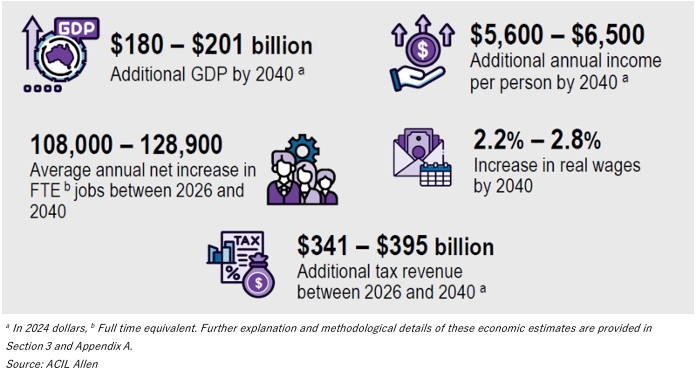
Economic modelling outcomes of a robotics future for Australia.
A large prize, built on incremental change
The report’s headline numbers are substantial, but the assumptions behind them are relatively grounded.
Its “aspirational” scenario centres on three shifts: doubling industrial robot density, lifting service robot adoption across non-manufacturing sectors, and expanding the domestic robotics industry.
Taken together, those changes are projected to drive stronger GDP growth, higher real wages and increased tax revenues over the next 15 years.
Importantly, the gains are not tied to a single sector. Robotics is framed as a general-purpose productivity tool — one that can lift efficiency across manufacturing, logistics, healthcare and services, with flow-on effects across the broader economy.
Strong research, limited rollout
Australia’s starting point is not weak capability, but uneven translation, according to the report.
The country has established strengths in robotics research, particularly in field applications tied to mining, agriculture and remote operations. These are areas where automation solves immediate, high-value problems — and where Australian-developed systems are already globally competitive.
But that success has not translated into widespread adoption.
Industrial robot usage remains low by international standards, with Australia’s robot density less than half the global average and declining in relative terms over the past decade.
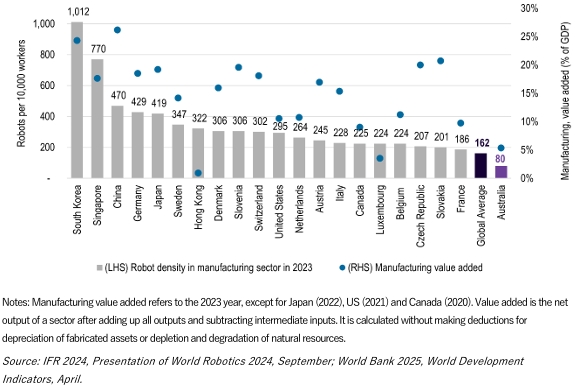
Industrial robot density and manufacturing value added in selected countries, 2023.
At the same time, there is little domestic manufacturing of robots, and service robotics — despite strong niche capability — remains fragmented and difficult to measure at scale.
The commercialisation bottleneck
The report points to a set of structural constraints that will be familiar across Australia’s tech sectors.
Access to capital remains a key hurdle, particularly for smaller firms facing high up-front costs. Research and industry links are often weak, limiting the ability to translate academic breakthroughs into deployable systems. And infrastructure — from testing environments to scaling facilities — is still underdeveloped.
There is also a coordination problem. Australia’s robotics ecosystem is spread across universities, clusters and industry groups, but lacks the scale and integration seen in leading global hubs, the report said.
The result is a system that produces strong innovation but struggles to commercialise it consistently.
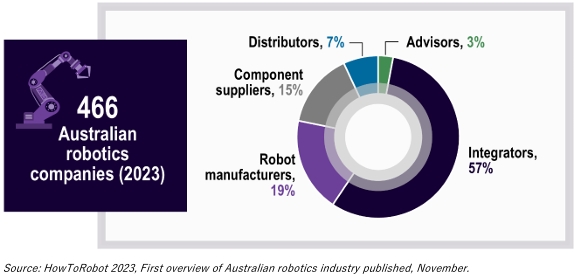
Overview of robot and automation companies in Australia, 2023.
Jobs, wages and the workforce shift
The labour market implications are central to the report’s case.
Rather than displacing workers outright, increased robotics adoption is expected to shift employment towards higher-skill roles — particularly in maintenance, systems operations and technical support.
The modelling suggests real wages could rise by around 2.2% to 2.8% by 2040, alongside a lift in annual incomes of up to A$6,500 per person.
That reflects the productivity argument underpinning the report: automation increases output per worker, which in turn supports higher incomes and broader economic growth.
Still, the transition will depend heavily on training systems and workforce mobility — areas that have historically lagged structural change.
A question of scale — and timing
Amazon’s own use of robotics — from warehouse automation to AI-driven fleet management — is presented as a working example of how these systems can be deployed at scale.
But replicating that across the broader economy is less straightforward.
Large operators can absorb the capital costs and integration challenges associated with robotics. Smaller firms, particularly in manufacturing and services, face a steeper path.
That dynamic reinforces a key point in the report: adoption, not invention, is the constraint.
The window to act
The study ultimately frames robotics as a strategic choice rather than a purely technological one.
Australia has the underlying capability to build a globally competitive robotics sector, supported by strong research institutions and existing industry strengths. But without more coordinated investment — across infrastructure, commercialisation pathways and industry adoption — that capability risks remaining underutilised.
The A$201 billion figure sets out what’s possible. Whether it materialises will depend, according to the report, on how quickly — and how broadly — robotics moves beyond niche applications and into the wider economy.