
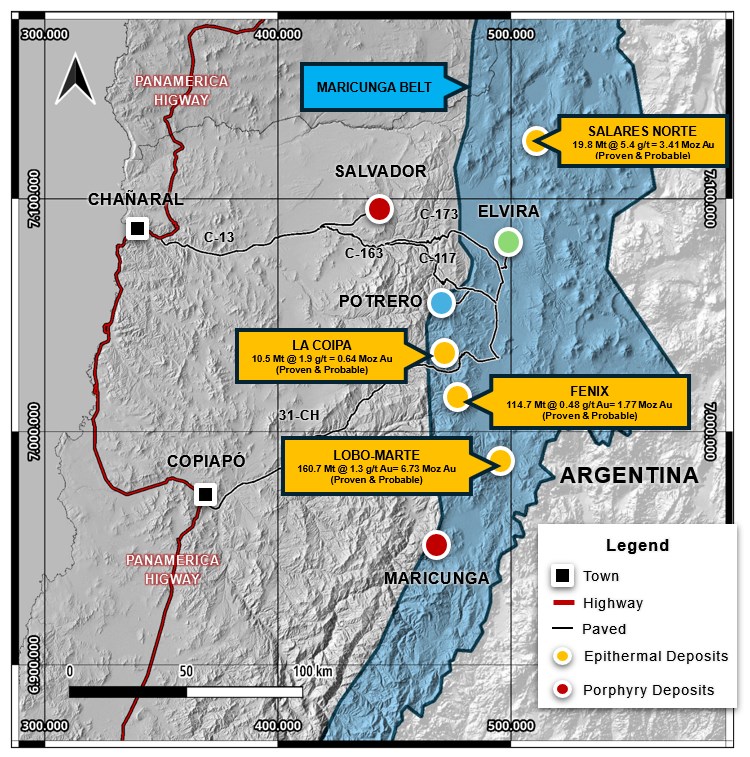
Montero Mining and Exploration Ltd (TSX-V:MON, OTC:MXTRF) has reported the results of independent geochemical vector modelling conducted by Fathom Geophysics on rock samples collected from its Elvira gold project in Chile’s Maricunga Gold Belt.
The modelling, which is part of Montero’s integrated exploration program, combines geological mapping, geophysical surveys, surface geochemistry, and artificial intelligence-assisted analysis to refine exploration targets within the Elvira hydrothermal system.
According to the company, the results highlight two coincident deep porphyry-style targets beneath the central alteration system. These findings support the interpretation that the Elvira project hosts a large high-sulphidation epithermal system, potentially linked to a deeper porphyry mineralizing centre.
“Independent geochemical footprint modelling has defined coherent porphyry-style targets beneath Elvira,” Montero CEO Dr Tony Harwood said in a statement.
“Integrated with our geological, geophysical, and surface epithermal data, these results support the interpretation of a large vertically zoned mineralized system at depth. We are now applying artificial intelligence-assisted modelling to refine and prioritize drill targets.”
The geochemical modelling utilized 38 rock samples analyzed by four-acid digestion ICP-MS methods, targeting key pathfinder elements including arsenic, bismuth, copper, lithium, molybdenum, antimony, selenium, tin, tellurium, thallium, and tungsten.
Two established geochemical zonation models, the Cohen (2011) porphyry footprint model and the Halley et al. (2015) porphyry alteration and geochemical dispersion model, were applied to generate high-confidence target zones.
The Cohen model identified a high-confidence target (EL-FG-01C) beneath the central sampling area, with the most significant anomaly occurring approximately 1.5 km below surface. A second target (EL-FG-01H), generated using the Halley model, occurs slightly east of the current sampling area and at a somewhat greater depth, though interpreted to represent the same underlying mineralized system.
Montero noted that the current modelling is based on a limited number of samples and that additional geochemical sampling, particularly to the east and along open anomalous trends, is expected to refine and potentially consolidate the interpreted targets.
The company plans to continue integrating geological, geochemical, and geophysical data, with upcoming work focused on extending surface sampling, refining three-dimensional exploration models, and prioritizing potential drill targets.