
Australia’s growing reliance on imported oil has left the economy increasingly exposed to global supply shocks, with electrification — particularly in transport — emerging as the most viable long-term solution, according to a new briefing from the Institute for Energy Economics and Financial Analysis (IEEFA).
The report warns the world is facing “the largest supply disruption in the history of the global oil market”, with the Iran conflict and closure of the Strait of Hormuz threatening key supply routes and pushing prices higher.
For Australia, that risk is amplified by structural shifts over the past two decades that have eroded domestic energy security.
From self-sufficiency to import dependence
IEEFA’s analysis highlights a stark reversal in Australia’s oil position.
In 2000, the country was largely self-sufficient, with eight refineries supplying around 98% of domestic petroleum demand. Today, domestic production meets just 5.6% of demand, while the remaining two refineries account for only 17% of refined product supply.
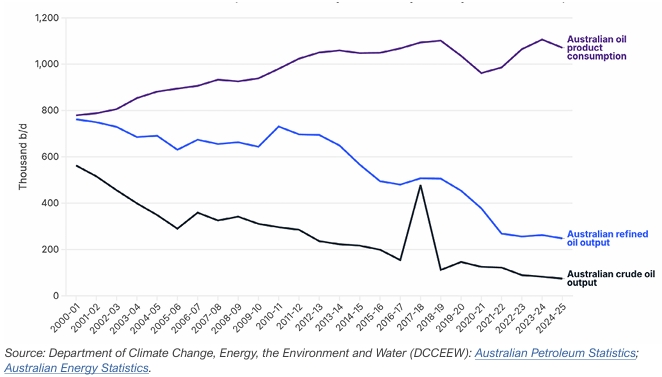
Australian crude oil output, refined oil product output, and petroleum sales.
That shift has left Australia with the largest trade deficit in refined petroleum products globally and heavily reliant on imports for transport fuels.
“While Australia only buys a small percentage of its crude oil from the Middle East, it is highly exposed through the Asian refineries we import refined products from,” IEEFA energy finance analyst Kevin Morrison said.
The situation is further compounded by critically low stockpiles. Australia holds just 37 days of petrol and around 30 days or less of diesel and jet fuel — the lowest level among International Energy Agency members, compared with an average of 141 days held by major importers.
IEEFA warns this combination of high import reliance and limited reserves presents a “large economic risk”, with potential impacts spanning inflation, trade balances and key industries.
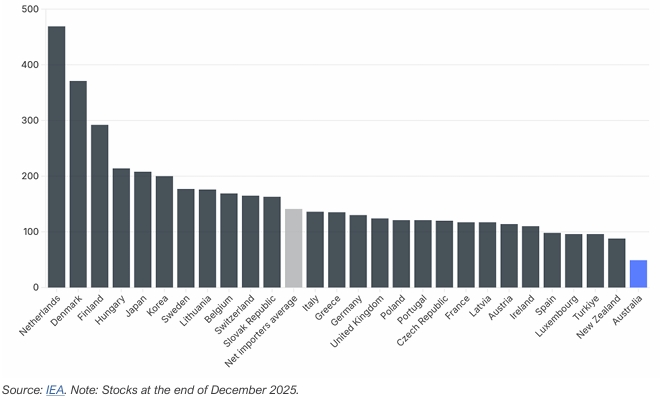
Oil stocks of IEA countries (oil importers) in days of net imports.
Freight sector in the firing line
Transport sits at the centre of that exposure, with diesel underpinning much of Australia’s economic activity.
Road freight carries the majority of non-bulk goods nationwide, while mining and agriculture also depend heavily on diesel-powered equipment and logistics.
“We could see serious impacts on our agricultural production, mineral exports, as well as inflation and economic growth,” Morrison said. “Despite this, governments on both sides have repeatedly ignored warnings about the country’s vulnerability.”
With diesel shortages or price spikes likely to ripple through supply chains, the report underscores the urgency of reducing reliance on imported fuels.
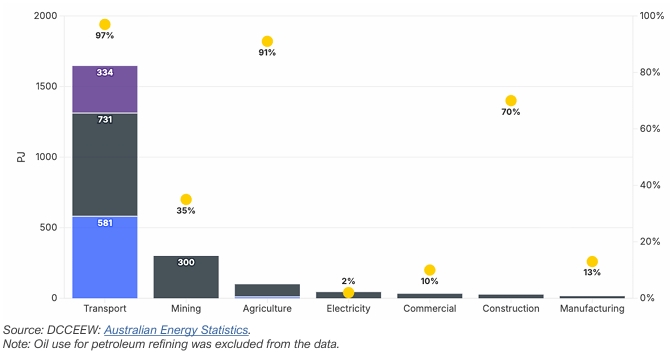
Use of oil products by sector of Australia’s economy, petajoules (PJ) and % of energy use, FY2023-24.
Electrification seen as long-term fix
While short-term measures such as demand reduction and supply agreements may help ease immediate pressures, IEEFA argues that electrification offers the only scalable, long-term solution.
“Australia lags on electric vehicle adoption, and progress in mining and heavy transport electrification is minimal,” IEEFA Australia CEO Amandine Denis-Ryan said. “The government is even considering removing some of the incentives which have been driving EV purchases.
Electric vehicles are significantly more energy efficient than internal combustion engines and can be powered by domestically generated renewable energy, reducing exposure to global oil markets.
Industry push builds in heavy transport
The report’s focus on heavy transport comes as industry players begin advancing practical pathways to reduce diesel use in freight.
Janus Electric Holdings Ltd (ASX:JNS) has been developing a model centred on converting existing diesel trucks to electric using swappable battery systems, targeting a faster and lower-cost transition than full fleet replacement.
Recent analysis from the company suggests Australia’s heavy freight fleet — more than 128,000 trucks — could transition to electric power within around five years by aligning conversions with standard engine replacement cycles.
Janus estimates such a shift could cut national diesel consumption by up to 10 billion litres annually, materially reducing Australia’s reliance on imported fuel.
The company has also been expanding its footprint, with recent developments including US port-focused deployments, a Canadian partnership linking its technology to circular energy projects, and funding initiatives to support its zero-emissions truck rollout.
While still at an early stage, these efforts reflect broader momentum in tackling one of the most diesel-intensive parts of the economy.
Policy pressure mounts
IEEFA’s findings suggest Australia has limited options to address its oil exposure in the near term, particularly given the lack of domestic reserves and the time required to build strategic stockpiles.
Instead, the report calls for faster implementation of policies already outlined in government transport and resources sector plans, with a stronger focus on electrification and energy efficiency.
“The severe energy threat warrants a comprehensive government policy response that accelerates electrification of Australia’s transport and mining sectors,” Denis-Ryan said.
Without more rapid progress, Australia risks remaining highly exposed to future oil shocks — even as viable alternatives begin to emerge.