
Kalamazoo Resources Ltd (ASX:KZR) has reported strong early results from Phase 1 growth drilling at its Ashburton Gold Project in Western Australia, with initial assays confirming extensions to mineralisation below the existing Mt Olympus resource.
Results from five of the first eight diamond holes have returned broad and high-grade gold intersections, supporting the potential to expand the current 1.44Moz resource base and reinforcing confidence in the company’s geological model.
Among the standout intercepts, hole KADD0003 returned 8.8 metres at 11 grams per ton (g/t) gold from 20.5 metres, including 2.9 metres at 21g/t. Hole KADD0004 delivered 43.8 metres at 3.4g/t from 93 metres, including 21 metres at 4.6g/t and a higher-grade zone of 5.5 metres at 9.6g/t from 58.6 metres.
At Olympus West, KADD0006 intersected 30.9 metres at 1.5g/t gold from 214.5 metres, including 9.2 metres at 2.4g/t, as well as a narrower high-grade interval of 0.8 metres at 23g/t from 187.7 metres.
Further support for depth extensions came from hole KADD0002, which returned 3.9 metres at 4.3g/t gold from 417.9 metres, indicating mineralisation remains open at depth.
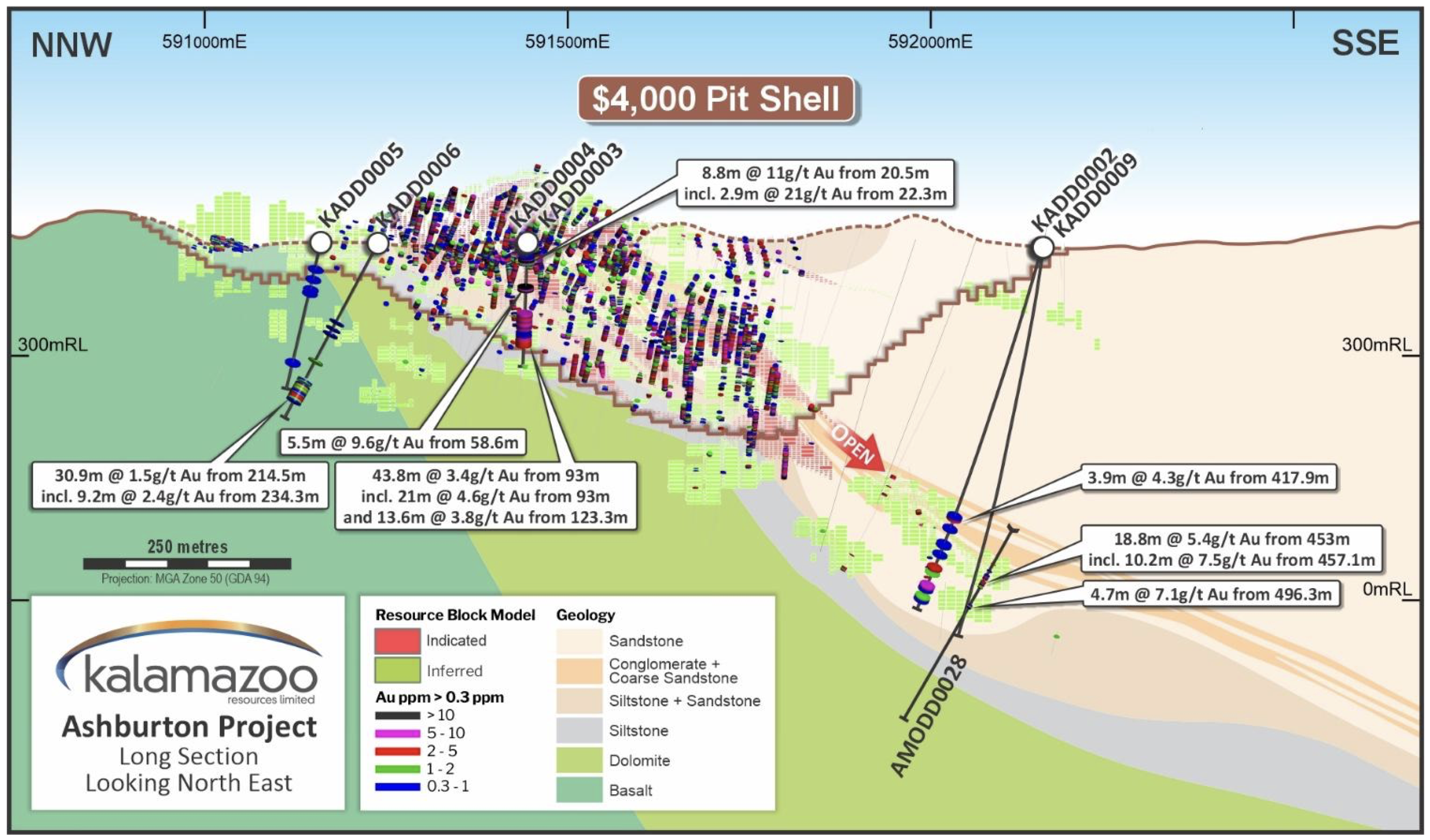
Mt Olympus Long Section (looking ~NNE), Indicated and Inferred block model (orange and green blocks), historic drill hole intercepts and assays (>0.3 g/t Au) and Scoping Study AUD$4,000/oz pit shell design (brown outline).
“Initial results from the Phase 1 Growth drilling program are highly encouraging, confirming that the Mt Olympus mineralised system extends significantly down plunge beneath the current pit shell, with strong grades encountered outside the existing resource and remaining open at depth. The program has validated our geological model and reinforces the strong association between gold mineralisation, conglomerate host units and the Zoe Fault feeder structures," Kalamazoo’s executive director Ben Ackerman said.
"Following the upcoming Resource Definition drilling program, we plan to resume growth drilling as we continue to expand the Ashburton Gold Project mineral resource base and build a robust foundation for future studies, with a clear objective of delivering a production profile exceeding 1 Moz.”
Mineralisation extends below current pit shell
The results demonstrate both continuity and grade across the system, with drilling confirming that mineralisation extends around 300 metres down plunge below the base of the current Mt Olympus pit shell outlined in the 2025 scoping study.
Kalamazoo said the program had validated key structural controls on mineralisation, particularly the association between gold-bearing conglomerates and the Zoe Fault system, which is interpreted as a primary feeder structure.
More assays to come as drilling advances
Assays are still pending for three holes, including KADD0007, KADD0008 and KADD0009, with visible mineralisation already noted in some of these intervals.
The company is now preparing to transition into resource definition drilling in the near term, with the aim of incorporating these results into an updated resource model. Follow-up growth drilling is also planned as Kalamazoo continues to target an expansion of the Ashburton inventory and assess its development potential.
New CEO to strengthen project
Kalamazoo has appointed experienced mining executive Andrew McDougall as chief executive officer, effective May 4, 2026. McDougall brings more than 25 years of operational and technical leadership across gold and diversified mining businesses globally. He joins from Westgold Resources (ASX:WGX), where he most recently served as chief technical officer, and has also held senior roles with Anglo American, AngloGold Ashanti and Rio Tinto. His background spans asset strategy, mine planning, studies, capital allocation and project execution.