
Tungsten Mining NL (ASX:TGN, OTCQB:TGNMF) is preparing a major reverse circulation drilling campaign at its Mt Mulgine project in Western Australia, with 140 holes planned for about 40,000 metres at the Mulgine Trench deposit as the company looks to grow and upgrade its tungsten-molybdenum resource base. The comoany is aiming to define one of the largest tungsten resources globally at a time of record-high tungsten prices.
Tungsten is currently sitting at US$316.79/kg.
Chairman Gary Lyons said rising tungsten prices were highlighting the importance of stable supply of the critical mineral and said the Mt Mulgine drilling campaign reflected the company’s push to advance its Australian tungsten assets.
“Tungsten prices continue their rise to record levels, underscoring the importance of the stable and timely supply of this vital critical mineral to markets across the world. This planned Mount Mulgine drilling campaign reflects TGN’s drive to meet these favourable and ongoing market conditions through the development of its globally significant tungsten assets in Australia – one of the world’s most secure mining jurisdictions.”
Drilling is scheduled to begin in early May 2026, with assay results expected to be released progressively from about six weeks after the program starts. The campaign is designed to test continuity beneath the 2020 mineral resource estimate, targeting extensions 80 metres to 160 metres down-dip and along strike.
The program will test the upper parts of its previously reported Exploration Target of 165 million to 200 million tonnes grading 0.10% to 0.12% WO3 and 180 to 220 parts per million molybdenum, containing 165,000 to 240,000 tonnes of WO3 and 30,000 to 36,000 tonnes of molybdenum.
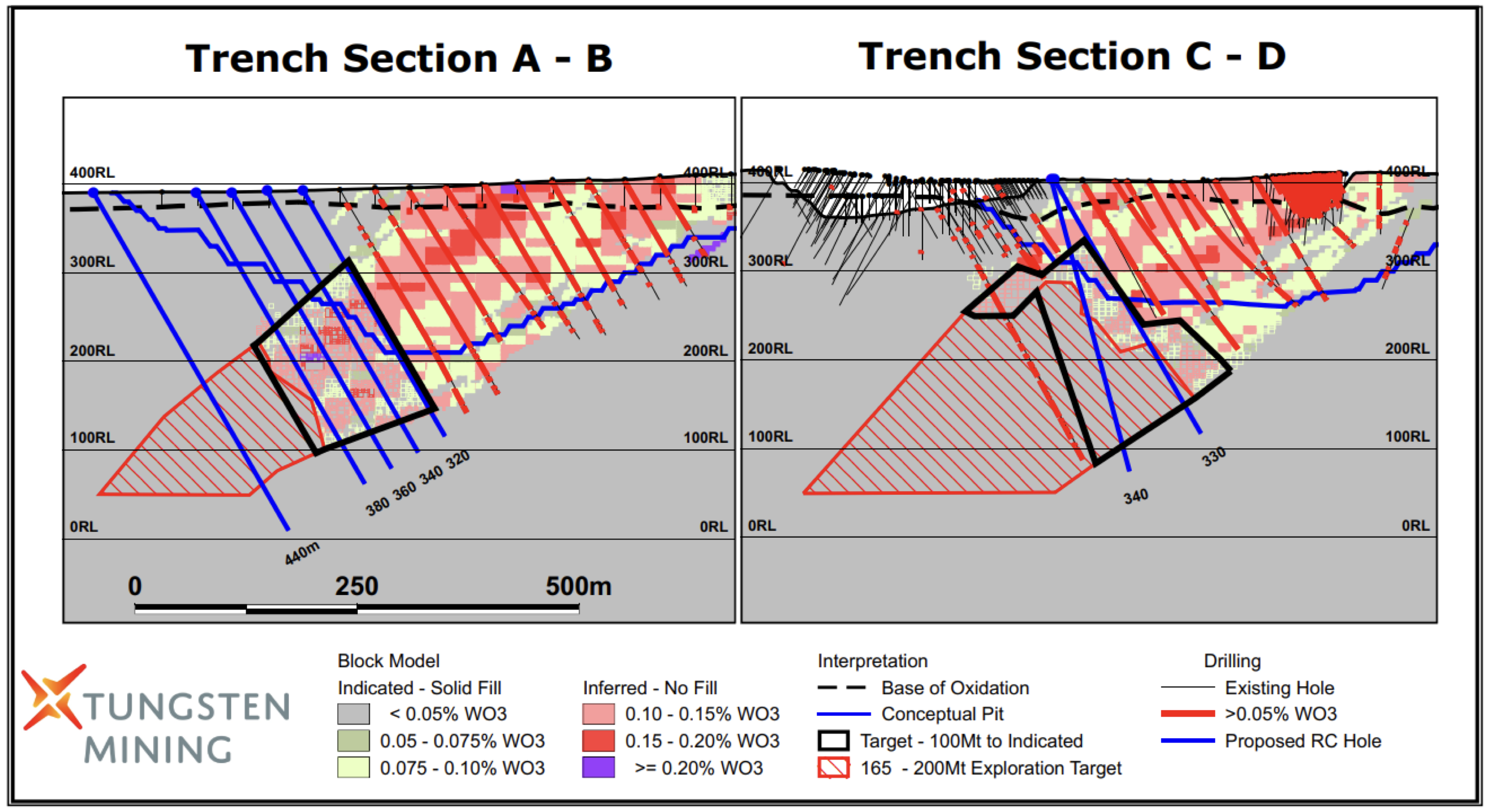
Exploration Target cross section.
Program aims to expand and upgrade resource base
The exploration target sits in addition to the existing Mulgine Trench mineral resource estimate of 247 million tonnes at 0.11% WO3, 280ppm molybdenum, 0.13g/t gold, 6g/t silver and 0.04% copper, containing 270,000 tonnes of WO3.
The drilling may also support an upgrade of as much as 100 million tonnes into the Indicated category from material that is currently Inferred or unclassified.
The proposed program includes infill and extension drilling on a 40-metre by 40-metre pattern across the 1.5-kilometre-long deposit, along with 3 deeper 480-metre exploration holes to test mineralisation further at depth.