
Lodestar Minerals Ltd (ASX:LSR, OTC:LSMLF) has intersected visible copper sulphide mineralisation in its first drill hole at the Three Saints copper project in northern Chile, providing early geological support for a potential iron oxide copper-gold (IOCG) system within the prospective Coastal Cordillera belt.
The maiden diamond drill hole, L3SRD003, intersected chalcopyrite, magnetite, pyrite and molybdenite across multiple intervals from about 190 metres depth to the end of the hole at 600 metres, with mineralisation remaining open at depth. The project sits in a region that hosts several large IOCG-style deposits, including the Candelaria mine about 65 kilometres away.
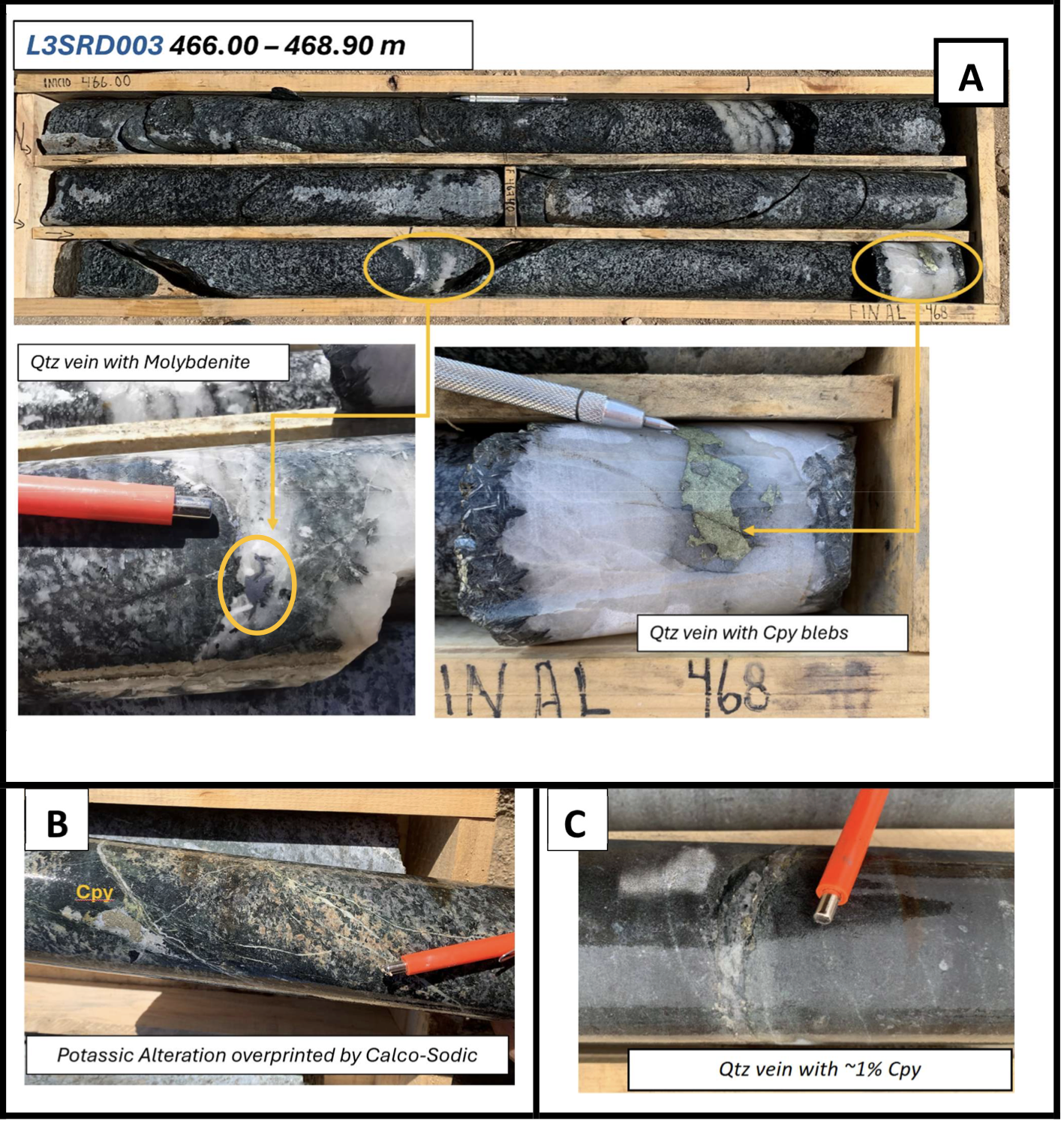
Photographs of L3SRD003 HQ diamond drill core. A) Tonalite intrusive (host rock) with quartz veins presenting molybdenite, chalcopyrite and magnetite mineralisation. Depth 466.00 - 468.90m B) Visible chalcopyrite (Cpy) mineralisation within a feldspar alteration overprinted by calco-sodic altered tonolite. Depth 240.00 m. C) Andesitic dike with quartz (Qtz)-chalcopyrite (Cpy) vein and a chlorite (Chl)-magnetite (Mgt) alteration halo. Depth 277.50m.
While assays are pending, the company said the presence of visible sulphide mineralisation in the first hole is an encouraging sign that drilling has intersected a potentially mineralised hydrothermal system.
“The observation of chalcopyrite and magnetite in our maiden drill hole at Three Saints is a very encouraging indication that this first hole has intersected a potential economic system. The alteration and sulphide assemblages identified are consistent with IOCG-style (Iron Oxide Copper Gold) mineralisation recognised elsewhere in this highly prospective belt (Candelaria Mine, Lundin Mining’s Largest Operation, ~65km away). This initial program was designed as a two-hole RC campaign to a depth of approximately 350 metres per hole. During drilling, ground conditions and geological observations led us to transition to diamond drilling, which provided improved geological logging, clear identification of sulphide mineralisation and testing of the target at greater depth to 600 metres," Lodestar executive director and head of exploration Coraline Blaud said.
"Observing visible chalcopyrite in the first drill hole provides confidence in the geological model and supports the decision to continue drilling the target with a second diamond hole. It is important to note that these observations are qualitative in nature and laboratory assays will be required to determine the copper grade and significance of the mineralisation. The drill core will be assayed for multielement analysis as well as for gold and silver.
"The Three Saints Project is located within the same regional metallogenic belt that hosts the Candelaria Mine – IOCG deposit. While the alteration and mineralisation styles observed in the core show similarities to IOCG systems in the region, the company cautions that this comparison is conceptual only and there is no assurance that mineralisation encountered at Three Saints will be comparable in scale, grade or economic characteristics to other deposits in the district.”
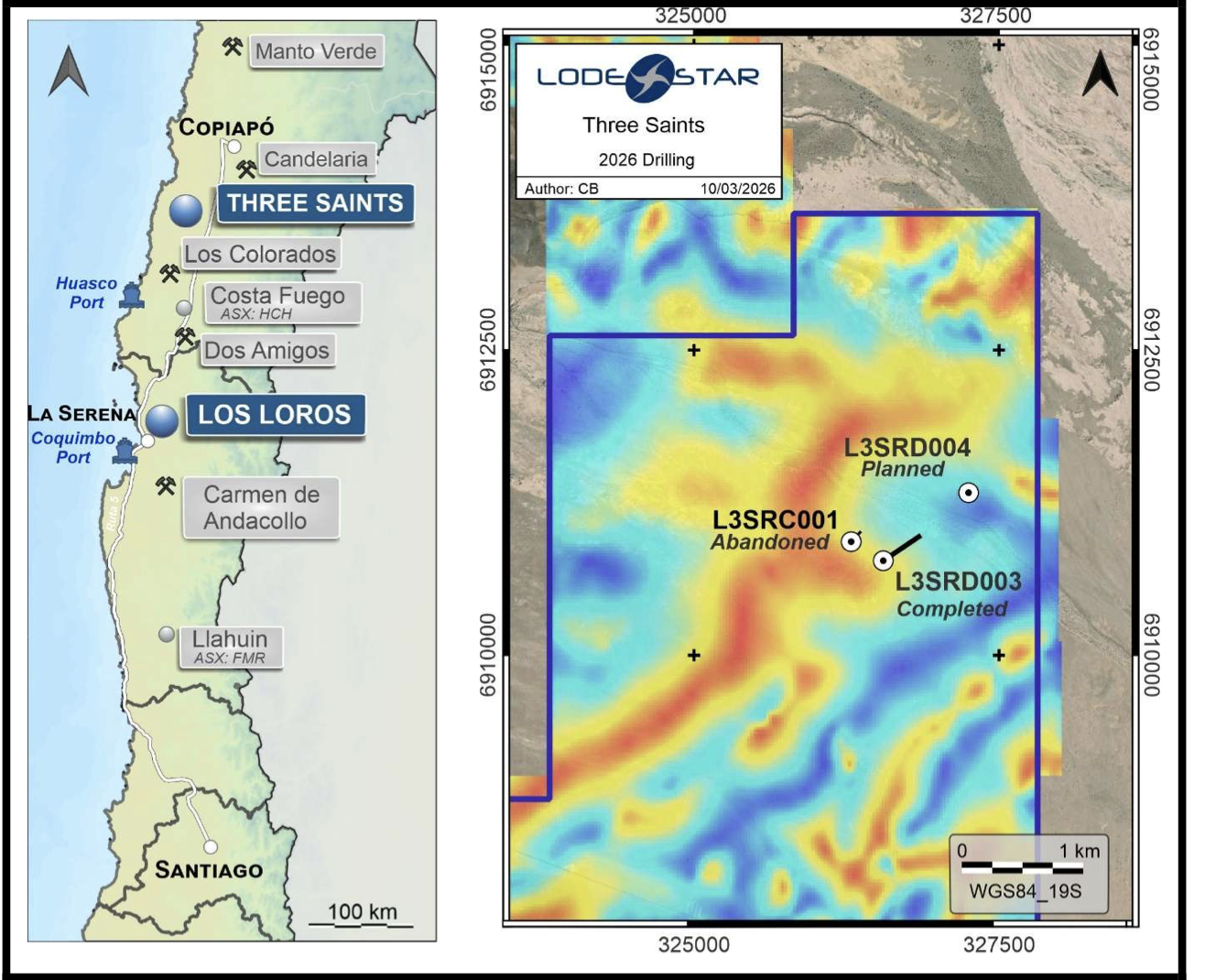
Three Saints project location and plan view of the drilling in relation to the magnetic geophysical anomaly targeted.
Mineralisation strengthens with depth
Geological logging of the HQ diamond drill core identified chalcopyrite—the primary copper sulphide—occurring in several styles, including disseminated mineralisation, quartz-hosted veins and hydrothermal breccias associated with magnetite and pyrite.
The mineral assemblage was observed throughout recurring intervals from about 190 metres downhole to the end of the 600-metre hole. According to the company, the frequency and intensity of sulphide mineralisation appears to increase with depth, with greater concentrations of magnetite and sulphide-bearing veins encountered toward the bottom of the hole.
These sulphides occur alongside alteration minerals such as chlorite, actinolite, biotite, albite, potassium feldspar and epidote, which are commonly associated with hydrothermal systems linked to IOCG-style mineralisation.
The drill hole was designed to test an undercover geophysical target defined by a magnetic “demagnetisation” anomaly, a feature that can be associated with both porphyry copper and IOCG mineral systems where hydrothermal alteration has modified the magnetic properties of host rocks.
The hole passed through around 183.5 metres of overburden before intersecting tonalite intrusive host rocks, which continued to the end of hole and contain the observed alteration and sulphide mineralisation.
Assays pending as follow-up drilling planned
The drill core from L3SRD003 is being transported to La Serena for detailed geological logging, cutting and sampling, with half-core samples to be sent to ALS laboratories in Santiago for multi-element analysis. Assay results are expected during the second quarter of 2026.
A second diamond drill hole, L3SRD004, is planned to test potential extensions of the mineralised system and the associated geophysical anomaly. The hole will be pre-collared using reverse circulation drilling before continuing with diamond drilling to an expected depth of about 500 metres.
Lodestar noted that visual estimates of sulphide mineralisation do not represent measured copper grades and laboratory assays will be required to determine the economic significance of the mineralisation encountered.
The Three Saints project is located about 35 kilometres from the Chilean coast and roughly 20 kilometres from the Pan-American Highway, providing access to established infrastructure within one of the world’s most prolific copper-producing regions.