
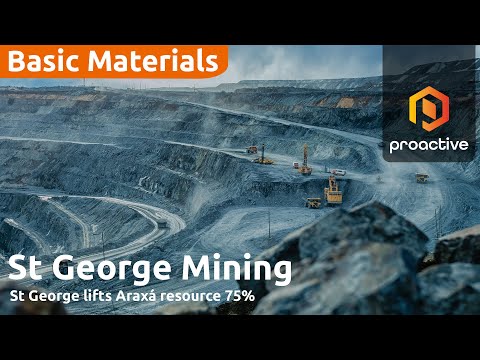
St George Mining Ltd (ASX:SGQ, FRA:S0G, OTC:SGQMF) earlier this week reported a major upgrade to the Mineral Resource Estimate at the company’s 100%-owned Araxá rare earths–niobium project in Brazil, significantly increasing the scale of the deposit as the company advances development plans.
Executive chairman John Prineas told Proactive the updated resource now totals 70.91 million tonnes at 4.06% total rare earth oxides (TREO) and 0.62% niobium pentoxide (Nb₂O₅) at a 2% TREO cut-off, representing a 75% increase from the previous estimate.
Prineas said the resource growth reflects the success of an extensive drilling campaign completed since mid-2024.
Interview highlights
- St George Mining Ltd announced a major upgrade to the Mineral Resource Estimate at the Araxá rare earths–niobium project in Brazil.
- Total resources increased 75% to 70.91Mt at 4.06% TREO and 0.62% Nb₂O₅.
- The upgraded resource follows drilling campaigns since July 2024 that delivered strong near-surface intersections.
- The scale of the project now places Araxá among the largest rare earth deposits outside China.
- Investor interest has been strong following the announcement at PDAC in Toronto.
- Two New York-based investment firms have approached the company regarding a potential Nasdaq listing targeting a US$1 billion valuation.
- The company continues drilling with 44 holes completed and 50 additional diamond drill holes planned.
- A separate East area discovery located 1km from the main deposit is also being drilled.
- St George Mining is targeting niobium production within around two years, with rare earth production potentially following about 18 months later.
- Both commodities could potentially be in production before 2030.
Proactive: Welcome back to Proactive Investors, ladies and gentlemen. I'm your host, Kerry Stevenson. I've asked John Prineas, Executive Chairman of St George Mining Ltd (ASX:SGQ), to join us. He’s coming to us from PDAC, so we won’t take up too much of his time — there’s a cocktail party to get to.
John, big announcement around the Araxá project, which the company took 100% control of only in February last year. This is a resource upgrade and it’s getting big — on par with some of the largest deposits. Can you tell us what the news is and why it’s significant for St George Mining?
John Prineas: Yes, it’s a very exciting announcement and we’re pleased to share it here at one of the world’s biggest mining conferences in Toronto. We were already a globally significant resource, but we’ve been drilling since July last year. Anyone who’s been following us has seen some amazing hits from surface. About 100 metres is normal for us, but we’ve also had intersections of up to 160 metres from surface with high-grade rare earths and high-grade niobium.
All that work has now gone into a resource upgrade. We’ve increased the resource from about 40 million tonnes to over 70 million tonnes at strong grades. In the rare earth space, the scale of the deposit now puts it on par with some of the largest producers outside China.
Proactive: Given that you’re at PDAC and the announcement came out yesterday, what’s been the reaction from the investment community?
John Prineas: The response has been very strong. Investors here know about Mountain Pass in the United States, which is one of the largest rare earth producers outside China. It has a market capitalisation of around US$11 billion.
People are drawing comparisons with where St George Mining could potentially go. We’ve even had two New York-based investment firms express interest in helping list the company on the Nasdaq with a potential US$1 billion valuation. That’s very exciting and something we will certainly consider as a wealth creation opportunity for shareholders.
Proactive: What is the biggest challenge for the company right now?
John Prineas: The main focus is getting back to site and continuing the drilling program while advancing the economic studies. We’re starting to get on the radar of larger corporate groups and there are also potential defence-related supply mandates to consider. At the moment the company is still undervalued at around a $500 million valuation compared to global peers.
Proactive: Looking ahead to production, how long might that take if development is fast-tracked?
John Prineas: The niobium side is technically straightforward. Our neighbours have been producing niobium for around 40 years and our team includes people who previously worked on those operations. We’re targeting niobium production within about two years, which could generate significant cash flow. Rare earth production could follow about 18 months later, meaning both products could be in production before 2030.
Proactive: Finally, how big do you think this deposit could ultimately become?
John Prineas: The drilling program is continuing. We’ve already completed 44 drill holes with results still to come, which will feed into another resource upgrade. We also have 50 diamond drill holes planned, and the East area discovery about one kilometre from the main deposit is still being drilled.
There is a lot more volume that could be added to the resource. I’m not going to guess the final size, but it would not surprise me if we emerge as the largest hard rock hosted rare earth deposit in the world within the next few months.
Proactive: John, thank you for taking time out of a very busy PDAC to update us on the latest developments.
John Prineas: Thank you, Kerry.