
Atomic Eagle Ltd (ASX:AEU, FRA:6QZ0) has declared a maiden ore reserve for its flagship Muntanga Uranium Project in Zambia after an independent engineering review confirmed the technical integrity of the project’s feasibility study.
The company reported a probable ore reserve of 39.6 million tonnes at 320 parts per million U₃O₈, containing 28.0 million pounds of uranium, based on the outcomes of a previously completed feasibility study and an independent review undertaken to support ASX compliance.
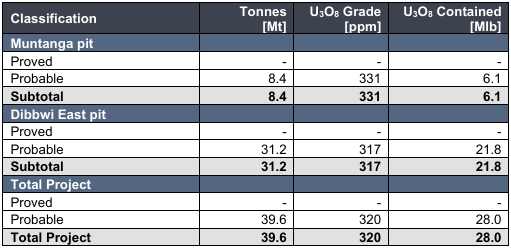
Muntanga Ore Reserve estimate as at 1 January 2025.
The review, conducted by engineering consultancy PRODEO Consulting Pty Ltd, concluded that the feasibility study’s production targets, capital costs and operating assumptions are supported by reasonable technical inputs and align with accepted industry practices.
“We are very pleased that the independent engineering review has confirmed the quality and integrity of the technical work underpinning the 2025 feasibility study completed on the project,” said Atomic Eagle chief executive Phil Hoskins.
“With a strong technical baseline now confirmed, we are well positioned to pursue resource growth and optimisation opportunities that we believe have the potential to materially enhance the scale, economics and long-term value of the project.”
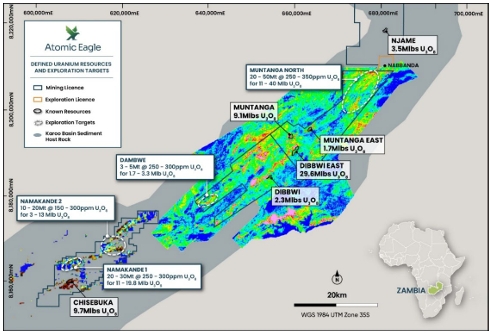
Muntanga Uranium Project – Exploration Target and Resource Locations.
Feasibility study outlines long-life uranium project
The feasibility study outlines a 12-year mine life centred on a low-strip open-pit mining operation using conventional processing and heap-leach recovery methods.
Key operating parameters include:
- Average annual production: ~2.2 million pounds of U₃O₈
- Total life-of-mine production: ~25.3 million pounds
- Plant throughput: 3.5 million tonnes per year
- Average metallurgical recovery: more than 90%
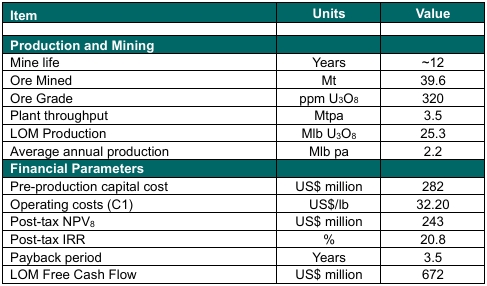
March 2025 Feasibility Study – Key Operating and Financial Parameters.
The proposed processing route involves crushing ore to about 25 millimetres before agglomeration and heap leaching, followed by uranium recovery through ion exchange and precipitation to produce saleable yellowcake.
Financial modelling for the feasibility study suggests robust economics, including:
- Post-tax net present value (NPV8): US$243 million
- Post-tax internal rate of return (IRR): 20.8%
- Payback period: around 3.5 years
- Life-of-mine free cash flow: US$672 million
Initial development capital is estimated at about US$282 million, with life-of-mine operating costs estimated at US$32.20 per pound of U₃O₈.
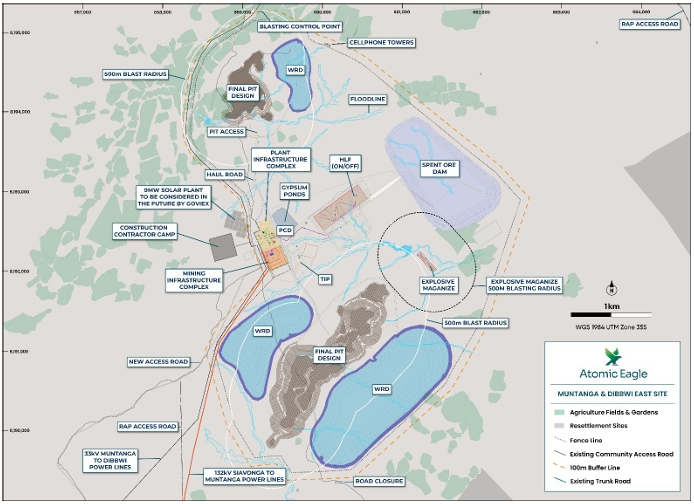
Muntanga mine site layout
Expansion potential remains key focus
Atomic Eagle said the confirmed feasibility baseline will allow it to pursue project optimisation and evaluate potential scale increases through resource growth.
The company recently updated the project’s broader mineral resource inventory, which now includes:
- Measured and Indicated resources: 50.4Mt at 359ppm U₃O₈ for 40.0Mlb
- Inferred resources: 35.8Mt at 238ppm U₃O₈ for 18.8Mlb
Management believes expanding the resource base could support higher production throughput and significantly enhance project economics.
To support that strategy, the company plans to launch its largest drilling campaign at Muntanga in nearly two decades later this month. The program will target extensions to the Chisebuka deposit as well as maiden drilling at the Muntanga North and Namakande 1 and 2 prospects, which display similar geophysical and geochemical signatures to known uranium deposits across the project area.
Path towards development
While Atomic Eagle has not yet made a final investment decision, the company intends to advance permitting, technical studies and financing discussions alongside the planned drilling campaign.
Environmental and social approvals are currently progressing in Zambia, including the review of the project’s environmental and social impact assessment and resettlement action plan.
If exploration success leads to expanded resources and updated feasibility work, the company expects to progress project financing and development planning thereafter, positioning Muntanga as a potential new uranium supply source in southern Africa.