
Red Mountain Mining Ltd (ASX:RMX)'s Thompson Falls Antimony Project has delivered further high-grade antimony and associated gold results from the historical Eastern Star mine area, reinforcing the prospectivity of the project on the Montana–Idaho border.
Rock chip sampling has returned average grades of 8.7% antimony and 0.37 grams per tonne (g/t) gold, with peak assays of up to 36.5% Sb and 1.12g/t Au.
Recent results include:
- 17.0% antimony and 1.12g/t gold
- 16.4% antimony and 0.17g/t gold
- 15.4% antimony and 0.32g/t gold
- 11.0% antimony and 0.04g/t gold
- 10.2% antimony and 0.71g/t gold
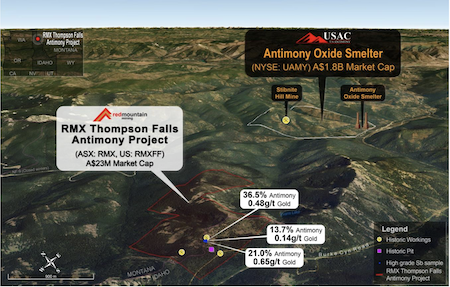
View looking northeast of Red Mountain’s Thompson Falls Antimony Project showing the project ‘s proximity to United States Antimony Corporation’s Thompson Falls smelter and Stibnite Hill Mine.
An exceptionally high-grade stibnite sample returned a 47.3% Sb reading from spot pXRF analysis, with visual estimates suggesting approximately 45% stibnite across the rock sample.
Elevated antimony and detectable gold
All samples collected from the mining area contained elevated antimony and detectable gold, highlighting the polymetallic nature of mineralisation at Thompson Falls. The results also indicate limited residual lead and silver in tailings material, suggesting historical operators effectively extracted those metals and potentially left behind antimony-rich material.
Thompson Falls is located at the eastern end of Idaho’s prolific Coeur d’Alene mineral district, one of the largest silver-producing regions globally. The district has historically produced 1,257Moz silver, 7.8Mt lead, 3.0Mt zinc, 1.1Moz gold and 191kt copper, with antimony historically treated as a by-product.
Red Mountain’s claims sit near United States Antimony Corporation’s operating smelter and Stibnite Hill mine, positioning the project within an established antimony processing corridor.
With spring fieldwork underway, Red Mountain plans further reconnaissance mapping and sampling to identify additional historical workings and mineralised exposures, alongside inspections of existing underground mines to refine its understanding of mineralisation ahead of potential drilling.