
PolarX Ltd (ASX:PXX, OTCQB:PXXXF) has delivered what may be its most significant exploration result to date, with first-pass drilling at the Ridgeline prospect within its Humboldt Range project in Nevada returning multiple wide, high-grade gold intercepts — including a standout bonanza hit of 1.5 metres at 37.29 g/t gold. A further 2.8km of the same anomaly is still to be drilled
The company has wasted no time flagging a major follow-up campaign.
Managing director Dr Jason Berton described the results as confirming the scope for a significant discovery, noting that the grades compare favourably with the successful nearby operations and that the company has only scratched the surface of a much larger target.
“These are outstanding results from our first drilling program at Ridgeline and clearly highlight the scope for a significant discovery.
“The grades are as good or better than those at the highly successful operating mines nearby. The widths are substantial, the mineralisation runs from surface and we have only drilled 800m of the 3.6-kilometre-long anomaly. And we are yet to get the silver assays from the same holes.
“In light of these results, we are now making plans for a follow-up program to extend the known mineralisation at depth and along the rest of the anomaly”.
The drill results
The initial 13-hole reverse circulation program totalled just over 2,000 metres and covered only 800 metres of the Ridgeline anomaly's 3.6-kilometre strike length. Despite that limited footprint, gold mineralisation was intercepted in 10 of the 13 holes, confirming multiple parallel mineralised trends from surface.
The standout hole was SP25-005, which delivered three separate mineralised zones: 16.8 metres at 0.55 g/t gold from 18 metres depth, then 9.1 metres at 6.38 g/t gold — including 1.5 metres at 37.29 g/t — from around 90 metres, and a further 22.9 metres at 1.16 g/t gold from 131 metres. That single hole alone demonstrates both the bulk-tonnage potential of the wider mineralised envelope and the presence of high-grade bonanza-style veining within it.
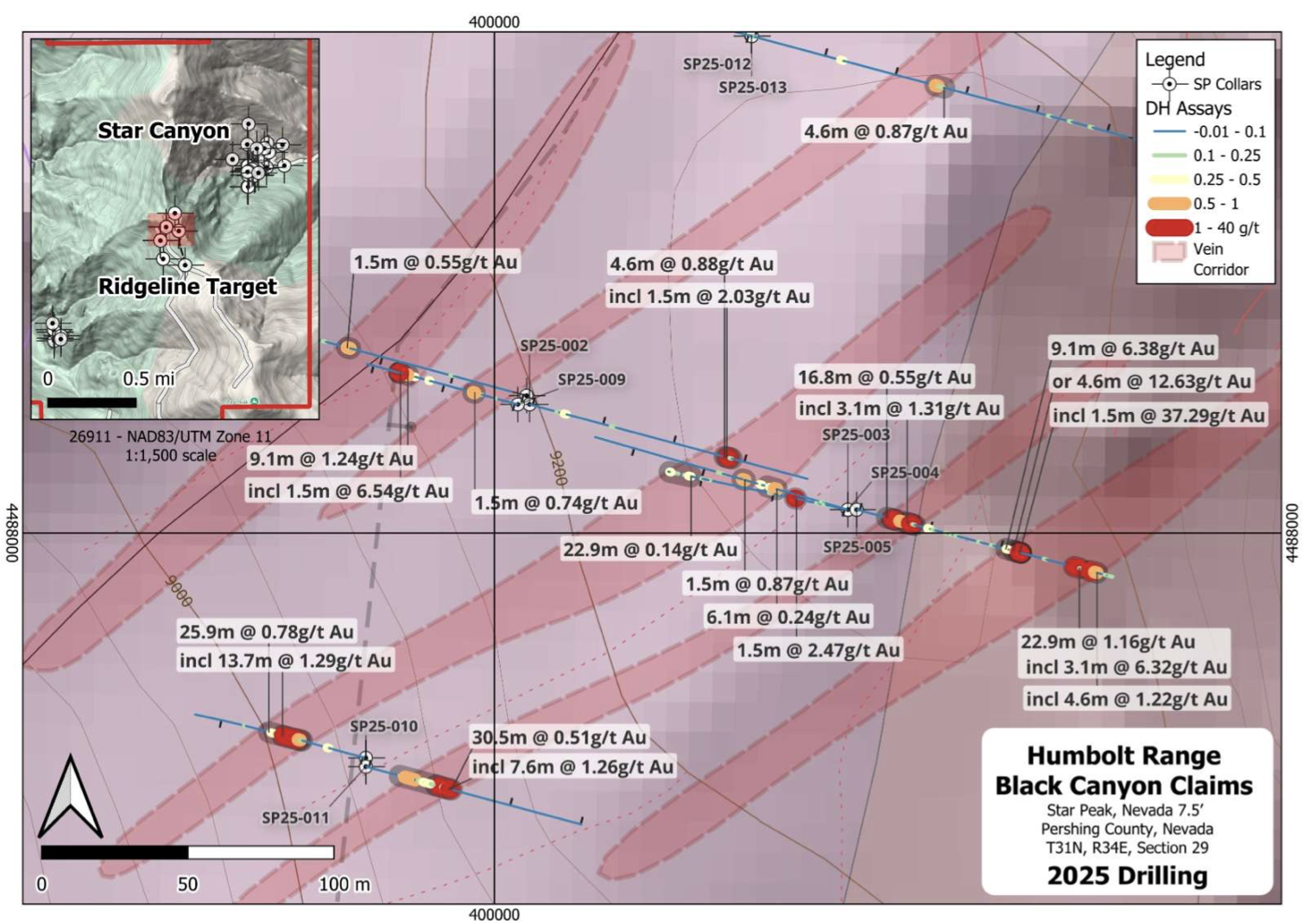
Ridgeline plan view summary of gold assay results. Multiple mineralised zones have been identified, trending NE to SW. The system remains open in both strike directions and at depth.
Other notable intercepts include SP25-011 returning 30.5 metres at 0.51 g/t gold from just under 20 metres, SP25-010 delivering 25.9 metres at 0.78 g/t gold, and SP25-009 hitting 9.1 metres at 1.24 g/t gold. Silver assays from the same holes are still pending — a further potential positive yet to be factored in.
Why this matters
The grades being returned at Ridgeline are, by the company's own assessment, on par with or better than those at operating mines in the immediate vicinity — a neighbourhood that includes Integra Resources' 5 million ounce Florida Canyon heap-leach gold mine less than 3 kilometres away, Coeur Mining's Rochester silver-gold mine 15 kilometres to the south, and Solidus Resources' 5-million-ounce Spring Valley gold project just nine kilometres from PolarX's Fourth of July claims.
Those neighbours are all large-tonnage, modest-grade, bulk-scale open-pit operations using heap-leach processing. Florida Canyon, for context, runs at a reserve grade of 0.35 g/t gold with a cut-off of just 0.13 g/t. The widths and grades PolarX is returning at Ridgeline already sit comfortably above that threshold, and with only a shallow depth of around 100 metres currently tested, the vein system remains open at depth — a point supported by IP and magnetic survey data.
Scale of the opportunity
The numbers underscore how early-stage this discovery remains. The Ridgeline anomaly extends over 3.6 kilometres in strike length and up to 1.3 kilometres in width, with coincident IP chargeability, gold and silver soil anomalies, and extensive quartz veining at surface. Only 800 metres of that anomaly has been drilled, meaning a further 2.8 kilometres remains completely untested by the drill bit.
Previous rock chip samples at Ridgeline had already graded up to 43.8 g/t gold and 86.1 g/t silver, foreshadowing the results now confirmed by drilling. And the Ridgeline program is just one component of a broader land package — PolarX holds 364 lode mining claims across two claim groups at Humboldt Range, with the Rochester Rhyolite host rock extending across the entire project area and additional high-grade historical veins awaiting permit approval to drill test.
What's next
PolarX is moving on two fronts. A return to Ridgeline for a major follow-up RC drilling program is planned for mid-April, weather permitting, with the aim of extending the known mineralisation along strike and at depth. Simultaneously, the company is applying for drill permits to test several historically mined high-grade veins in the Black Canyon valley — including the Lois, Indian Ike, JC and Midas veins, some of which have historical surface grades running into the hundreds of grams per tonne of gold.
On a cautionary note, the company flagged that significant laboratory delays in Reno held up the delivery of these results — a frustration shared with other explorers in the region. PolarX says it has severed ties with the laboratory in question, and silver assay results from the current program, along with pending Alaska Range results, will be reported on receipt.