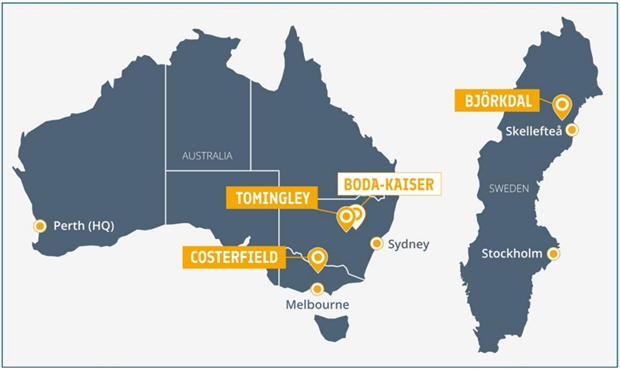
Alkane Resources Ltd (ASX:ALK, OTC:ALKEF) has outlined a string of exceptionally high-grade gold and antimony intersections from infill and extension drilling at the Kendal deposit, a near-mine target adjoining the currently mined Youle lode at its Costerfield operation in Victoria.
The latest results confirm Kendal as the antimony-rich, up-dip continuation of the high-grade Youle and Shepherd systems and point to a substantial body of shallow mineralisation close to existing underground infrastructure. Development to access the newly extended Kendal system began in late 2025 and remains ongoing.
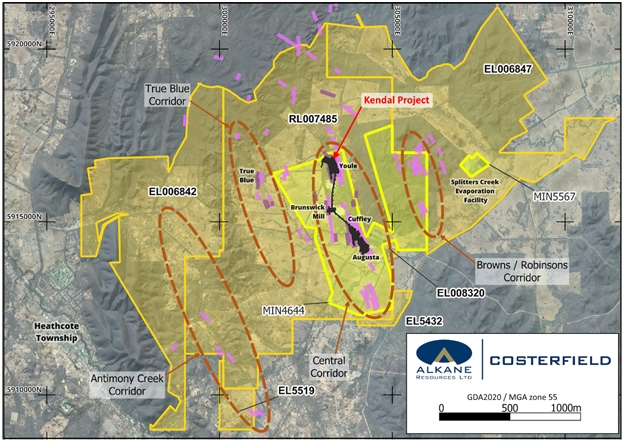
Regional map of the Costerfield Project in GDA grid showing Alkane tenements and the main corridors of mineralisation identified.
High-grade continuity above Youle
Drilling over the past year has significantly expanded the known extent of the Kendal vein system, both offset from and adjacent to historic mine workings. While the area was mined between 1861 and 1939, Alkane’s modern close-spaced drilling has revealed significant veining that went undiscovered during historic operations.
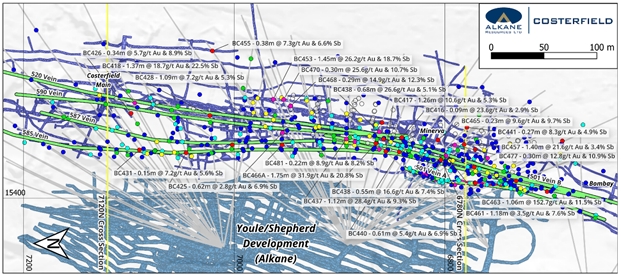
Costerfield / Kendal area plan view with major Kendal vein best fit traces displayed (green), cross section positions (yellow lines), 2025 drill traces and >10g/t AuEq intercepts labelled. Historic Kendal intercept positions are shown as faded circle.
Standout intercepts from the 501 vein, immediately above and south of Youle, include:
- 132.2 g/t gold and 19.8% antimony over 1.94 metres (estimated true width 1.04m)
- 25.3 g/t gold and 42.8% antimony over 1.71m (ETW 0.97m)
- 13.5 g/t gold and 22.1% antimony over 2.67m (ETW 1.24m)
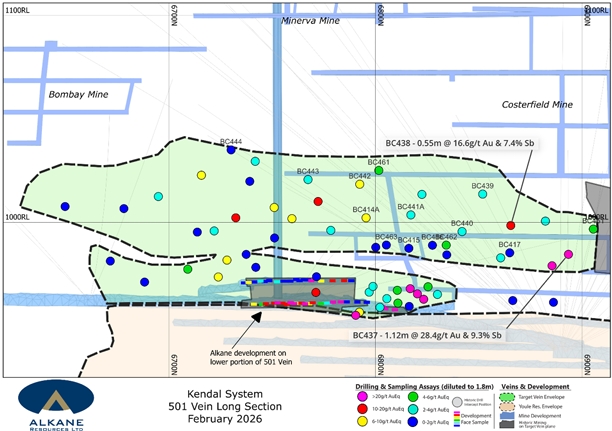
Long Section of the Kendal 501 Vein with high grade assays highlighted. The lower portion of the 501 vein has already been accessed by Alkane, and diluted face grades are shown alongside drilling intercepts.
Additional strong results were recorded from the 520 vein, which spans more than 500 metres in strike and up to 200 metres vertically, including:
- 267.5 g/t gold and 5.6% antimony over 2.3m (ETW 1.22m)
- 143.7 g/t gold and 10.8% antimony over 1.35m (ETW 1.06m)
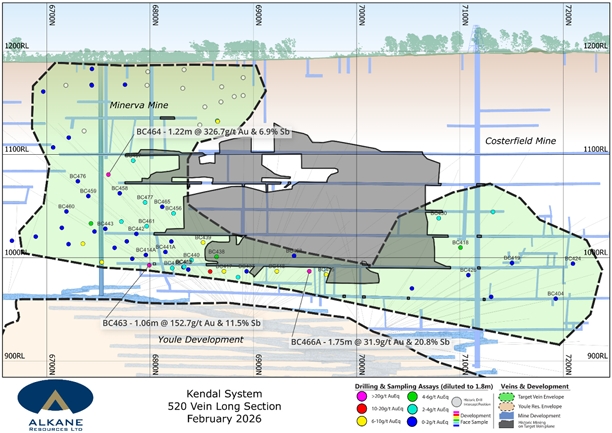
Long Section of the Kendal 520 Vein with high grade 2025 assays highlighted. The section shows the strong continuity of the Kendal system outside of the historically mined sections, both vertically and along strike.
Alkane managing director and CEO Nic Earner said the drilling demonstrated “the large potential remaining for significant high-grade mineralisation at shallow levels near to the Costerfield mine”.
“Accessing and mining the newly defined mineralisation is a top priority for the Costerfield team and should provide the processing plant with an additional source of high-grade gold and antimony ore for some time to come,” he said.
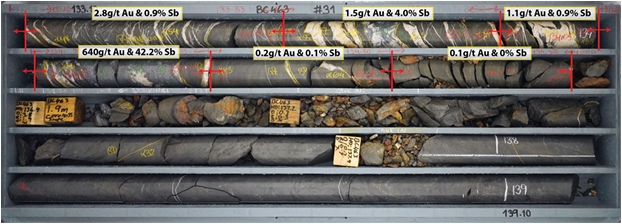
Photo of drill core from BC463 (520 Vein) showing the sheeted nature of the ore veins. Note the oxidised interval adjacent to the intercept signifies an historical stope adjacent to the in situ high-grade veins. Composited interval graded 143.7g/t gold and 10.8% antimony over 1.35m (ETW 1.06m).
Multiple veins over 600 metres strike
With the latest program integrated into its geological model, Alkane has delineated 25 individual veins within the Kendal system. The overall system extends for around 600 metres along strike and averages about 70 metres in width.
Some veins, such as the 520 vein, can be traced for most of the strike length. Others, including the 501, 519, 523 and 545 veins, returned further exceptional results, such as:
- 261 g/t gold and 32.5% antimony over 0.15m (523 vein)
- 84.4 g/t gold and 35.2% antimony over 0.41m (545 vein)
- 138 g/t gold and 7.7% antimony over 0.27m (519 vein)
Several additional intersections adjacent to modelled veins also delivered bonanza grades, including up to 275 g/t gold and 165 g/t gold with significant antimony credits.
The company noted that the antimony content at Kendal is significantly higher than at the Shepherd system, currently a main ore source at Costerfield, while also maintaining very high gold grades.
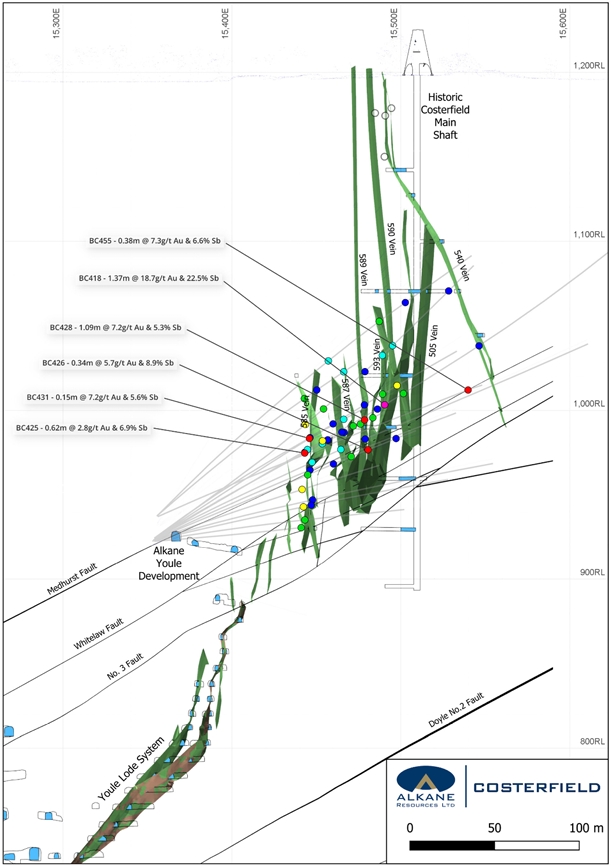
Cross section looking north at mine northing 7120N showing Kendal veins in cross section and drill intercepts between 7000N and 7135N. 2025 drill intersections grading over 10g/t AuEq when diluted to 1.8m are labelled. The historic Costerfield Main shaft and workings can be seen centred at 15,500E, and the modern Alkane development offset to the west and depth. Note the average depth of the Kendal mineralisation ascends to the north with the plunge of the anticline.
Structural complexity unlocks missed mineralisation
Costerfield sits on the hinge and western flank of the north-striking Costerfield Anticline. The Kendal veins are structurally controlled by cleavage fabrics and bedding-parallel faults within siltstone host rocks, with individual veins offset across shallow-dipping faults before linking down-dip into the Youle and Shepherd lodes.
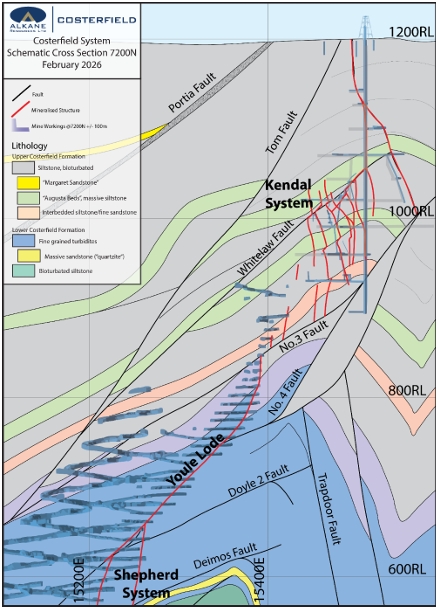
Geological cross section of the Costerfield gold-antimony vein system at mine northing 7200N, showing the Kendal vein system’s position in the Costerfield Anticline and its relationship with the below Youle and Shepherd veins which are currently mined.
The structural complexity, including sheeted vein swarms and fault offsets, is a key reason significant mineralisation remained untested at shallow levels within 300 metres of surface. Modern drilling techniques have allowed Alkane to reinterpret and link mineralisation across the historic Costerfield, Minerva and Bombay mine areas.
Historic drilling from the 1990s has been used as geological support but remains unverified.
Development underway, resource update planned
Early confidence in the southern portions of the Kendal system prompted Alkane to commence access development from existing underground infrastructure in late 2025.
The company is working towards reporting a mineral resource for Kendal, with the intention of integrating it into the broader Costerfield resource and life-of-mine plan.
Further drilling is warranted, including at the underexplored Costerfield Main reef to the east. Near-mine drilling is currently focused on the southern part of the field, where work continues at the recently discovered Brunswick South deposit and extensions to Cuffley. Drilling at Kendal is expected to resume in 2026.
Costerfield has been in modern continuous production since 2006 and forms part of Alkane’s portfolio of three operating gold and antimony mines across Australia and Sweden. At the Tomingley Gold Operations in New South Wales, Alkane on Tuesday announced it has confirmed a gold-bearing structural corridor beneath the Roswell deposit, highlighting further resource expansion potential at depth and along strike.
The Kendal results reinforce the potential for ongoing high-grade resource growth close to infrastructure, supporting production continuity and future mine life extension at the Victorian operation.