
St George Mining Ltd (ASX:SGQ, FRA:S0G, OTC:SGQMF) has delivered its thickest intercept to date at the Araxá Rare Earths and Niobium Project in Brazil, as ongoing drilling continues to expand the footprint of high-grade mineralisation beyond the current resource model.
The standout result from diamond hole AXDD055 returned 164.45 metres from surface grading 2.93% total rare earth oxides (TREO) and 0.39% Nb₂O₅, including 62 metres at 5.15% TREO and 0.66% Nb₂O₅ from 22 metres, and 15 metres at 8.78% TREO and 1.18% Nb₂O₅ from 55 metres.
The intersection extends well beyond the current Mineral Resource Estimate (MRE), which is modelled to a depth of 100 metres from surface.
“With the current MRE modelled to just 100m below surface, it’s exciting to see another record thick intercept that confirms high-grade mineralisation well beyond that level,” executive chairman John Prineas said.
“The mineral system clearly remains open — both at depth and laterally — with further growth in the mineralised footprint expected as we continue drilling 24/7.”
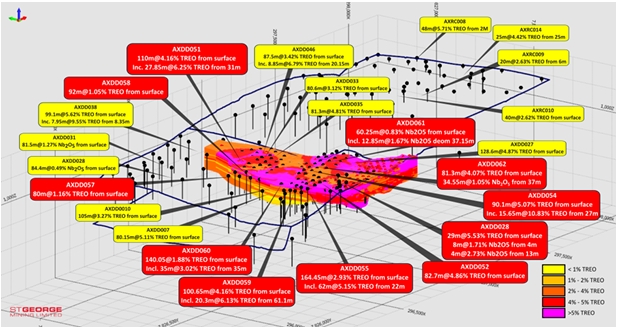
Oblique section showing some of the latest diamond drill holes as well as other significant drilling completed in the current campaign, set against the current 3D model of the MRE. The latest drill holes are shown with red labels.
Broad, high-grade zones from surface
Assays were received for a further 17 drill holes, with multiple wide, high-grade intervals reported from surface.
Among the better results:
- AXDD051: 110m at 4.16% TREO and 0.34% Nb₂O₅ from surface, including 68m at 5.16% TREO and 0.43% Nb₂O₅.
- AXDD052: 82.7m at 4.86% TREO and 0.76% Nb₂O₅ from surface, including 56.7m at 4.77% TREO and 0.84% Nb₂O₅.
- AXDD054: 90.1m at 5.07% TREO and 0.55% Nb₂O₅ from surface, including 15.65m at 10.83% TREO and 0.77% Nb₂O₅.
- AXDD059: 100.65m at 4.16% TREO and 0.55% Nb₂O₅ from surface.
- AXDD062: 81.3m at 4.07% TREO and 0.72% Nb₂O₅ from surface.
The company said the results continue to demonstrate consistent, thick mineralisation across the project area, both within and outside the existing MRE boundary, increasing confidence in the geological model and highlighting potential for further resource growth.
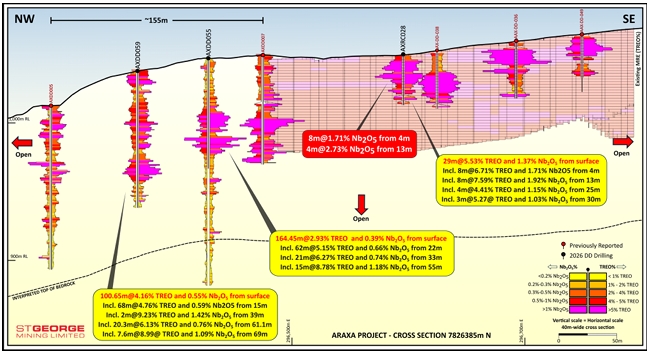
Section A – A’ showing high-grade TREO intercepts (cut-off 1% TREO) and high-grade Nb2O5 intercepts (cut-off 0.2% Nb2O5) along with the existing MRE outline, showing both in-fill drilling and the expansion of the existing MR along strike and at depth.
In AXDD055, fresh rock was intersected at 131.6 metres, with mineralisation continuing below that level. St George reported grades above 1% TREO across the fresh rock interval, with a neodymium-praseodymium (NdPr) to TREO ratio of about 21%, consistent with previous drilling and the existing resource.
The presence of high-grade mineralisation in fresh rock supports the potential for depth extensions. Other operators in the broader Barreiro carbonatite complex have identified mineralisation down to 800 metres from surface.
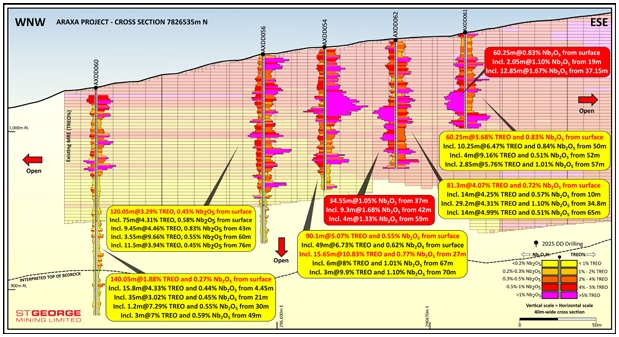
Section B – B’ showing high-grade TREO intercepts (cut-off 1% TREO) and high-grade Nb2O5 intercepts (cut-off 0.2% Nb2O5) along with the existing MRE outline, showing the westward expansion of the existing MRE.
Resource growth and development studies
St George currently has three diamond rigs and one reverse circulation rig operating around the clock at Araxá, with 20 additional drill holes pending assay.
The company said increased drill density in previously sparsely drilled areas is assisting resource modelling and could support future updates to the MRE.
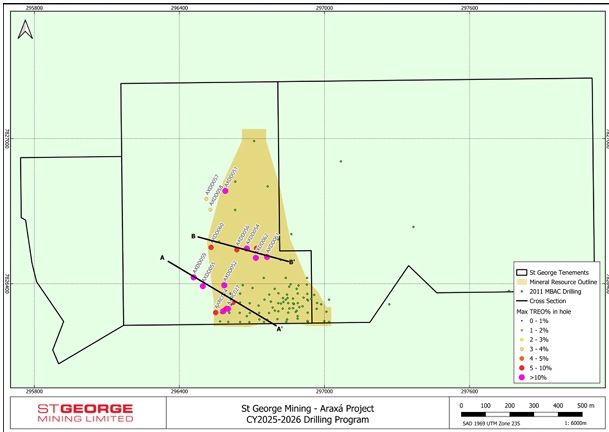
Plan view map of Araxá area showing the location of the diamond drilling relative to the MRE.
St George acquired 100% of the Araxá Project in February 2025. Located in Minas Gerais, the project sits adjacent to CBMM’s world-leading niobium operations and benefits from established infrastructure, a skilled workforce and state support for expedited permitting.
An MRE announced in April 2025 outlined a total niobium resource of 41.2 million tonnes at 0.68% Nb₂O₅ and a total rare earth resource of 40.6 million tonnes at 4.13% TREO.
“The expanding resource has potential to increase mine life and provide optionality for mine planning — key development criteria being considered in the economic studies currently under way,” Prineas said.
“We look forward to reporting further assay results over the coming weeks and keeping shareholders updated as we continue to advance our work at Araxá.”