
- FTSE 100 up 22 points to 10,468
- Defence shares lifted by spending increase report
- US markets closed today for holiday
4.02pm: AI fear trade resurrected
The FTSE 100 is heading towards an unspectacular finish on Monday, when volumes have been affected by markets being on holiday in the US and China, not to mention many UK schools on half-term.
From the start to this last half hour, banks and defence companies have been providing most of the gains.
The fallers have shifted a bit though, with the AI scare trade resurrected as St James's Place (down 5.8% today and 24% since the start of February), RELX (down 3.2% and 27% in the year to date), Sage (2.7% and 25% YTD), Experian (2.3% and 26% YTD) and Pearson (1.4% and 11% YTD) among those on the slide.
3.22pm: FTSE trend watching
Some apparent trends in financial markets are emerging this week, says Kathleen Brooks, research director at XTB.
European stocks are mostly higher, with the FTSE's 0.3% gain mirrored by moves in Paris and Milan, while Madrid is seeing a 1% gain for the IBEX and in Frankfurt the DAX is slightly in the red.
The financial sector has been providing some lift after a nasty sell-off in European banks last week, Brooks notes, reflecting the AI "fear trade".
NatWest, Barclays and Prudential lead the way. NatWest is higher by more than 4% today, after losing over 16% from its post-2008 high at the start of the month.
Brooks notes that UK gilts are the top performers in Europe, with the 10-year at a month's low and the 2-year yield at its lowest in almost three years.
"Overall, markets are steady today, as we wait to see if UK CPI and labour market data will increase expectations that the BoE will cut rates next month.
"If inflation does moderate as expected, the pound’s losses could be capped, since an interest rate cut would boost the economy and help drive inflows to the gilt market."
She says the AI scare trade is "on hold" as we wait and see the US come back from the long weekend "before we know if the sell off continues.
"There is a growing sense that fears about AI swallowing up large swathes of global jobs and industries are overdone and this week could see a recovery in some of the sectors that have seen the worst of the sell off, including software stocks. Investors could also be enticed back, now that valuations are looking much improved compared to 2025."
2.56pm: China ties
The UK accounting watchdog has launched a consultation on a temporary rule change aimed at making London more attractive to Chinese companies seeking a listing.
Under the proposal, auditors of Chinese-registered groups listing global depositary receipts in London would be allowed, for a limited period, to use Chinese Standards on Auditing rather than UK standards.
The move by the Financial Reporting Council follows a request from the UK Government, which believes current rules may be discouraging some issuers from choosing London.
The change would apply only to companies listing through the Shanghai or Shenzhen Stock Connect segment of the London Stock Exchange’s International Order Book. Auditors would still need to register with the FRC as third country auditors and remain subject to supervision.
The FRC said the amendment would be time-limited and include safeguards such as clear disclosure of the auditing standards used. It is seeking views on whether the approach strikes the right balance between investor protection and supporting economic growth.
1.43pm: Space trust's valuations rocketing
Seraphim Space Investment Trust has flagged that valuations of its four largest portfolio companies rose in the December quarter, delivering a combined fair value uplift of £69 million.
Last year was a good one for the trust, rising back up above its 2021 IPO price, after being hit by almost two years of selling after initial excitement wore off.
Seraphim said each of its top four holdings recorded an increase in valuation, equivalent to a 24% increase on its previously published net asset value.
The biggest is its stake in ICEYE, which was valued at £132 million at 31 December, up from £99 million at 30 September, after contract wins including a €1.7 billion multi-year contract from the German government through its joint venture with Rheinmetall.
James Bruegger, chief investment officer, said: “The substantial valuation uplifts across all four of our largest holdings reflect the benefits these companies are now starting to reap as a result of consolidating their leadership positions in their respective categories.”
12.35pm: FTSE chugging away
The FTSE 100 is inching its way steadily back higher as we move into the afternoon part of the session.
NatWest and other banks, plus the defence sector are still the main driving forces.
Shell and BP are also supporting the index.
A reminder that the US is closed for business today, though European markets may still see some Stateside investors logging on, though only on their own accounts.
As it is the Lunar New Year, Chinese markets are also closed.
11.59am: AI report on AI
Deutsche Bank has decided that if you can’t beat the robots, you might as well get them to write the research note.
With markets in a tizzy over artificial intelligence, the bank turned to its own tool, dbLumina, which runs on Google’s Gemini 2.5 Pro, and asked it to analyse which sectors are most at risk.
“You are a sophisticated analyst specialising in the implications of AI for the economy and markets,” macro strategist Jim Reid instructed, requesting a report of "no more than 3,000 words with deep analysis".
A minute later, out it popped, citing dozens of different sources, from Stanford University, Brookings, the World Economic Forum and rival investment banks, to the 'AI bubble' page on Wikipedia and articles posted on Reddit.
While the AI concluded that “AI is set to increase global GDP and labour productivity”, there was less reassuring news for readers in several industries.
The report warned that “data-rich sectors with repetitive, pattern-based tasks are most likely to be disrupted”.
Information technology (with most coders now using AI assistance) and software (the SaaS model could be disrupted due to fewer licences being needed) are first in the firing line, it said.
This is expected to be followed by finance (fears have rocked names on both sides of the Atlantic last week), customer services, manufacturing and logistics, and media and entertainment (as seen for RELX, Informa and LSEG earlier this month).
Those safe, for now? The report's research suggested jobs requiring “empathy and human connection”, with early-years teachers, nurses and social workers mentioned.
Manual dexterity in messy environments was also mentioned, such as plumbing, carpentry, and on-site construction, as well as “strategic and creative leadership”. Corner-office executives can breathe easy, for now.
11.42am: Defence spending would boost GDP
If the reports about accelerating the increase in UK defence spending are true, it could hit two birds with the one stone (or missile), says market analyst Daniela Hathorn at Capital.com.
"Economic research shows that higher government defence spending can have a stimulative effect on activity, especially if it goes into capital investment and domestic supply chains, which boosts jobs and income across related industries.
"The fiscal multiplier for investment is typically positive, meaning that increased defence outlays could add to GDP growth beyond the nominal spending figure."
However, Hathorn adds, it would depend on how the spending is financed.
"If the government funds it through higher borrowing, bond markets could demand higher yields, which might push up government borrowing costs more broadly and weigh on risk assets.
"However, while defence spending increases can support sectors tied to military equipment and services, they also raise questions about broader fiscal priorities.
"If accelerated spending leads to cuts in other areas or pressures on public finances, this could dent consumer sentiment and weigh on growth-sensitive assets. UK consumer confidence is already fragile, with households worried about debt and credit conditions."
11.14am: Consumer confidence is low
UK consumer confidence has apparently remained low in recent weeks.
S&P Global, which also carries out the PMI surveys, found that the mood worsened in February, although flattening off from the drop in January.
The S&P Global UK Consumer Sentiment Index (CSI) inched up to 44.8 in February from 44.6 in January, still some way below the 50-point mark that separates positive and negative sentiment.
Rainy weather for much of the country was matched by the mood among UK households, says S&P economist Maryam Baluch.
"Although the overall degree of gloom has lifted slightly since January, consumer confidence continues to run at one of the lowest levels seen over the past two years," she adds.
"A period of prolonged rain and a dearth of sunshine have no doubt not helped to lift the low spirits seen among households, but there’s more going on here than just bad weather."
The survey revealed that households are increasingly worried about debt, especially as a rising need for credit was met with the steepest decline in availability of loans since the middle of 2024.
This, plus existing low confidence, suppressed appetite for major purchases, with intentions around big ticket expenditure at the lowest in ten months.
"The low appetite to spend bodes ill for the broader impetus to purchase, hinting at a sustained drag on economic growth from sluggish consumer spending in the first quarter," says Baluch.
10.12am: Pinewood and AI
Apax binning its bid for Pinewood Technologies comes only a fortnight after the talks were first revealed, with the private equity firm saying it won’t make a formal offer because of ‘challenging’ market conditions.
In those two weeks, a lot has happened in AI, which is possibly the root of this deal falling apart, suggests Dan Coatsworth, head of markets at AJ Bell.
"Pinewood is a technology provider to car retailers and manufacturers and has gone big in AI-related services.
"Two years ago, that strategic development would have attracted hoards of investors wanting exposure to all things AI. In 2026, the reverse is true as investors panic about companies being disrupted by the big AI platform providers including Anthropic and OpenAI.
"It’s notable that Pinewood’s share price hasn’t simply given up the share price spike from when Apax first revealed takeover interest.
"The shares have fallen even further as investors are now worrying why a big-name bidder has suddenly walked away, and whether Pinewood is going to be lumped with the multitude of other stocks that have struggled this year due to AI disruption-related fears."
9.50am: Small caps, big moves
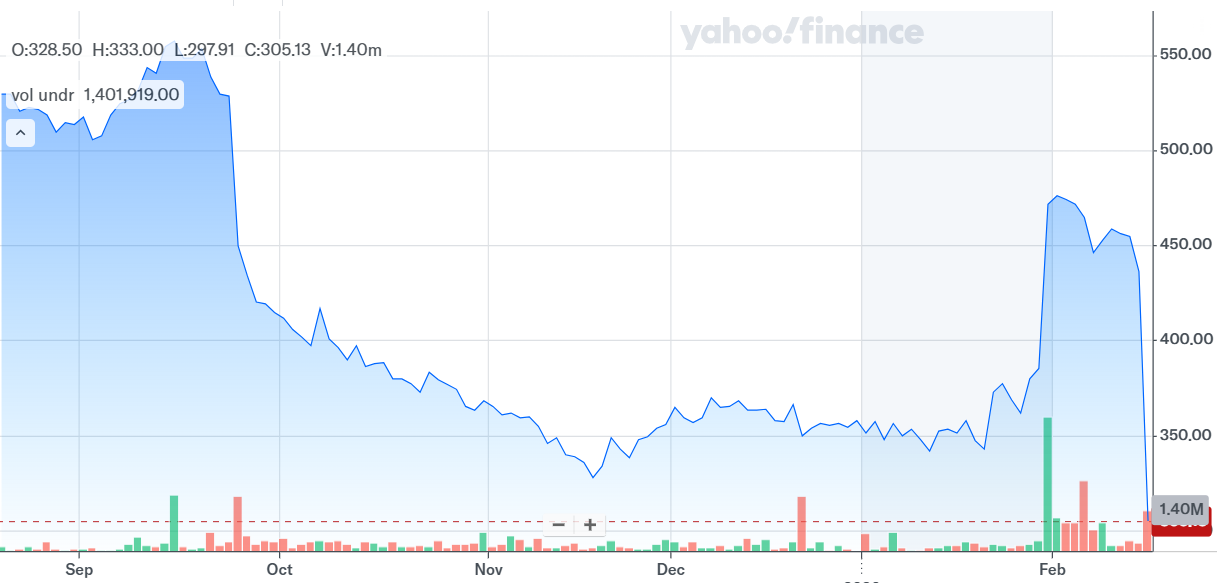
Some drama on AIM as SkinBioTherapeutics PLC shares have dropped another 39%, and are now down over 60% over the past week after the company said it expected to seek the reversal of all accrued royalty income from its audited revenues for the year ended 30 June 2025.
The AIM-listed life science business said it received information late on Friday 13 February, that has informed its ongoing investigation into the conduct of its former chief executive.
Board concerns about the former chief executive’s conduct led to him being suspended and then resigning, and the company said the investigation was continuing.
Elsewhere, Pebble Beach Systems shares have made a splash, up 11% after the company won a new contract worth an initial £1.3 million over five years to support a US streaming giant.
The deal was secured through a US-based partner and will see Pebble’s automation technology used to help the 'Tier 1' company expand into live sports broadcasting.
9.22am: Busy days ahead
It may be a slower start to the new week with the US closed for the President’s Day holiday today, "but the five days ahead still look busy", says market strategist Patrick Munnelly at Tickmill.
In the UK, attention turns to a run of "key" ONS releases: employment and wage data on Tuesday, the January inflation report on Wednesday, and retail sales on Friday.
"After the MPC’s narrow 5–4 decision to hold rates in February, markets will be scanning for evidence that a March cut is now firmly in play.
"Any additional softening in the labour market and/or wages, or a further cooling in inflation, would strengthen that case, and markets still appear to be underpricing the scope for additional Bank Rate cuts beyond March," he says.
The US calendar is also pretty full, with the biggest releases clustered on Friday: December PCE and the advance Q4 GDP print.
"With trade likely to boost the headline GDP number, the focus will be on whether underlying momentum is cooling, particularly domestic final demand, given recent weakness in labour and retail indicators."
Before then, there is industrial production, trade, housing and various data and other surveys spread through the week.
"Friday also brings flash February PMIs for the major economies, where the key themes will be whether Eurozone manufacturing continues to show improvement and whether the rebound in the UK’s January data proves durable.
On the central bank front, the Reserve Bank of Australia gives a decision tomorrow and the US Fed minutes follow on Wednesday, when the New Zealand central bank also meets, though no rate is expected (yet), says Munnelly.
8.59am: Barratt forecasts reduced
Barratt shares are further in focus from some analysis of a mixed set of interim results earlier in the month, where tough trading put pressure on margins and the order book.
This morning, Deutsche Bank has reduced its 2026/27/28 underlying PBT forecasts by 9%, 6% and 7%, respectively.
"Based on management targets for outlet growth, alongside improving margins, Barratt should show above average profit growth over the next few years. However, this positive outlook is tempered by its £1.3 billion [fire safety] provision balance, which will depress cash generation," says analyst Chris Millington.
The analyst sees potential for market conditions to improve, "possibly supported by a government demand side initiative".
8.37am: Housebuilders hit by reports of soft pricing
Barratt Redrow and Berkeley seem to be down after Rightmove reported slightly lower house prices, with competition among UK house sellers at an 11-year high.
The property portal said the average asking price of a newly listed home slipped £12 month-on-month to £368,019, effectively flat year-on-year.
That came after a strong rise for the time of year in January, when prices were 2.8% higher than in December.
Rightmove said a surge of new sellers since Boxing Day and through January has left buyers with more choice and greater room to negotiate.
Activity picked up after the Budget, with confidence among buyers and sellers in January returning to its highest level since September 2025.
However, buying demand is weaker than a year ago, when many rushed to complete deals before a stamp duty increase in England. With plenty of homes on the market, sellers are being urged to price realistically.
Colleen Babcock, property expert at Rightmove, said: "The market fundamentals haven’t changed. There are still lots of homes for sale, and buying activity isn’t as strong as this time last year, when many buyers were rushing to move before the stamp duty increase in England.
"So in February, sellers have taken a more cautious approach by holding onto January’s gains rather than pushing prices higher, at a time when competition is high and the market is still very price-sensitive.”
8.15am: FTSE 100 opens higher, led by banks and defence
The FTSE 100 has begun the week on the front foot, led by banks and defence sector names, but held back by falls for miners.
In opening trades, the London index was up 10 points at 10,457.
NatWest is top of the leaderboard, up 3.5%, after reporting results at the end of last week and beginning its share buyback today.
Barclays, Stan Chart, Lloyds and HSBC are also well bid.
Others among the top risers are some of those companies hit by AI-related worries in the past fortnight, including Autotrader and Rightmove.
Babcock International and BAE Systems are higher following the security summit over the weekend, with the BBC reporting this morning that Prime Minister Keir Starmer is "considering making a significant increase in defence spending".
Leading the fallers are housebuilders Barratt Redrow and Berkeley, followed by miners Endeavour, Rio Tinto, Glencore, Fresnillo and Anglo American.
7.59am: Market analysis
While US stock and bond markets are closed today, the economic data from the US last week has provided "some breathing room to markets", says analyst Ipek Ozkardeskaya at Swissquote.
A mixed jobs report was followed by weaker-than-expected retail sales, before inflation data showed core CPI fell back to the lowest since 2021.
The US 2-year Treasury yield fell to 3.40% – the lowest since October – as the probability of a Federal Reserve rate cut rose to 70%.
With gold kicking off the week with a move below the $5,000 level, Ozkardeskaya says, partly this is due to a marginally stronger US dollar.
"Some argue that softer US inflation is taking pressure off the yellow metal – traditionally seen as a hedge against inflation – but I believe that, given gold’s high correlation with risky assets over the past few weeks, a retreat in gold could be a sign that appetite across risk assets remains weak this Monday morning."
Looking ahead to this week, she says she expects "further capital inflows into the European defence sector, as the weekend’s security talks among Western allies were marked by two notable points: the highest US representative was not present, [and] the German Chancellor stated that Germany and France are not in talks on nuclear deterrence.
"Given how strongly Europeans have relied on the US for the continent’s security, the gap left by US disengagement must be filled, and quickly. Hence, European defence stocks will likely continue to benefit from solid inflows."
Tech and AI effects will also be in focus, she says, with a divergence between tech and the rest of the market seen at the end of last week.
"Falling yields helped lift sentiment in many sectors but failed to cheer up Big Tech."
Also, concerns about leveraged AI spending are now topped by "growing anxiety" that AI could replace businesses and jobs, she says.
7.41am: Beazley and Zurich get more time
Beazley and Zurich Insurance have secured more time for the latter to make a firm takeover offer, as discussions and due diligence are ongoing.
After an £8 billion recommended cash bid was agreed in principle at the start of the month, today was the original 'put up or shut up' deadline.
The pair confirm that Zurich has begun confirmatory due diligence and the boards are also negotiating detailed terms and drafting transaction documents.
The Swiss insurance giant now has until 5pm on 4 March to make its decision.
7.29am: Pinewood suitor Apax walks away
Pinewood Technologies, aka Pinewood.AI, has put out a statement this morning in response to one published by Apax Partners after 6pm on Friday.
In short, private equity firm Apax said: "In light of the prevailing challenging market conditions, Apax confirms that it does not intend to make an offer".
Challenging market conditions? Like the FTSE 100 hitting a succession of new record highs? Hmm.
Anyway, Pinewood's board said it "remains very confident in the positive long-term prospects for the group", which "occupies a leading position as a mission-critical, full-service, embedded technology provider to automotive retailers and OEMs, benefitting from high recurring revenues and long-standing OEM partnerships".
They also express belief that the company is "well-positioned to continue executing its strategy and to achieve its medium‑term FY28 guidance of underlying EBITDA of £58-62 million".
7.16am: FTSE 100 to start week on front foot
The FTSE 100 is predicted to start the week on the front foot, though Monday is likely to be quieter for global markets due to the US and China being closed for a national holiday.
On the futures market, London's blue-chip index has been called 21 points higher, after it added 76.5 points last week to close at 10,446.35.
Gold prices fell below $5,000 an ounce in the early hours, but have climbed back above that level since. Silver and copper are also slightly weaker since the end of last week, but have levelled off rather than bouncing back.
The coming week brings a healthy sprinkling of more FTSE 350 company results, with a strong mining theme, including Antofagasta and IHG tomorrow, BAE Systems and Glencore on Wednesday, Centrica and Rio Tinto on Thursday, and Anglo American, Segro and TBC Bank on Friday.