
Sunshine Metals Ltd (ASX:SHN) has outlined a potential pathway to production at its Liontown deposit in North Queensland, delivering a scoping-level mining study that points to robust cashflow from a staged open pit and underground operation.
The Liontown Mining Study — based on the November 2025 mineral resource — outlines an initial production target of about 75,200 ounces of gold at 2.96 g/t and 654,000 ounces of silver at 25.7 g/t over a 47-month mine life.
At assumed prices of A$6,500 per ounce gold and A$100 per ounce silver, the study estimates gross revenue of roughly $458 million and net operating cashflow of $162.7 million after all capital costs, with an all-in sustaining cost (AISC) of $2,741 per ounce.
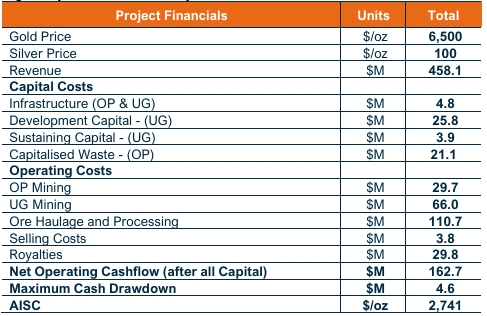
Mining Study Financial Summary.
Importantly, recent high-grade drilling results are not incorporated into the current study, with an updated mineral resource and revised mining study expected in April 2026.
A staged open pit and underground plan
Liontown, part of the broader Ravenswood Consolidated Project, lies about 40 kilometres southwest of Charters Towers and hosts a total resource of 6.3 million tonnes at 1.5 g/t gold, 27 g/t silver, plus copper, zinc and lead credits.
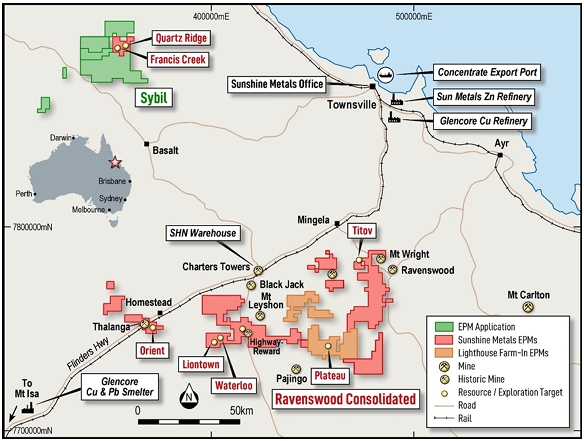
Shallow oxide gold prospects at Ravenswood and proximity to established mines, infrastructure and the mining hub of Charters Towers in Queensland.
The mining study focuses on three gold-dominant zones — Shallow Au, Carrington Fresh and the high-grade Au Panel — representing about 790,000 tonnes at an average 4.27 g/t gold and 31.6 g/t silver.
The development strategy comprises:
- Stage 1 and 2 open pits, followed by
- A 42-month underground longhole stoping operation targeting the high-grade Au Panel.
Recovered production under the base case is estimated at 64,300 ounces of gold and 426,000 ounces of silver, after metallurgical recoveries of around 85% for gold and variable silver recoveries depending on grade and weathering profile.
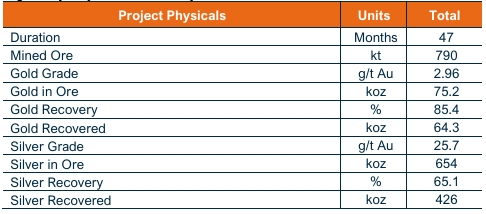
Mining Study Physicals Summary.
The study assumes toll treatment at a third-party mill in the region, with commercial discussions ongoing. Open pit mining would operate for roughly 30 months across three stages, while underground production would ramp up after an initial development period of around six months.
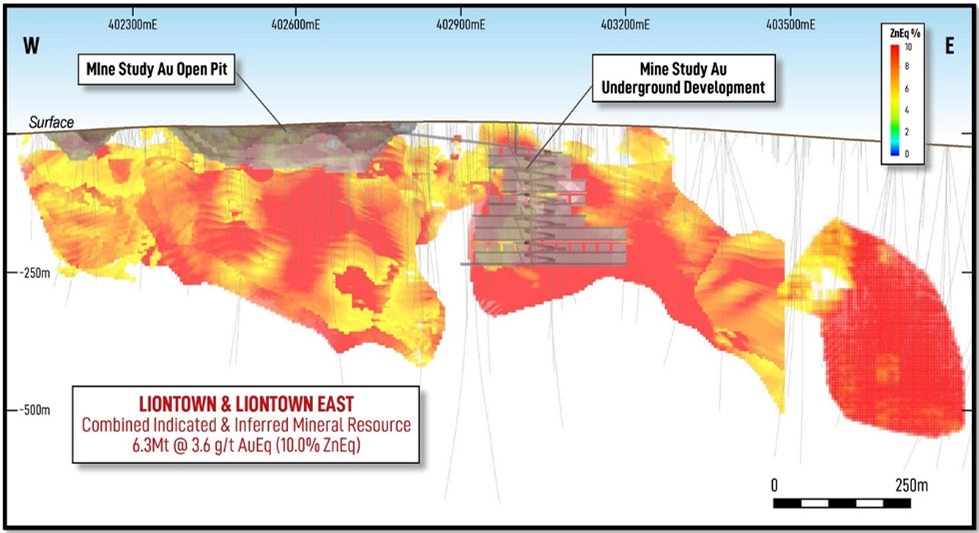
Mining Study Open Pit and underground design against the entire Liontown Resource. Pit and underground infrastructure proposed for extraction of gold, is expected to be useful long-term infrastructure when considering the extraction of the remaining base metal resource. Liontown Base Metal Mining Study will commence in 2026.
Modest capital intensity
One of the more notable aspects of the study is its relatively low peak funding requirement.
Total capital costs, including underground development and capitalised waste stripping, are estimated at around $55 million. However, the maximum cash drawdown during operations is projected at just $4.6 million, reflecting the staged development approach and early cashflow generation.
Sunshine held about $4.7 million in cash on December 31, 2025, and has since received an additional $1 million from dividend income and grant funding.
Managing director Dr Damien Keys said the study underscored the potential of Liontown’s near-surface gold and silver mineralisation and provided a platform for Sunshine to transition towards production.
“With the study complete, we are advancing discussions with third-party partners regarding funding, development, haulage and processing options,” he said. “This approach is aimed at accelerating the pathway to first production, targeted for late 2026, while preserving capital and maintaining focus on resource growth across the broader Liontown system.”
Strong leverage to gold price
The study demonstrates meaningful sensitivity to gold price movements.
At the base case of $6,500 per ounce gold, net operating cashflow is estimated at $162.7 million. At a gold price of $7,100 per ounce — closer to current levels — operating cashflow increases to about $198.8 million.
Each $200-per-ounce move in the gold price changes projected net operating cashflow by roughly $12 million.
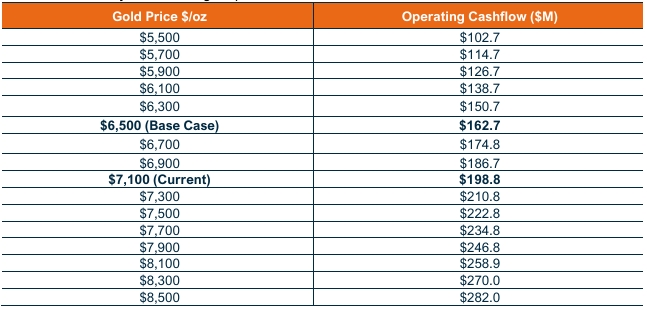
Sensitivity to $200/oz gold price increments.
Silver has a more modest impact, with each $5 per ounce change in silver price affecting cashflow by about $1.9 million.
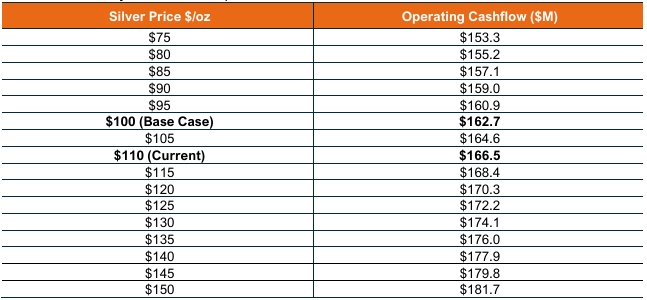
Sensitivity to $5/oz silver price increments
Notably, the mining study extracts only about 8% of the total Liontown resource, leaving significant base metals inventory — including copper, zinc and lead — outside the current development plan. Sunshine has flagged a separate base metals mining study to commence in 2026.
Upside from recent drilling
The current production target excludes a suite of recently reported grade control intercepts, including standout results such as:
- 30 metres at 6.68 g/t gold and 396 g/t silver, including 3 metres at 52.1 g/t gold and 2,932 g/t silver; and
- 24 metres at 7.08 g/t gold and 305 g/t silver.
These results are expected to inform an updated resource and revised pit optimisation shell in April 2026, potentially enhancing project economics.
Additional upside may come from reassessment of historic mined voids that were assigned zero grade in the study but have returned high-grade assays in recent sampling.
Scoping-level study
Sunshine cautioned that the mining study is a preliminary economic assessment prepared to a scoping-study level of accuracy of ±30%. It includes 27% inferred mineral resources in the production target and does not yet support the declaration of ore reserves.
Further drilling, geotechnical work, metallurgical test work and permitting steps will be required before a definitive development decision.
Nevertheless, with approvals advancing, contractor engagement under way and funding discussions in progress, Liontown now has a clearer development framework as Sunshine seeks to move from explorer to producer in North Queensland.