
Yandal Resources Ltd (ASX:YRL) has mapped a primary gold-bearing structure over more than 1.2 kilometres of strike at its Arrakis Prospect, setting up a new phase of closer-spaced drilling in 2026 as the company looks to define higher-grade trends within the system.
The latest reverse circulation (RC) results from late 2025 drilling confirm fresh rock mineralisation along the Arrakis trend at the 100%-owned Ironstone Well-Barwidgee (IWB) Gold Project in Western Australia’s northern Yandal Greenstone Belt.
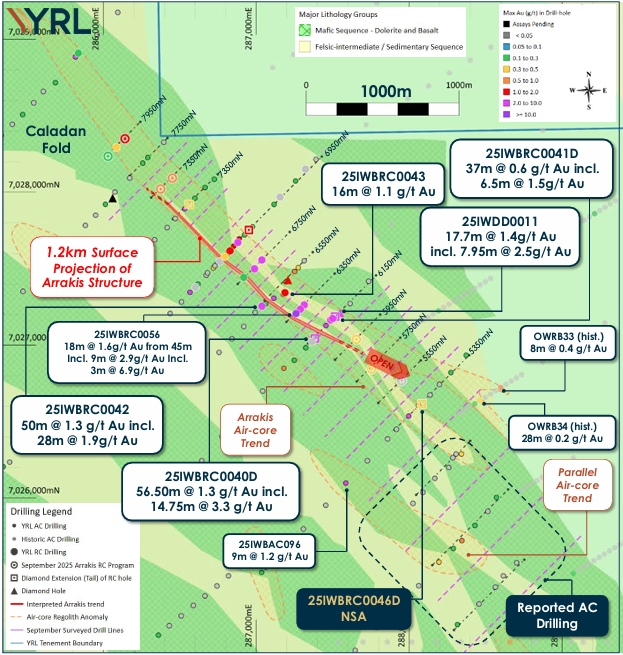
A collar plan over the Arrakis Prospect within the Caladan target area, showing simplified bedrock geology interpretation. All Yandal drilling is plotted along with all historic drilling with end of-hole depths >20m. Collars are thematically coloured by max Au (g/t) in the hole. Dashed yellow polygons represent air-core regolith anomalies (Results include ~4m @ 0.1 g/t Au or greater, with the upper profile or the bottom-of-hole sample is 0.1g/t Au or greater). Dashed purple lines represent heritage-surveyed 100m-spaced lines to support 2026 drilling.
Broad-spaced drilling defines 1.2km structure
The completed 17-hole, 3,800-metre RC program was designed to map the geometry and extent of the Arrakis mineralised system across 200-metre-spaced sections ahead of infill drilling.
All assays have now been received, with results demonstrating a relatively simple and predictable mineralised structure over 1.2 kilometres of strike. Mineralisation remains open to the southeast, where geological modelling suggests a change in strike that has not yet been effectively tested.
Significant intercepts from the program include:
- 24m at 1.3g/t gold from 136m in hole 25IWBRC0051, including 7m at 2.8g/t
- 18m at 1.6g/t gold from 45m in 25IWBRC0056, including 9m at 2.9g/t
- 8m at 2.7g/t gold from 95m in 25IWBRC0054, including 6m at 3.3g/t
- 6m at 1.8g/t gold from 159m in 25IWBRC0053, including 3m at 3.1g/t
The results highlight both broad zones of shallow mineralisation and narrower, higher-grade zones at depth, with continuity demonstrated along strike and down dip.
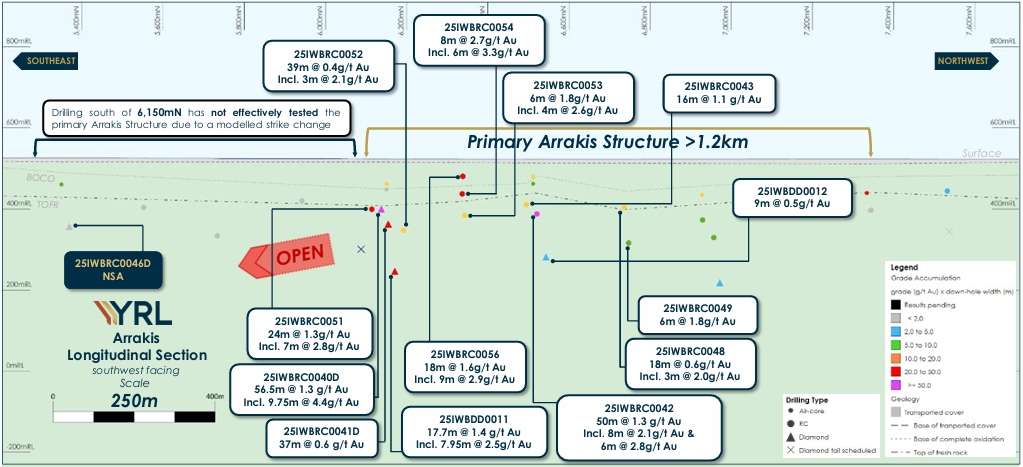
A longitudinal section displaying intercept midpoints within the main Arrakis mineralised structure (intercepts from subordinate structures are excluded). Grade accumulation (length multiplied by Au grade) is based on down-hole length, with no true width correction applied. This longitudinal section has been prepared to show the distribution of recent intercepts across the interpreted Arrakis trend. While there is some preliminary evidence of mineralisation continuity, additional drilling is needed to confirm mineralisation continuity on a larger scale. For this reason, grade contours and high-grade plunge interpretations have not been applied.
Geological model refined by diamond drilling
Eight diamond holes, including four re-entries to previously drilled RC holes, were completed across more than two kilometres of strike in late 2025 to refine the geological model and support targeting.
While the most southern diamond tail, 25IWBRC0046D, did not intercept the Arrakis structure, the result — together with RC drilling south of the 6,150mN line — supports an interpretation that the structure swings toward the southeast and remains open and untested in that direction.
Managing director Chris Oorschot said the program had provided a clearer understanding of the system’s geometry and mineralisation styles.
“With these results, Yandal enters 2026 with a primary mineralised structure defined over more than 1.2km of strike at Arrakis, with demonstrated capacity to host both shallow broad-scale and narrower, high-grade gold mineralisation,” Oorschot said.
“Limited closer-spaced drilling has also demonstrated strong mineralisation continuity both along strike and down dip,” he added. “Our broad-spaced RC program has successfully mapped out the extent of our primary mineralised structure.”
He added that resolving geological controls on higher-grade and broader-scale mineralisation would be a key focus once drilling resumes in March.
Air-core anomalies extend potential
Air-core drilling on three 400-metre-spaced lines has extended the Arrakis anomaly a further 400 metres to the southeast and identified several parallel anomalies of interest.
Follow-up RC drilling is planned in the June quarter to test these targets.
The broader RC and diamond results have enabled further refinement of the Arrakis geological model, positioning the company to shift from reconnaissance-style mapping to more targeted drilling aimed at defining thicker and higher-grade zones.
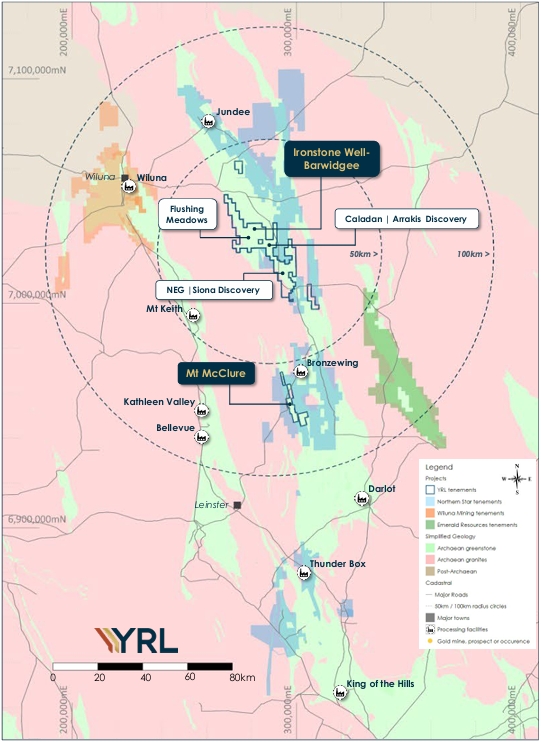
Yandal Resource exploration Project locations within the Yandal Greenstone Belt. The Arrakis Prospect is located within the Caladan target area.
Drilling to resume in March
Preparations are under way to install and commission a 21-person exploration camp, with RC and diamond drilling scheduled to recommence in March.
Planned work will focus on:
- Closer-spaced 100m drilling to test mineralisation continuity to the southeast
- Defining the geometry of high-grade zones
- Diamond drilling below recent RC intercepts, including preliminary metallurgical test work
- Testing several parallel air-core anomalies
Yandal maintains a strong cash position and plans an active exploration schedule across 2026.
Beyond Arrakis, the company is preparing targeted RC programs at the New England Granite target area and heritage surveys ahead of framework diamond drilling at the Flushing Meadows deposit, which hosts a 268,000-ounce resource at 1.1g/t gold.
With a 1.2-kilometre strike length now defined at Arrakis and mineralisation open along strike and at depth, Yandal is moving into 2026 with a clearer geological framework — and a more focused drilling campaign designed to test the scale and economic potential of its latest discovery.
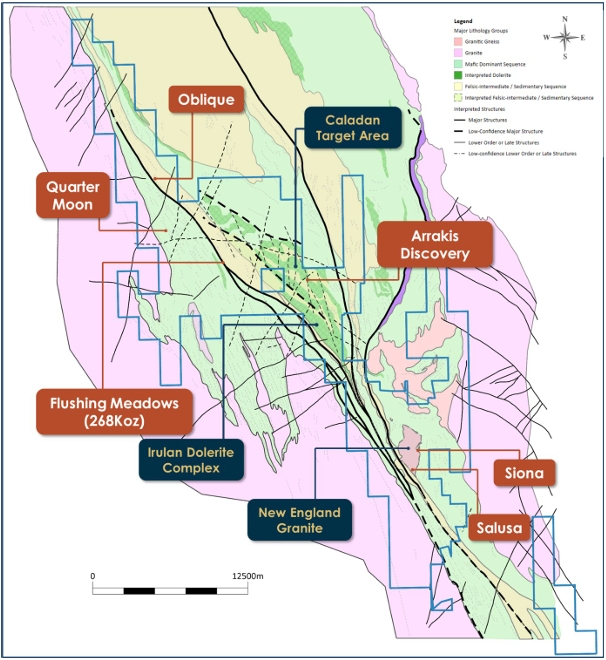
Yandal Resource exploration target areas and prospect locations within the northern Yandal Greenstone Belt. The Arrakis Prospect is located within the Caladan target area.