
Novo Resources Corp (TSX:NVO, OTCQX:NSRPF, ASX:NVO, FRA:1NOR) has sharpened its focus on a multi-jurisdiction gold and antimony exploration pipeline, with an upgraded exploration target at its Victorian Belltopper project and a series of drill-ready prospects emerging across Western Australia and New South Wales.
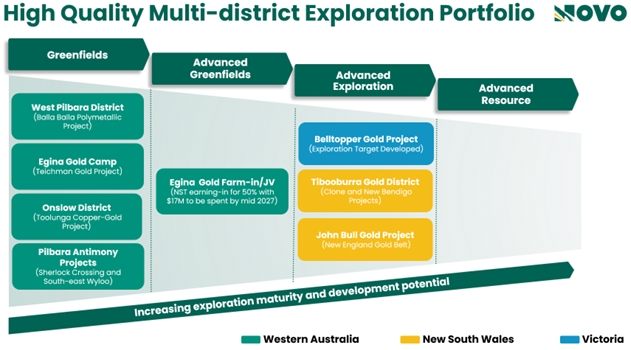
The company’s latest business review outlines a portfolio moving steadily towards an active 2026 drill campaign, underpinned by a strengthened exploration model at Belltopper and high-grade surface and drill results across the Pilbara and NSW.
Belltopper target expands in historic Bendigo zone
Belltopper Gold Project remains a centrepiece of Novo’s east coast strategy. An updated 2026 Exploration Target has delivered a material uplift in both tonnage and grade compared with the 2024 estimate, following a detailed geological reassessment.
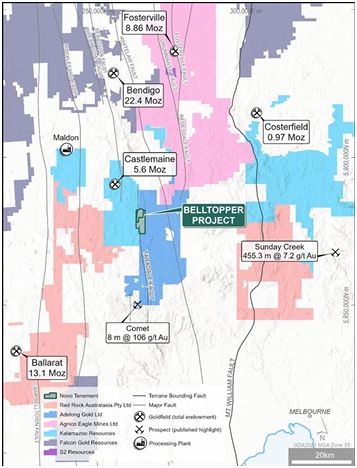
Belltopper Gold Project location map with regional gold occurrences and major structures.
The revised target now ranges between 2.1 million and 3.1 million tonnes at 6.7–8.9 g/t gold, representing tonnage growth of 40–48% and a grade increase of up to 6% over the earlier model.
The update incorporates a newly recognised reef associated with the Western Domain Fault and extends strike and depth continuity across four previously identified priority reefs. Novo has also refined its grade assumptions by factoring in historical metallurgical recovery data and reinterpreting waste and low-grade material.
Read more: Novo Resources lifts Belltopper target as geological model unlocks new reef potential
Belltopper sits in Victoria’s Bendigo Tectonic Zone, about 60 kilometres south of Agnico Eagle’s Fosterville gold mine, within a district that has produced more than 60 million ounces historically. Preliminary planning is under way for potential drilling in the second half of 2026 to further test and build confidence in the updated exploration target.
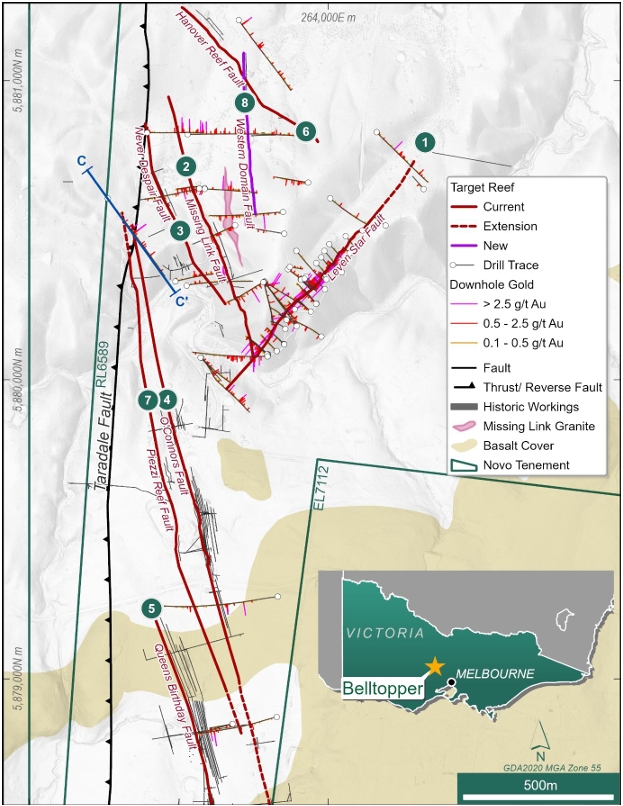
Overview Map of the Belltopper Gold Project showing location of the eight reefs included in the 2026 Exploration Target, downhole gold tenor, historical workings, and important geological elements of the field.
High-grade surface results at Tibooburra
In northwestern NSW, the 100%-owned and farm-in Tibooburra Gold Project has delivered encouraging reconnaissance results across the historic Albert Goldfield.
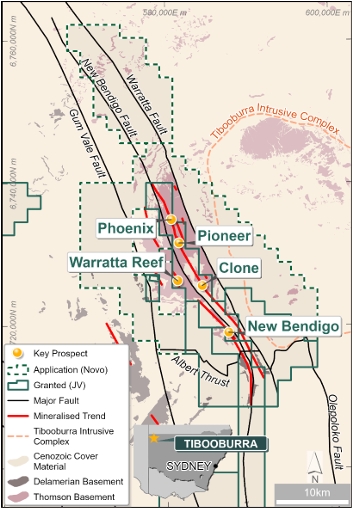
Geology and main prospects of the Tibooburra tenements highlighting the Albert Goldfields at the boundary of the Thomson and Delamarian orogens wrapping around the west side of a cluster of large granite intrusions to the east.
Mapping and surface sampling programs in late 2025 defined several new targets, including Pioneer North, which returned a peak rock chip result of 39.9 g/t gold, and Pioneer South, where seven of 20 samples graded above 4 g/t gold, including a high of 19.8 g/t.
The Pioneer South mineralisation extends along a roughly 600-metre undrilled trend of historic workings within a broader multi-kilometre alteration corridor. Drill targets are now being assessed at Pioneer, Clone and New Bendigo, including follow-up reverse circulation (RC) drilling to test down-plunge high-grade shoots identified in 2025.
Elsewhere in NSW, Novo has secured all regulatory approvals for a planned 1,750-metre RC program at the John Bull Gold Project, where it is farming in alongside TechGen Metals Ltd. Landholder access negotiations are ongoing, with drilling set to test four high-priority targets once access is finalised.
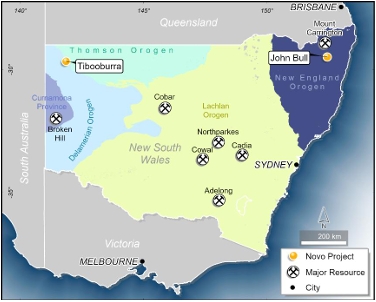
Location map showing Novo’s NSW projects.
Pilbara antimony-gold focus gains momentum
In Western Australia’s Pilbara, Novo is advancing multiple gold and antimony prospects across its Egina and Wyloo areas.
At Teichman in the Egina Gold Camp — part of a joint venture with the Creasy Group — mapping and rock chip sampling have outlined multiple shear-hosted targets across a 2.5-by-1.3 kilometre area. Peak assays include 77.5 g/t gold at Pride NNE, 51.4 g/t gold at Pride N and 38.3 g/t gold at Mountain Maid, highlighting the presence of high-grade mineralisation along two main shear corridors.
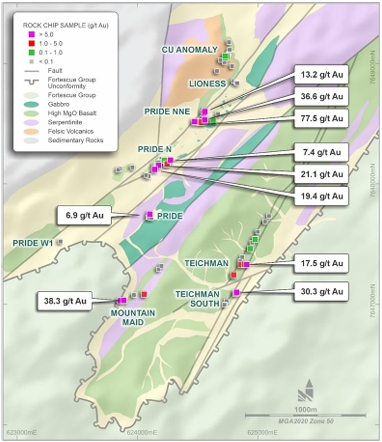
Teichman prospects highlighting Novo rock chip results > 5 g/t Au and geological interpretation with regolith cover.
Further south at the Wyloo Project, soil and stream sediment programs have defined coherent multi-element anomalies with elevated antimony values, enhancing the project’s polymetallic potential. A 150-metre-strike soil anomaly at Wyloo SE has outlined strong silver-antimony associations, while a 2.5-kilometre-by-800-metre target has been defined at Wyloo SW.
A heritage survey is scheduled for March to enable RC drilling at Wyloo SE in Q2 2026.
Meanwhile, scout drilling at Sherlock Crossing returned 3 metres at 2.96 g/t gold and 1.86% antimony from 108 metres, including 1 metre at 7.71 g/t gold and 4.77% antimony. The mineralised system remains open at depth, with geochemical vectors suggesting potential strengthening of the system down-dip.
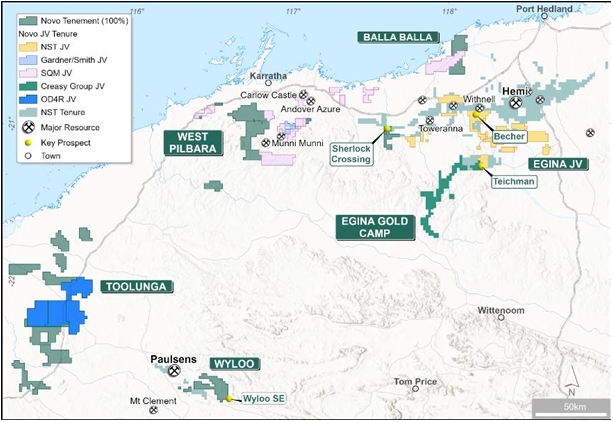
Novo Pilbara and Onslow tenure showing main projects and significant prospects.
Funding position and portfolio discipline
Novo reported a cash balance of A$8.5 million at December 31, 2025, alongside investments valued at about A$23 million in listed and unlisted companies.
The company continues to streamline its tenure holdings across the Pilbara, relinquishing ground deemed non-core while advancing joint ventures, including its Egina earn-in with Northern Star Resources Ltd.
Leadership changes were also announced, with long-serving general manager exploration Karen De Luca stepping down at the end of February. Experienced geologist Bruce Hooper has been appointed interim general manager exploration while a permanent replacement is sought.
With drilling scheduled across Wyloo, Balla Balla and Toolunga in Q2 2026 — and further programs flagged for Belltopper and Teichman in the second half — Novo enters 2026 with multiple catalysts across three states, reinforcing its strategy of assembling and advancing gold projects with standalone development potential.